
The Beginning and Growth of 33m2 Targeting Unmet Demand (White Space)
"We only pay for the water and electricity we use, so why do we have to sign a full two-year contract for a house?" From this question, Space V's short-term rental platform '33m2 (33㎡)' began. CEO Park Hyung-jun founded Space V in 2018 based on more than 10 years of real estate brokerage experience, and introduced 33m2 in 2019. At the time, there was a steady demand for people looking for a house to stay in for a short period due to business trips, multi-week projects, interior renovations, or mismatched moving dates. However, goshitels were uncomfortable, hotels were expensive, and even if someone wanted to rent a house short-term, supply was severely lacking except in a few areas like Gangnam, making it a market with distinct 'unmet demand (white space)'.
33m2 precisely targeted this niche market. To resolve the biggest barriers to short-term rentals—the hassle for landlords and the anxiety for tenants—33m2 unified the deposit at 330,000 won regardless of the transaction amount, and introduced a system to safely manage it via an escrow method. In addition, it maximized convenience by supporting non-face-to-face online contracts, and introduced '33 Care', the nation's first tenant liability insurance covering damage and fire, to alleviate landlords' anxieties. These innovations attracted both landlords and tenants to the platform, creating a strong network effect and acting as a core driver for preempting the short-term rental market.
The Standard of Scale-up: Explosive Revenue Metrics Growing Over 2 Times Annually
Successful market settlement immediately led to explosive financial growth. Space V's revenue, which was at the level of 13 million won at the time of the platform's launch in 2019, grew remarkably to 14.28 billion won as of 2025.
In particular, the growth trend over the last five years is phenomenal. Revenue, which was merely 60 million won (0.06 billion won) in 2021, expanded to the scale of 14.3 billion won in 2025, reaching a staggering four-year compound annual growth rate (CAGR) of 290%. Looking at the last three years upon entering a full-scale scale-up phase, the company recorded over a two-fold growth every year with 2.37 billion won in 2023, 6.71 billion won in 2024, and 14.28 billion won in 2025, proving its overwhelming dominance in the short-term rental market through financial metrics.
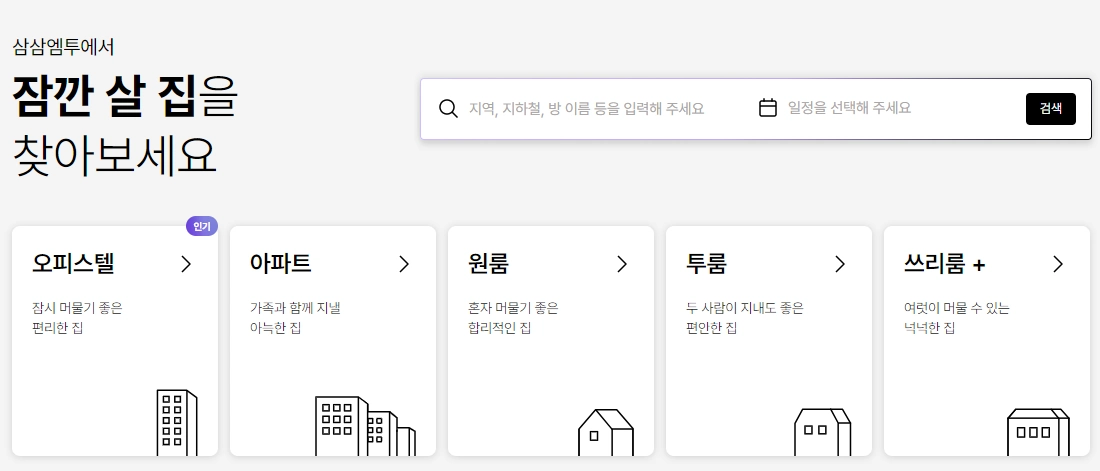
[Source: 33m2 (33㎡) Homepage]
Operating Profit Turnaround: Establishing a Profitable Structure of Growing While Making Money
While high-growth startups are prone to falling into the trap of 'deficit growth,' suffering from snowballing deficits even as they increase revenue, 33m2 has completely broken free from this.
Until 2023, it recorded an operating loss of about -100 million won, undergoing an investment period to build the platform and secure the initial market. However, starting from 2024, it successfully achieved a turnaround to a surplus, generating an operating profit of 1 billion won, and subsequently proved its firm profitability by achieving an operating profit of 3.97 billion won in 2025. This means that it has completed a sound profit structure equipped with both external expansion and profit generation capabilities simultaneously.
Behind this profitability improvement lies highly advanced cost efficiency. The proportion of SG&A expenses to revenue is showing a stabilizing trend compared to the past. Among the approximately 10.3 billion won in SG&A expenses incurred in 2025, the largest portion was taken by commission expenses (3.49 billion won) and advertising expenses (3.08 billion won). Despite these being investment costs necessarily accompanying service expansion and awareness enhancement, the growth rate of revenue significantly exceeds the growth rate of costs, showing that the platform's profit leverage effect is becoming full-scale.
Furthermore, the liquidity and cash reserves, which show the fundamental strength of the company, are also highly excellent. As of 2025, Space V holds about 9 billion won in cash and cash equivalents and 13 billion won in short-term financial instruments, reaching about 22 billion won in immediately mobilizable cash assets alone. This is a level that far exceeds the company's total liabilities of 18.7 billion won in 2025, establishing an extremely high level of financial stability that will not be shaken by any external variables.
In conclusion, Space V's 33m2 preempted the market by smartly resolving the unmet demand of the short-term rental market, and through this, it caught both 'two rabbits' of explosive external growth of more than two times every year and an operating profit turnaround to surplus, establishing itself as a new core player in the proptech market. Recently, it has been rapidly absorbing B2B (business-to-business) demand from large conglomerates and overseas corporations beyond regular individuals. Industry attention is focused on how far Space V, which changed the paradigm of the residential market with the philosophy of 'renting a house only for the necessary period, just like water and electricity,' will expand the boundaries of the proptech industry in the future.
Company financial data, investment reports, and startup analysis — all in one place
Explore PitchdeckCurated news, every week — straight to your inbox
Every Friday · Unsubscribe anytime