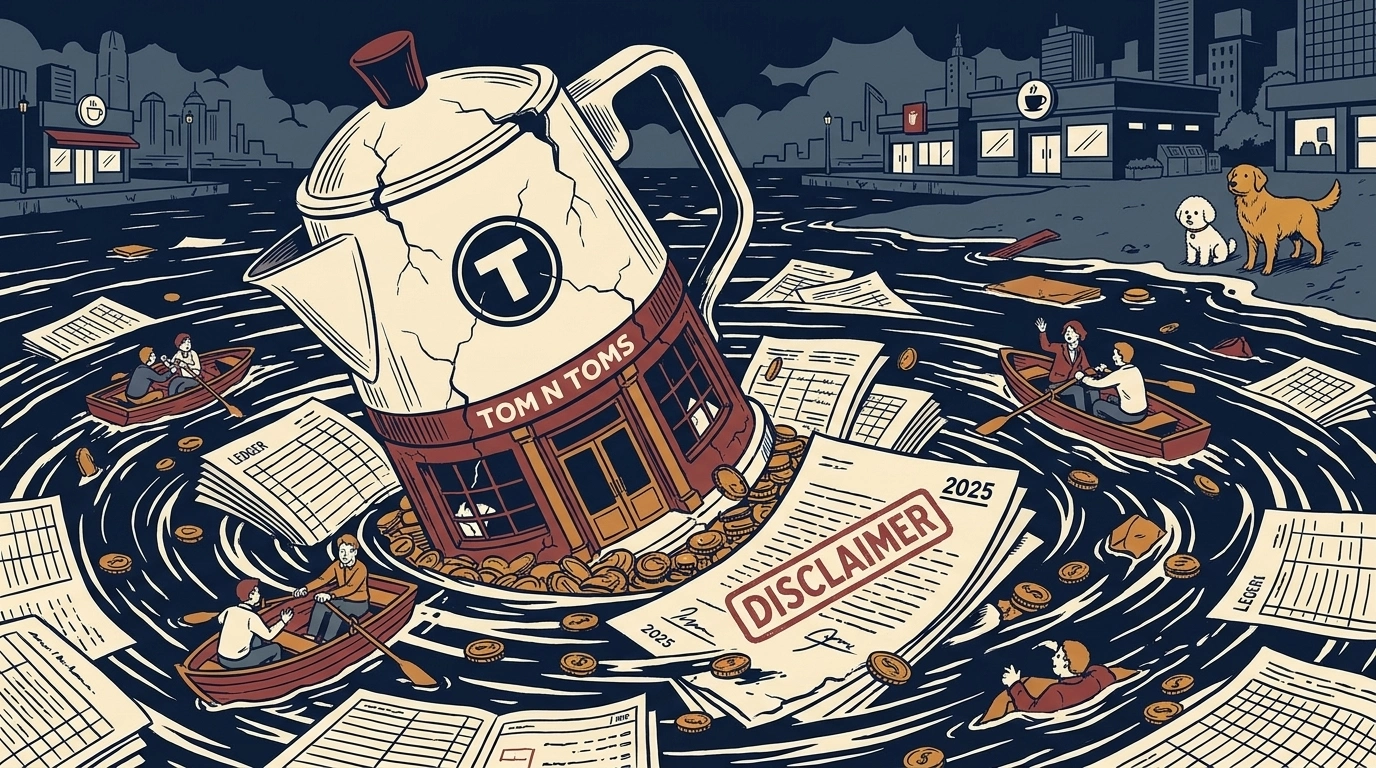
Expanding its stores with unstoppable momentum from the late 1990s through the mid-to-late 2000s and reigning as the legend of the 'first-generation homegrown franchise coffee', TOM N TOMS is facing the greatest management crisis since its founding. On top of declining sales, the company has fallen into a swamp of debt and deficits that threatens its survival, ending up in a situation where it has even received a 'disclaimer of opinion' from an accounting firm.
Financial Statements Pushed to the Edge... The Ultimate 'Disclaimer of Opinion' Situation
Recent evaluations of TOM N TOMS' financial condition by an external auditor clearly show that the company is standing at a crossroads of survival. The audit opinion on TOM N TOMS has rapidly deteriorated over the past two years.
From 2021 to 2023, TOM N TOMS maintained an 'unqualified opinion'. However, behind the scenes, strong warning lights were already flashing. For the 2024 financial statements, the auditor issued an 'unqualified opinion' but explicitly stated a 'material uncertainty related to going concern' in the audit report. At the time, TOM N TOMS recorded a massive net loss of 11.7 billion won in a single year, and a severe liquidity crisis was pointed out, with current liabilities exceeding current assets by approximately 21 billion won.
Despite these warnings, the situation did not improve, and for the 2025 financial statements, a final 'disclaimer of opinion' was issued. Gwanggyo Accounting Corporation cited the basis for the disclaimer of opinion, stating, "There exists an uncertainty of a magnitude that casts significant doubt on the company's ability to continue as a going concern, and we were unable to obtain sufficient audit evidence to reasonably estimate the success or failure of the countermeasures (such as financing and restructuring) currently being pursued by the company." In other words, financial uncertainty has become extremely high.
Dismally Collapsed Performance... Endless Fall and Complete Capital Impairment
The business scale of TOM N TOMS, which once soared by hitting a peak revenue of 87 billion won in 2016, has now completely shrunk.
The downward trend in performance is steepening out of control. Revenue, which somehow maintained the 40 billion won range (approximately 41.4 billion won) until 2023, plummeted to 31 billion won in 2024, and further plunged by about 38% year-on-year to 19.1 billion won in 2025, facing an endless revenue cliff. Store reductions and weakened competitiveness have been directly reflected in the numbers.
The swamp of losses is even deeper. TOM N TOMS is trapped in a vicious cycle where it has failed to record a surplus even once over the past five years, repeatedly suffering operating losses and net losses. As deficits accumulated, even capital, the fundamental strength of the company, has bottomed out. As of the end of 2024, it fell into a state of complete capital impairment (-4.5 billion won) where total liabilities exceeded total assets, and by the end of 2025, the scale of capital impairment had nearly doubled to -8.3 billion won.
[Source: TOM N TOMS Website]
Suffocating 'Liquidity Crunch'... Asset Deterioration and Snowballing Interest
The biggest problem facing TOM N TOMS is the severe 'liquidity shortage' and 'asset deterioration' where cash available for immediate circulation has dried up. As of the end of 2025, the current liabilities that TOM N TOMS must repay within one year are a whopping 24.6 billion won greater than the current assets that can be immediately converted into cash. Total liabilities also exceed total assets by 8.3 billion won, leaving the company in a marginal situation where it cannot pay off its debts without external capital infusion or asset sales.
The quality of operating activities on the books has also deteriorated extremely. In 2024 alone, TOM N TOMS recognized a staggering bad debt expense of approximately 4.8 billion won regarding trade receivables and other receivables. (Bad debt expenses within selling and administrative expenses of about 2.36 billion won, and other bad debt expenses within non-operating expenses of about 2.49 billion won). This demonstrates a fatal 'liquidity crunch' phenomenon where, even if the company records on its accounting books that it made money through franchise sales or deliveries, cash does not actually flow into the company due to the failure to collect receivables from business partners or franchisees.
Additionally, the uncontrollably worsened financial condition of its subsidiaries is pointed out. Its core subsidiary, Naveplus Co., Ltd., in which it holds a 100% stake, faced a 'material uncertainty of going concern', and its book value was fully impaired despite the acquisition cost amounting to 9.1 billion won. Naveplus' current term revenue was in the 2.1 billion won range, plummeting to one-sixth of the previous year's (12.2 billion won), and it recorded a net loss of approximately 1.3 billion won.
To make matters worse, the maturity date of 2.4 billion won in corporate bonds raised by TOM N TOMS through the Korea Credit Guarantee Fund is approaching on June 27, 2026, and with the maturities of borrowings from financial institutions consecutively arriving as well, there is speculation that TOM N TOMS may have to file for corporate rehabilitation.
A Foreseen Downfall... 'Owner Risk' and 'Loss of Market Competitiveness'
This downfall of TOM N TOMS is analyzed not as something that happened overnight, but as the result of long-accumulated management missteps and a failure to adapt to changes in the external environment.
The most painful blow was the 'owner risk' of founder and CEO Kim Do-kyun. Former CEO Kim was indicted on charges of privately pocketing 1.2 billion won in sales incentives provided by a milk supplier from 2009 to 2015, and taking about 3 billion won in unfair 'toll fees' by inserting a disguised affiliate into the bread dough supply process. In 2020, his suspended prison sentence and hefty fine were confirmed. The company's credibility plummeted to the bottom, causing a severe vacuum in management leadership at a most critical time.
Furthermore, the company completely failed in its positioning within the extremely competitive domestic coffee market. While global premium brands backed by capital power like Starbucks and ultra-low-cost brands armed with cost-effectiveness like Mega Coffee and Compose Coffee bisected the market, TOM N TOMS lost its distinct differentiation in the middle. Although it belatedly launched the low-cost coffee brand 'Metaking Coffee' targeting small-scale stores and introduced a professional management system to seek a turnaround, the market reaction was cold, and expansions into non-core businesses such as the virtual asset (NFT) business intended as a breakthrough failed to lead to a rebound in performance.
Ultimately, with plummeting credibility due to 'owner risk', a loss of market competitiveness from failing to follow changing consumer trends, and the resulting massive accumulated debt intertwined with large-scale bad debt write-offs, the 'first-generation homegrown franchise coffee legend' has degraded into a bleak situation where it must worry about its survival alongside the worst report card of a disclaimer of opinion.
Company financial data, investment reports, and startup analysis — all in one place
Explore PitchdeckCurated news, every week — straight to your inbox
Every Friday · Unsubscribe anytime