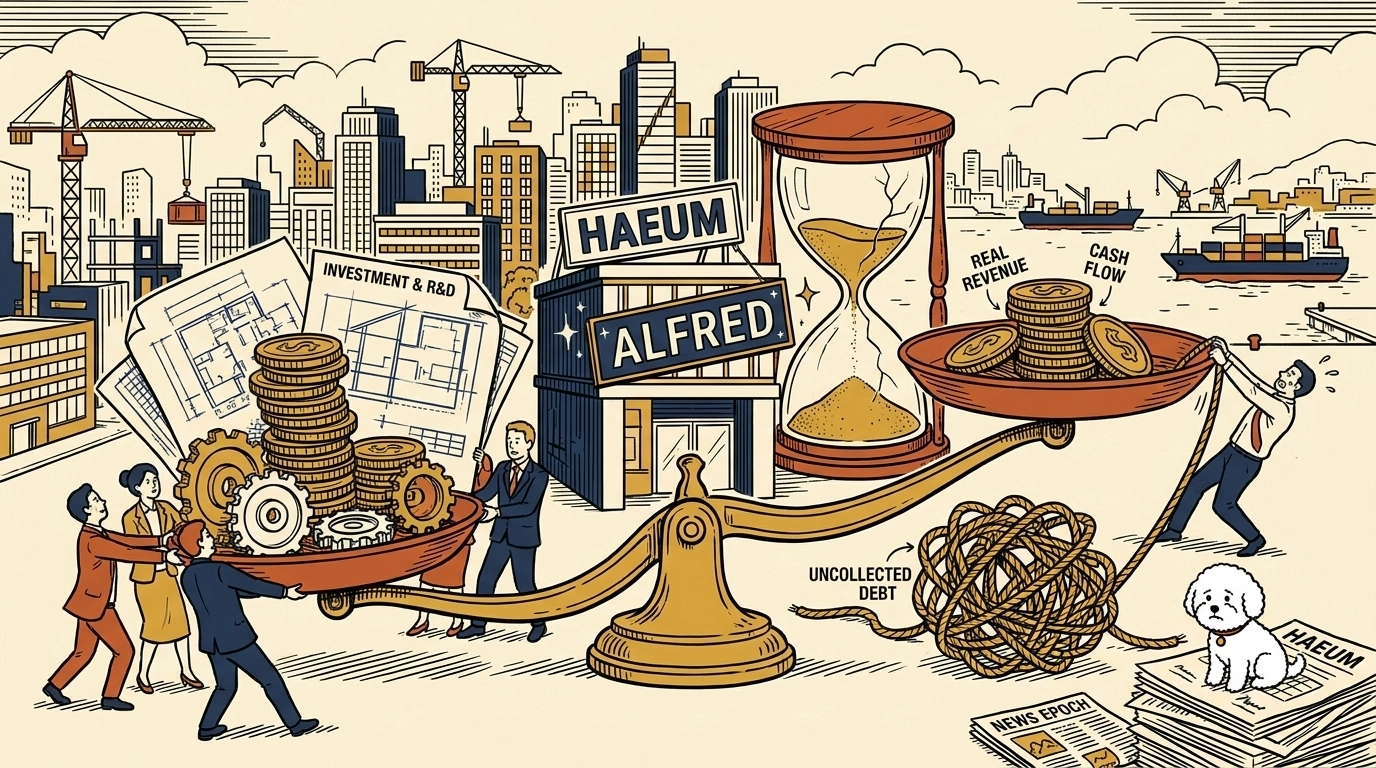
Heum Co., Ltd., which has led TaxTech by integrating tax and artificial intelligence (AI) technologies and attracted large-scale investments of over 19 billion KRW cumulatively, stands at the crossroads of a major leap forward. The company, which changed its sign from 'Heum Labs' to 'Heum' in its early days, recently made a sudden decision through its board of directors to change its corporate name once again to 'Alfred Co., Ltd.' This is interpreted as a strong will for reform to step forward in the external market as a 'financial agentic AI' enterprise, breaking away from its existing image of internal transactions centered on tax accounting firms. However, behind this flashy branding revamp lie the urgent challenges of a recent bitter deterioration in performance and a deformed trade receivables structure.
Light and Shadow of External Growth... The Dream of a Surplus Ended in One Year
Looking at Heum's summarized profit and loss flow from 2019 to 2025 is truly like a 'roller coaster'. Sales, which hovered around the 1.5 to 1.9 billion KRW mark from 2019 to 2021, drew an explosive upward curve to approximately 3.3 billion KRW in 2022 and about 9.6 billion KRW in 2023. As a result of focusing on external expansion while enduring a long period of deficits, the company finally achieved the splendid feat of a turnaround in 2024, recording sales of about 13.19 billion KRW and a net income of 2.77 billion KRW.
However, the joy of the surplus did not last beyond a single year. In the following year, 2025, the company's sales plummeted to about 7.8 billion KRW, and it sank back into a massive deficit, posting a staggering net loss of 4.21 billion KRW.
Behind this dramatic 'deficit shock' is a combination of a sharp contraction in sales and a surge in fixed-cost-type expenses. Platform sales, the company's core revenue source, evaporated by 41.6% from 12.83 billion KRW in 2024 to 7.49 billion KRW in 2025, leading the decline in total operating revenue. On the other hand, the spending brakes for future investments and human resources did not work. Even in a crisis where sales were halved, salary expenditures nearly doubled from 920 million KRW the previous year to 1.8 billion KRW, and retirement benefits also increased from 360 million KRW to 520 million KRW. In addition, 3.13 billion KRW, an increase of more than 700 million KRW from the previous year, was poured into ordinary research and development expenses, and commission fees also jumped from 880 million KRW to 1.29 billion KRW, severely pressuring profitability.
Accounts Receivable Larger Than Sales... The 'Risk' of Concentration on Internal Transactions
The part that raises even greater concern than the slowdown in profitability is financial soundness, particularly the issue of 'trade receivables' that have snowballed. As of the end of 2025, the company's trade receivables balance was approximately 9.74 billion KRW, accounting for an absolute proportion of 69% of its total assets (approximately 14.06 billion KRW).
A bigger problem is the quality of these receivables. In 2025, 99.64% of total sales were generated from transactions with related parties. Almost the entirety of the 9.74 billion KRW in ending trade receivables that the company is supposed to collect is also money tied up within the group or affiliates, such as 'Heum Tax Accounting Firm', which are other related parties. This means that the reliance on internal transactions is overwhelming, rather than normal market transactions with external third parties.
The speed of collection also raises doubts. The total sales for the current period were just over 7.8 billion KRW, but the uncollected money (ending trade receivables balance) amounts to 9.74 billion KRW. Considering that trade receivables were close to 10.58 billion KRW at the end of the previous year (2024), this is a point where a so-called 'financial arteriosclerosis' phenomenon—in which payment collection from affiliates is not carried out on time and accumulates over the long term—is suspected.
Consequently, the company burned through 3.41 billion KRW in cash from operating activities over the course of 2025, but barely managed to hold on by expanding its capital through a paid-in capital increase (cash inflow from financing activities) of about 5 billion KRW backed by Series B investments. Since its ability to generate cash from its main business has been severely damaged, it is pointed out that simply attracting investment funds makes it difficult to guarantee long-term survival.
In order for the newly launched 'Alfred Co., Ltd.' to take a leap forward into a true unicorn expected by the market, drastic structural reforms are inevitable. It must break away from a sales structure that is excessively concentrated on internal related parties and achieve independent expansion into the external market.
Company financial data, investment reports, and startup analysis — all in one place
Explore PitchdeckCurated news, every week — straight to your inbox
Every Friday · Unsubscribe anytime