
Founded in 2016, Lifestyle Project (LSP) is a company continuing its aggressive outward expansion encompassing the cosmetics and healthcare sectors. Following the merger with 'Optima (OptimaCare)', a pharmacy chain with over 40 years of tradition and about 850 locations nationwide, it recently acquired the beauty healthcare platform 'Skin Rx', which boasts 350,000 customers, through a stock exchange, building a beauty and healthcare ecosystem that crosses online and offline realms.
Strong Brand Lineup Encompassing K-Beauty and Healthcare
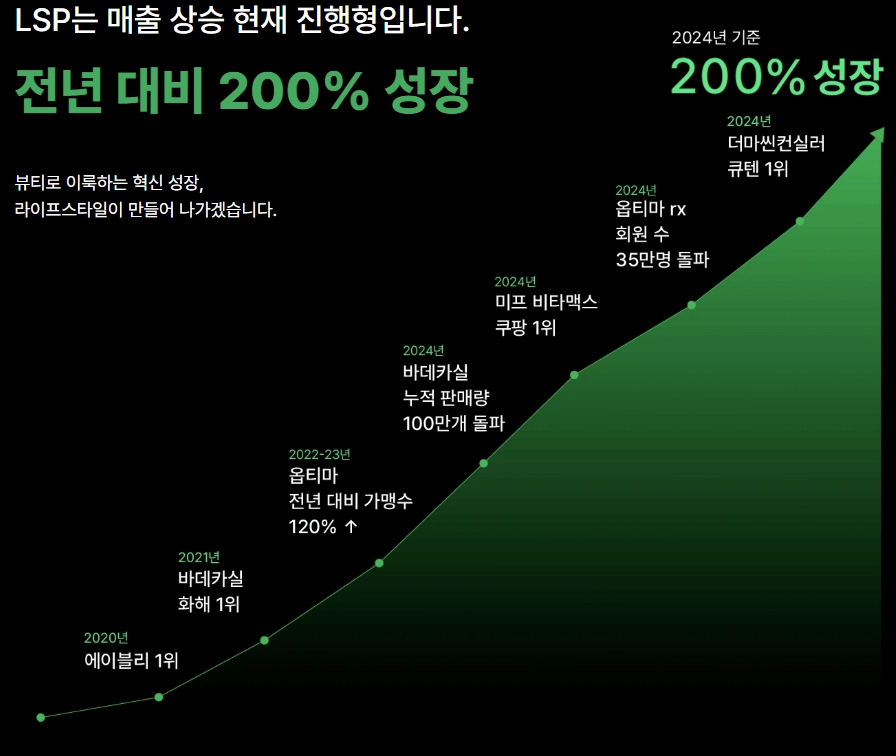
Lifestyle Project is rolling out a variety of core brands that have solidified their presence in the market. The men's cosmetics brand 'MIP' has high recognition, ranking first in Coupang's men's cosmetics category, and in the case of the sensitive skin care specialized brand '23YEARSOLD', its flagship product, a concealer, has swept the number one spot on local e-commerce platforms such as Qoo10 Japan and Amazon Japan, elevating the status of K-Beauty. In addition, it boasts a solid portfolio including the acne-prone skin cream 'Badecasil' and the health functional food 'Optima Balance'.
Offline bases are also undergoing innovation. The recently opened 'Optima Wellness Museum (OWM) Pharmacy' in Gangnam, Seoul, displays over 3,000 types of wellness products and provides customized curation consultations using measurement equipment, transforming into a complex lifestyle cultural space beyond a simple pharmacy.
[Source: Lifestyle Project Website]
Rapid Top-line Growth and Turnaround to Operating Profit in 2025... But Net Loss Continues
Such a diversified brand portfolio and aggressive M&A have led to explosive revenue growth. Revenue, which was around 13.4 billion won in 2023, reached 24 billion won in 2024 and 35.5 billion won in 2025, increasing by an astounding approximately 164% over the last two years.
Profitability indicators have also noticeably improved. The company recorded massive operating losses of about 3.07 billion won in 2023 and about 1.1 billion won in 2024, but succeeded in turning a profit by recording an operating profit of 210 million won in 2025. However, the joy of turning a profit was short-lived, as the burden of non-operating expenses, such as massive interest costs (about 400 million won) on borrowings, held it back, leading to a continued net loss (about 580 million won) in 2025.
Still Suffocating Liquidity Crisis Despite Efforts to Alleviate Capital Impairment
The company is risking its survival on external capital injections to improve its financial structure, such as attracting a 4 billion won Series A investment from Yuil Technology Investment. It carried out consecutive paid-in capital increases of about 4.88 billion won in 2024 and about 2.09 billion won in 2025. In addition, about 1.78 billion won of the 2 billion won in convertible bonds issued in 2023 was converted into shares in 2025, positively impacting debt reduction and capital expansion. As a result, total equity, which was -5.41 billion won at the end of 2024, improved to -2.12 billion won at the end of 2025, successfully reducing the extent of complete capital impairment by more than half.
However, a short-term liquidity crisis is right at its doorstep. As of the end of 2025, the company's current liabilities (about 12.22 billion won) exceed its current assets (about 7.48 billion won) by an overwhelming approximately 4.74 billion won, leaving it under severe pressure to repay short-term debt.
The Ineradicable 'Going Concern Uncertainty' Tag Despite an Unqualified Audit Opinion
The company's external audit opinion has ridden a roller coaster over the last three years. In 2023, the auditor expressed a 'qualified opinion', stating that the accuracy of the financial performance could not be verified due to reasons such as non-participation in the physical inspection of beginning inventory. Subsequently, in 2024 and 2025, after the auditor was replaced, the company drew an 'unqualified opinion', with the auditor stating that the financial statements were fairly presented.
However, the auditor explicitly stated "material uncertainty related to going concern" as a key emphasis of matter in both the 2024 and 2025 audit reports. Pointing out "the situation where current liabilities greatly exceed current assets" every year and accumulated deficits as major risk factors, they left a heavy warning that if there are setbacks in the financial structure improvement plans, it may be difficult for the company to remain normally operational.
'Long-Term Capital Expansion' to Keep the Spark of Profit Turnaround Alive is Key to Survival
Now, Lifestyle Project's survival and leap forward depend on how it can fan the flames of the '2025 operating profit turnaround' achieved by utilizing its formidable brand power, network of around 850 pharmacies, and platform. The key is how quickly immediate improvements in operational efficiency can offset the working capital deficit. To achieve this, additional capital expansion (paid-in capital increase) and long-term debt restructuring to resolve the short-term liquidity crisis pushed to the brink are analyzed as essential steps, rather than optional ones.
Company financial data, investment reports, and startup analysis — all in one place
Explore PitchdeckCurated news, every week — straight to your inbox
Every Friday · Unsubscribe anytime