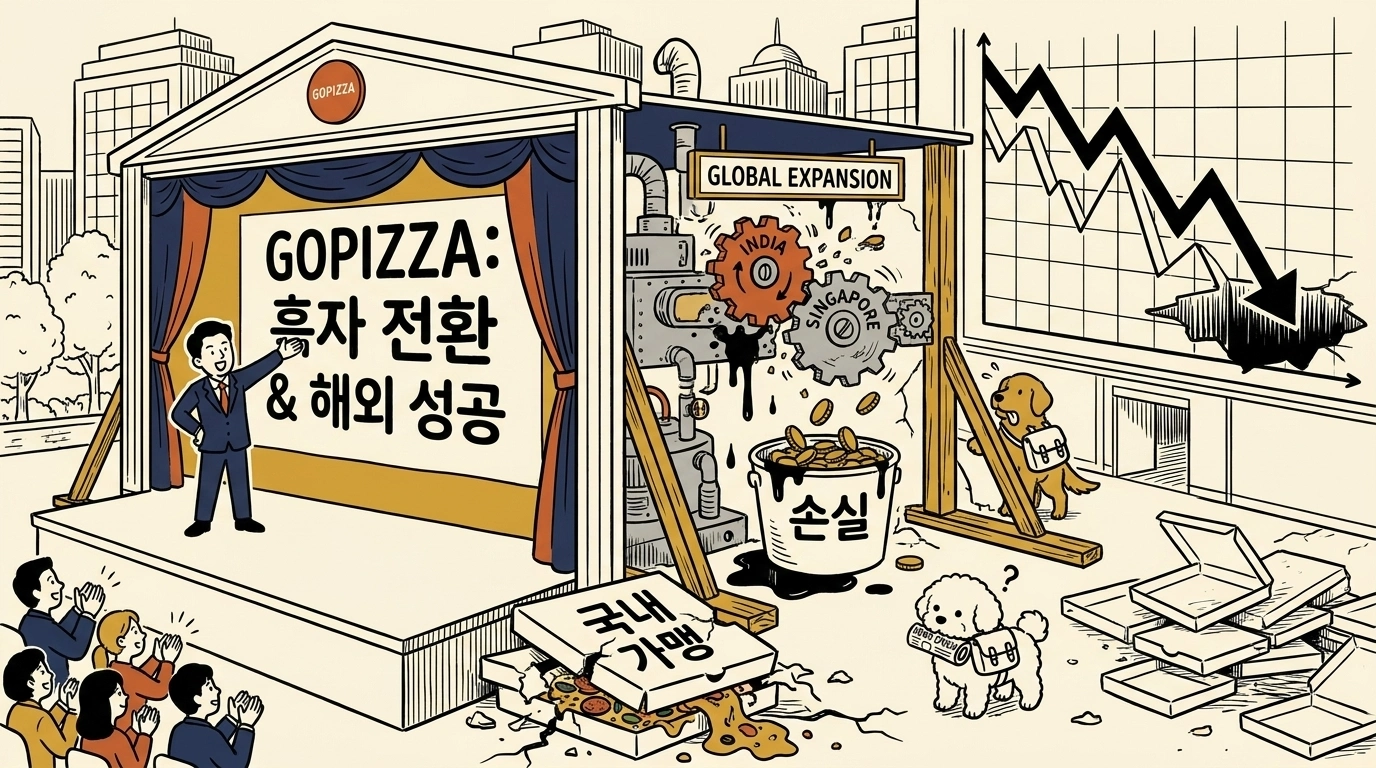
Gopizza recently launched a massive PR campaign through the media, touting its 'first half-year EBITDA surplus since its founding' and 'successful establishment of overseas businesses such as in India,' expressing confidence in an annual operating profit turnaround by 2026. However, contrary to this flood of rosy media play, Gopizza's current reality as indicated by its actual financial statements is very harsh.
Although media reports use the expression 'half-year EBITDA surplus,' looking at it as is, the accounting books show a continued state of severe 'deficit.' Furthermore, its overseas subsidiaries, which were supposed to be the core engine of growth, have become the epicenter of massive losses, and even the domestic franchise business, which should be a solid foundation, is significantly faltering, raising growing doubts about the company's fundamental business model.
The Optical Illusion of a 'Turnaround'... The Reality is a 'Continuing Deficit' Amid Negative Growth
The media is touting that Gopizza aims to achieve an annual EBITDA and operating profit turnaround this year based on its domestic corporate entity. However, Gopizza's net loss for the 2025 term reached 6.82 billion won, and its operating loss was 2.96 billion won, leaving it in a state of a massive 'continuing deficit.'
Of course, compared to the previous year (a net loss of 11.18 billion won and an operating loss of 3.85 billion won in 2024), the deficit margin has somewhat narrowed, but this is not 'healthy profit generation through sales growth.' In fact, the total sales revenue, which was 19.93 billion won in 2024, actually experienced significant negative growth, falling to 16.9 billion won in 2025. In other words, it is highly likely that the deficit reduction (or the second-half EBITDA surplus) that Gopizza boasts about is the result of recession-type efficiencies created through 'squeezing a dry towel,' such as intense cost control and the liquidation of low-profit stores, without being accompanied by top-line growth. This is why it is difficult for the market to give a high score to claims of a surplus that are solely based on cost-cutting while growth has stalled.
A Collapsing Core Business... A 41% Plunge in Product Sales and the Closure of Directly Managed Stores
The domestic business situation is more difficult than expected. The painful part is the sharp drop in 'product sales,' which is the core revenue source for the franchise headquarters. Product sales, estimated to be generated by supplying food ingredients and goods to domestic franchise stores, dropped by about 41%, from 8.37 billion won in 2024 to 4.93 billion won in 2025. This is a clear warning sign that either the number of franchise stores has decreased, or that individual franchise stores are not doing well and are buying fewer goods from the headquarters. Looking at the actual number of Gopizza franchise stores, it has been consistently declining: 108 in 2022, 105 in 2023, and 95 in 2024. The number of stores with canceled contracts was 18 in 2022, 29 in 2023, and 30 in 2024. This explains the cause of the sudden plunge in product sales.
On top of this, business suspensions have continued due to the closure of directly managed stores in the name of internal management, leading to the full impairment of the related 1.26 billion won goodwill balance, which is accelerating the contraction of the core business. It appears that they are maintaining existing facilities rather than making new investments. This can be indirectly confirmed by the book value of tangible assets, such as machinery and facility equipment, which went from 5 billion won in 2024 to 4.42 billion won in 2025, confirming there have been no new investments or facility expansions.
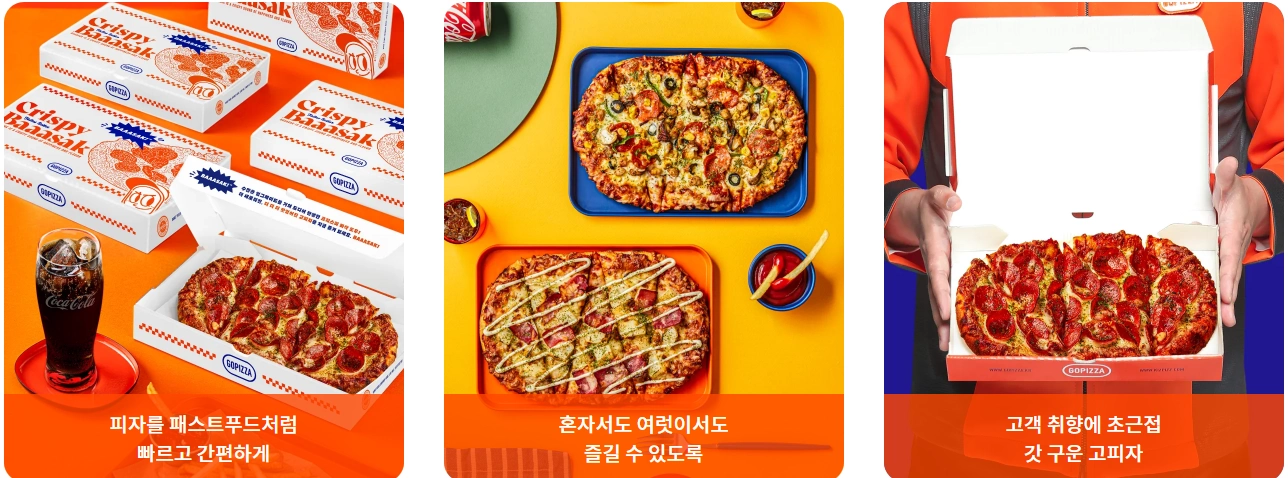
[Source: Gopizza Homepage]
'Success' in the Media, 'Miserable Failure' in the Books... Overseas Business Becomes a Bottomless Pit
Through media interviews, Gopizza constantly emphasizes that its entry into the global market has been successful, bringing up the performance of its Indian stores. However, the numbers prove a clear 'overseas miserable failure.'
The most fatal point to note is the massive equity investment loss. Following a staggering 7.5 billion won impairment loss on available-for-sale securities in 2024, another massive impairment loss of about 3.68 billion won occurred in overseas subsidiaries alone in the single year of 2025. This accounts for the majority of non-operating expenses and is the main cause snowballing the net loss. Despite pouring money earned from the Korean headquarters and funds infused by venture capitals (VC) into overseas markets, the overseas subsidiaries have failed to secure self-sustainability, chipping away at their book values and bruising the headquarters' financial statements.
India Subsidiary: It is the market the media hypes up as the most successful, but with continuous capital injections, the principal investment alone amounts to about 8 billion won. However, reflecting accumulated losses, the current book value has been slashed by more than half to 3.04 billion won.
Singapore Subsidiary: The entire principal investment of about 8.88 billion won lost its value and was 100% impaired to 0 won.
Indonesia Subsidiary: About 2.83 billion won was invested, but the remaining value on the books currently is only 880 million won.
Capital Impairment Crisis Up to the Chin and Severe Liquidity Crunch
With the overlap of shrinking sales and overseas losses, the company's financial soundness is pushed to the edge of a cliff. As of the end of 2025, Gopizza's undisposed accumulated deficit ballooned to 43.42 billion won. Despite barely overcoming a hurdle through a large-scale paid-in capital increase of 13.1 billion won in 2024, total equity (7 billion won) was halved compared to just a year ago (13.76 billion won). Because total equity is greater than capital stock (570 million won), it hasn't yet fallen into complete capital impairment, but at the current pace of deficit accumulation, it is in a precarious situation where capital could completely run dry within one to two years.
A red light has also turned on for immediate liquidity management. Even though sales declined, the scale of SG&A expenses—which includes high fixed costs such as employee salaries (4 billion won), rent (1.26 billion won), and depreciation (430 million won)—remains in the 10 billion won range, continuing to weigh heavily. On the other hand, as of the end of 2025, short-term borrowings were 4.84 billion won, and the total volume of current liabilities due within a year reached 9.73 billion won. However, the immediately mobilizable cash and cash equivalents are merely 1.96 billion won, making it tight even to secure operational funds.
Can a 200 Billion Won Valuation Truly Be Justified?
Compared to the performance of leading companies in the pizza industry, Gopizza's sluggishness appears even more dismal. Competitors all achieved clear top-line growth and profit increases in 2025 compared to 2024. Domino's Pizza (Chungo DPK) grew from 201.1 billion won in sales and 7 billion won in operating profit in 2024 to 210.8 billion won in sales and 9 billion won in operating profit in 2025. Papa John's Korea rose from 71.7 billion won in sales and 3.4 billion won in operating profit in 2024 to 80.5 billion won in sales and 3.9 billion won in operating profit in 2025, while Banolim Pizza (Pizza & Company) also proved performance growth, recording 59.3 billion won in sales and 2.7 billion won in operating profit in 2025, up from 48.2 billion won in sales and 2.4 billion won in operating profit in 2024.
On the other hand, Gopizza's report card is stained with negative growth and massive deficits. Following its recording of about 19.93 billion won in sales, a 3.86 billion won operating loss, and an 11.19 billion won net loss in 2024, its sales further declined to about 16.91 billion won in 2025, posting an operating loss of 2.97 billion won and a net loss of 6.82 billion won.
Gopizza is known to have been recognized with an estimated enterprise value of 150 billion won when it received investment from domestic VCs in 2022, and a whopping over 200 billion won during its investment attraction from CP Group in 2024. However, while competitors are expanding sales and increasing profits, Gopizza alone is facing a shrinking top line and continuing billions of won in deficits. With its current poor financial report card, it will be difficult to justify such an enterprise valuation to the market.
Time to Stop Media Play and Prove Its 'True Ability'
The media speaks of Gopizza as a global success case of K-Food and a promising company that has achieved a turnaround. However, the cold accounting books warn that it has not yet reached a break-even point, let alone a surplus, is squandering capital equivalent to a year's sales in the overseas market, and that the stamina of its most important domestic business is rapidly declining. What Gopizza needs right now is not clever modifiers like 'EBITDA surplus' and 'successful overseas expansion' or media play. Above all else, it is urgent to prove genuine sales growth, a substantial surplus achievement, and the practical survival ability of the overseas business that has become a burden.
Company financial data, investment reports, and startup analysis — all in one place
Explore PitchdeckCurated news, every week — straight to your inbox
Every Friday · Unsubscribe anytime