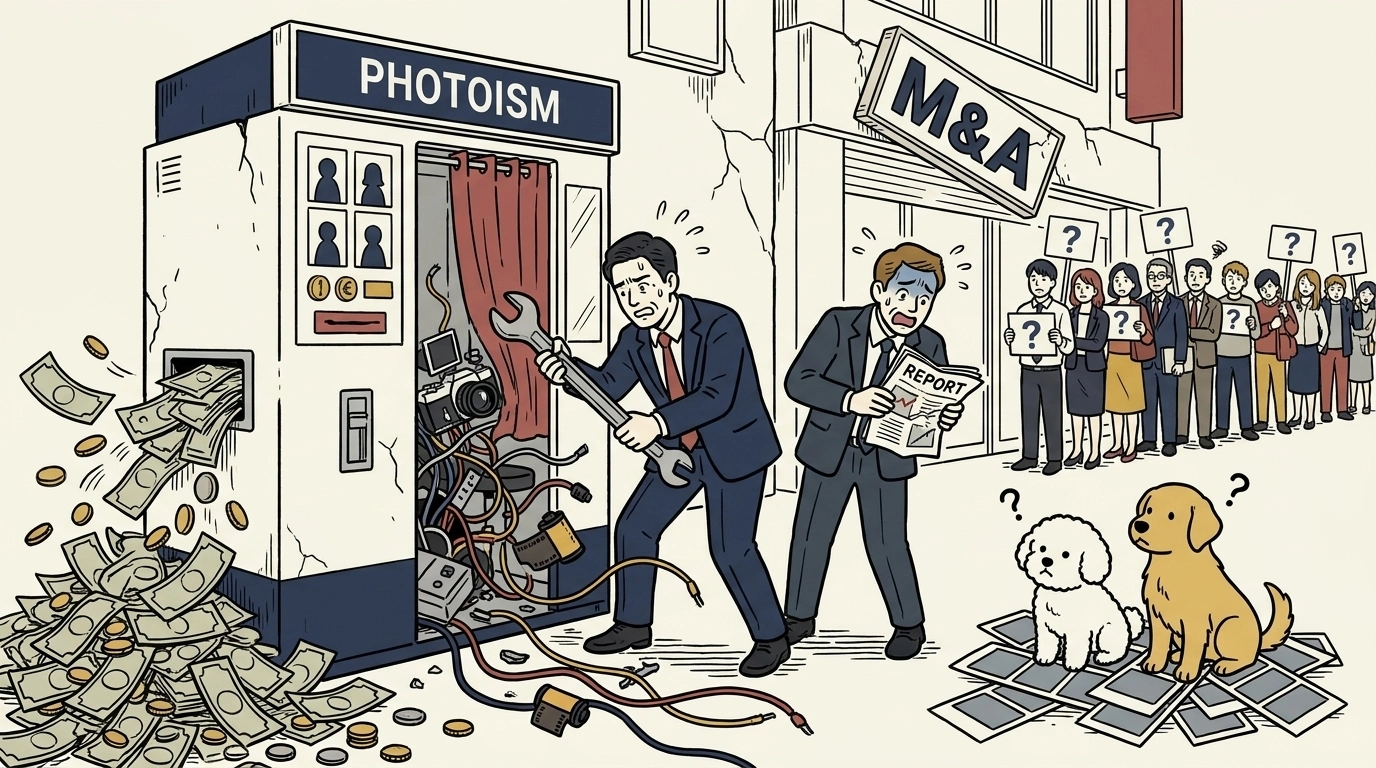
Seobuk Co., Ltd., the operator of South Korea's leading self-photo studio brand 'Photoism', is facing a severe financial crisis. Seobuk, which was confident about its initial public offering (IPO) based on record-high performance just last year, postponed its listing early this year under the pretext of 'focusing on new business in the US'. However, as recent external audits have revealed a total mess including a massive shift to a deficit, a slew of errors in past financial statements, class-action lawsuits with franchisees, and the aftermath of unreasonable M&As, the dominant analysis in the industry is that Seobuk's IPO postponement was not a voluntary choice, but rather that it was 'driven into a situation where the process itself is impossible'.
The Pretext for Postponing the IPO is 'Global Expansion'... The Reality is Plunging Accounting Credibility and 'Inability to List'
In April 2025, Seobuk showed strong confidence in its IPO, coordinating the schedule for the KOSDAQ preliminary listing review, stating that it had "broken the record for the highest performance since its foundation." However, in January of this year (2026), it suddenly announced that it would postpone the listing schedule, saying it would "first materialize the results of the new IP business underway in the US."
But the reality was different. 'Financial soundness' and 'accounting transparency', which are key requirements for requesting a preliminary review for a KOSDAQ listing, had completely collapsed. During the external audit process, significant errors in past accounting practices were discovered in droves, resulting in an unprecedented situation where the financial statements for 2024 (the 5th term) had to be restated on a large scale retroactively.
In the area of revenue recognition, an error was revealed where revenue was recognized in advance even though interior inspections at franchise stores were not completed. In addition, facts of minimizing costs and losses were also discovered, such as the failure to recognize allowances for bad debts on long-term uncollected receivables, the omission of valuation allowances for obsolete inventory, and the failure to reflect impairment losses in the underperforming F&B business division. As a result of correcting these errors, the separate net income for 2024, which was the core rationale for the listing, was drastically slashed by nearly half from the initially reported 6.23 billion won to 3.68 billion won. For an IPO company that must pass the strict review of the Korea Exchange, this is a fatal blow to its internal control and accounting credibility.
[Photoism Brand Introduction, Source: Photoism Website]
Superficial Outward Growth... A Shocking 'Shift to Deficit' Amid Surging Content Costs
Even before the shock of the accounting revisions faded, the performance in 2025 plummeted even more disastrously. Seobuk's separate sales in 2025 were approximately 56.94 billion won, successfully expanding its external size by growing 11.6% compared to the previous year. However, operating profit fell sharply from a surplus of about 5.94 billion won in 2024 to -7.4 billion won in 2025, turning into a deficit. Net income also recorded a massive loss of -9.57 billion won. On a consolidated basis (including subsidiaries), it recorded sales of about 60.43 billion won and an operating loss of -6.33 billion won, showing that even some profits from overseas subsidiaries such as those in Japan were not enough to plug the hole in the main body.
The fundamental cause of the deficit lies in the abnormal surge in 'content cost of sales'. Content sales themselves, such as collaborations, increased from about 20.33 billion won to 30.99 billion won, but the content cost of sales spent to generate this revenue soared by about 9.81 billion won (+86.6%), from 11.31 billion won in 2024 to 21.12 billion won in 2025. With the increase in sales (10.66 billion won) and the increase in costs (9.81 billion won) at a similar level, the company experienced an 'all show and no substance' type of growth where the royalty fees paid to IP holders drained out just as much as sales increased, thoroughly eating away at profitability. On top of this, payment commissions for external partnerships and platform operations also surged 51% from 4.76 billion won in 2024 to 7.19 billion won in 2025, deepening the swamp of deficits.
Painful M&A Failure and 100% Insolvency of Loans to Related Parties
Unreasonable expansion outside its main business also held the company back. Seobuk forcefully merged with and acquired 'Rover Universe Co., Ltd.' and others under the pretext of entering the F&B business, but it was ultimately evaluated that the 'goodwill' generated in this process had no recoverable value. Accordingly, it had to write off the entire 1.42 billion won at once as an impairment loss (expense).
In addition, the laxity of internal fund management was exposed. Judging that there was no possibility of recovering about 1.96 billion won in funds loaned to 'Good Voice Club Co., Ltd.', a related party and F&B joint venture, the company set a 100% allowance for bad debts, effectively treating the entire amount as insolvent. In effect, the funds of a company preparing for a listing evaporated in its affiliate.
A 2.2 Billion Won Lawsuit Triggering the Refixing of Redeemable Convertible Preference Shares (RCPS) and Franchisees' Collective Backlash Shaking the Foundation of the Franchise
The risk of a 'series of lawsuits' that could directly hit business continuity and corporate governance is also ongoing. The most fatal detonator is the lawsuit for a stipulated sum of 2.27 billion won filed by 'Photoism S Co., Ltd.' After winning the first trial, the appeal is currently underway at the Suwon High Court. If the company ultimately loses this lawsuit and an obligation to pay the judgment amount arises, a toxic clause will be triggered where the conversion price of the 'Redeemable Convertible Preference Shares (RCPS)' issued to existing investors is adjusted downward (refixing). This will have a massive negative impact on the company's capital structure and the equity value of existing shareholders.
Furthermore, 52 franchisees, the core partners of the franchise business, have taken collective action by filing a 'claim for return of unjust enrichment (litigation value of 104 million won)' against the headquarters. Regardless of the size of the amount, the very fact that it is escalating into legal disputes with franchisees acts as a signal of brand reputation decline and serial departures, which inevitably becomes a major deduction factor in future corporate valuation.
Drying Cash, Doubled Short-Term Borrowings... Suffocating Liquidity Pressure
As deteriorating performance, lawsuits, and investment failures intertwine, Seobuk's safe is showing its bottom. The cash and cash equivalents held by the headquarters (on a separate basis) evaporated by a staggering 66%, from about 14.22 billion won at the end of 2024 to 4.83 billion won at the end of 2025.
Conversely, short-term borrowings (short-term debt) to be repaid within one year surged more than twofold (+9.58 billion won) in just one year, from 8.02 billion won at the end of 2024 to 17.6 billion won at the end of 2025. The 'net debt ratio', which divides net debt (total debt minus cash on hand) by equity, soared from 27.05% in 2024 to 81.75% in 2025. With cash drying up right now, bank debts to be repaid are snowballing, leading to severe liquidity pressure.
Ultimately, the dominant analysis is that the pretext of 'US expansion' put forward by Seobuk for postponing the listing is nothing more than packaging to cover up worsened internal circumstances. In reality, it is estimated that the company has been driven into a state where it is difficult to independently cross the high threshold of the Korea Exchange's preliminary listing review due to the combination of large-scale revisions to financial statements, a massive deficit, snowballing short-term debt, and class-action lawsuit risks threatening corporate governance and brand reputation. Unless it promptly patches up conflicts with franchisees and extensively innovates the surging cost structure that is eating away at profitability, it is projected that resuming the listing process in the short term will be virtually impossible.
Company financial data, investment reports, and startup analysis — all in one place
Explore PitchdeckCurated news, every week — straight to your inbox
Every Friday · Unsubscribe anytime