
Golf platform 'Smartscore', which embarked on aggressive mergers and acquisitions (M&A) on the back of explosive growth during the COVID-19 pandemic, is facing severe backlash. As the overall growth of the golf industry slows, the sluggish performance of its subsidiary Majesty Golf—unexpectedly acquired from the private equity fund MBK Partners in the past—is shaking the parent company's financial structure, creating a profound sense of crisis.
Diverging Top-Line Growth and Profitability Following Large-Scale M&A
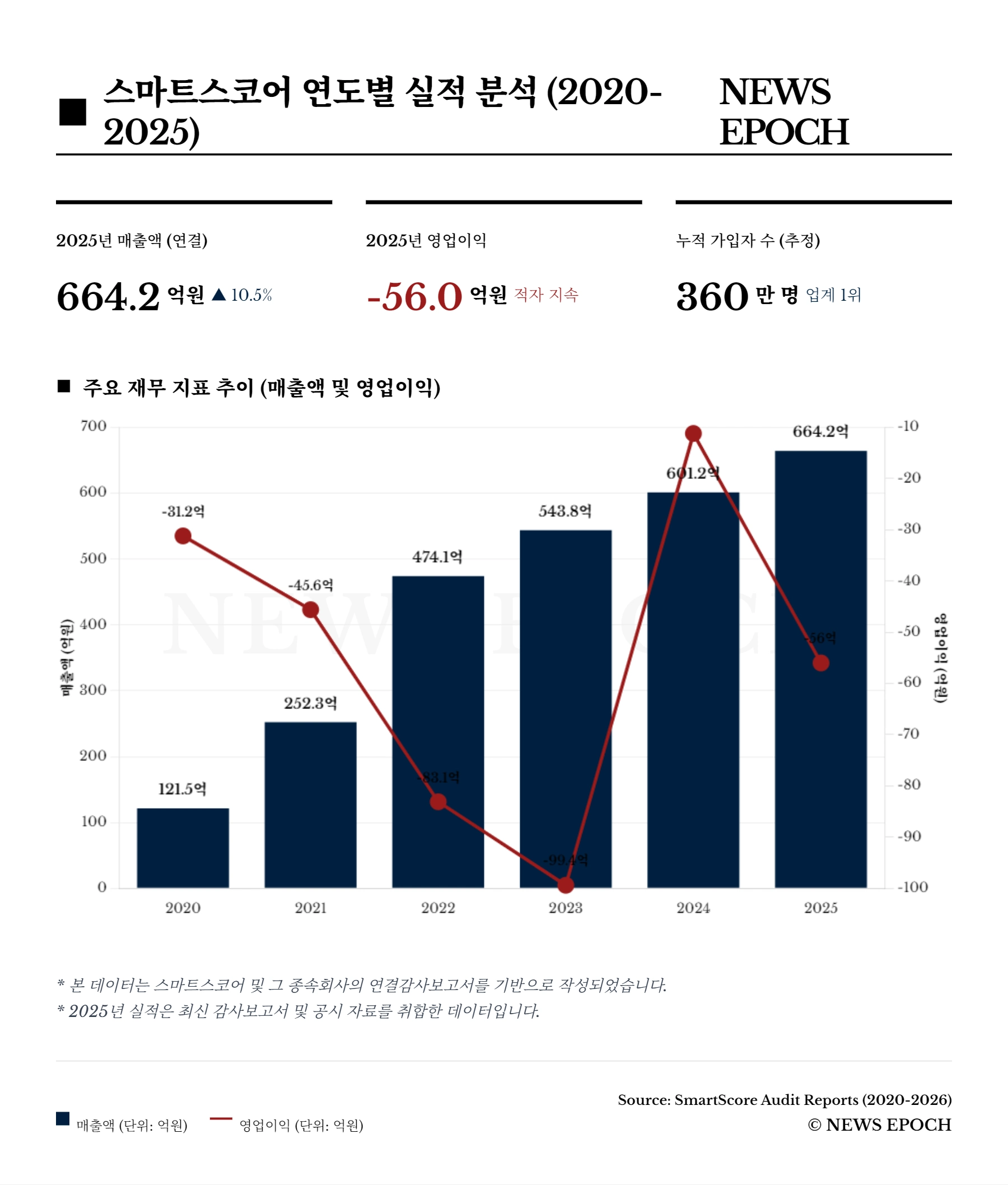
Looking at Smartscore's financial statements over the past five years (2021-2025), it is evident that the company's external growth and profitability trends sharply diverged starting from large-scale M&As, such as that of Majesty Golf.
In 2021, prior to its full-scale M&A drive, Smartscore maintained a stable surplus, recording approximately 42.8 billion won in revenue, 740 million won in operating profit, and 630 million won in net income on both a consolidated and separate basis.
However, starting in 2022, when major companies like Majesty Golf were incorporated as subsidiaries, the performance landscape changed 180 degrees. In 2022, consolidated revenue skyrocketed to 193.8 billion won, and operating profit swelled to 16.3 billion won. On the other hand, while separate basis (parent company) revenue grew to 51.1 billion won, the company swung to an operating loss of 8.3 billion won due to increased cost burdens.
The subsequent trend is even more painful. In 2023, consolidated revenue grew to approximately 234.1 billion won (pre-restatement basis) and generated an operating profit of 19.7 billion won, but the company fell into a swamp of deficits, recording a consolidated net loss of 15.8 billion won due to snowballing interest expenses. The parent company (separate basis) also posted a massive net loss of 21.5 billion won.
In 2024, consolidated revenue peaked at 253.2 billion won, with an operating profit of 17.6 billion won, but the net loss widened significantly to 61 billion won. In the same year, the separate basis also recorded 61 billion won in revenue and a net loss of 53.6 billion won.
Ultimately, in 2025, Smartscore's consolidated revenue experienced a negative growth of approximately 20.5% year-on-year to 201.1 billion won, and its operating profit was halved to 9.4 billion won. Conversely, separate basis revenue rebounded 22% year-on-year to 74.5 billion won, but it recorded an operating loss of 5.61 billion won and a net loss of 75.78 billion won. The massive net losses of 65.2 billion won on a consolidated basis and 75.8 billion won on a separate basis in 2025 are deep scars left by past external expansion. The only silver lining amid the large book net loss is that, thanks to the reflection of various non-cash depreciation, amortization, and impairment losses, the operating cash flow in 2025 recorded positive (+) figures on both a consolidated (41.6 billion won) and separate (20.3 billion won) basis, effectively defending actual cash inflows.
Majesty Golf Becomes the Winner's Curse, Even Raising Fears of Event of Default (EOD)
At the root of this crisis for Smartscore is its subsidiary, Majesty Golf (Majesty Holdings). The Smartscore consortium expanded its size by acquiring a stake in Majesty Golf for approximately 290 billion won in 2022, right when the golf industry was at its peak.
In 2022, just before the acquisition, Majesty's earnings before interest, taxes, depreciation, and amortization (EBITDA) peaked at 35.3 billion won, seemingly cruising smoothly. However, having already absorbed future golf equipment demand during the pandemic, and burdened by excessively accumulated inventory at the time, its EBITDA was halved to 16.7 billion won in 2023.
The problem lies in the large-scale acquisition financing of 120 billion won raised by the consortium at the time of the Majesty Golf buyout. According to media reports, the company needs to generate around 25 billion won in annual EBITDA to comply with existing financial covenants, but the decline in performance has put it in a position where it must immediately worry about an Event of Default (EOD). Consequently, urgent financial investors (FIs) have reportedly been discussing plans to raise new funds and restructure, even if it means lowering the enterprise value.
Snowballing Interest and Impairment Losses... Bringing Down the Entire Group's Profits
This sluggish performance of Majesty Golf is acting as a massive headwind that weighs down the overall performance of its parent company, Smartscore.
Above all, because Smartscore raised large-scale acquisition financing during the Majesty Golf buyout, its borrowing size remains high at around 94.1 billion won, and approximately 17.2 billion won is spent on interest expenses alone, severely eroding the company's profitability. To make matters worse, as the business performance of investee companies like Majesty Holdings deteriorated and their recoverable amounts fell short of book values, the Smartscore parent company had to recognize a staggering 19.85 billion won in impairment losses on investments in associates all at once in 2025.
The massive deficits of these subsidiaries were fully reflected in Smartscore's consolidated income statement as an equity method loss of 14.3 billion won, becoming a core reason for the collapse of the entire group's net income. On top of this, judging that the future economic benefits of intangible assets (such as development costs) recognized through past business combinations had decreased, the company processed an additional 19.75 billion won in impairment, making large-scale deficits unavoidable.
Largest Shareholder VIG Partners in a Dilemma, Exit in the Fog
With such overlapping bad news erupting, the concerns of Smartscore's largest shareholder, private equity fund VIG Partners, are also deepening. VIG Partners utilized acquisition financing when acquiring Smartscore in 2022, but with the performance of both the parent company and its subsidiaries declining, a red light has turned on for its investment recovery (exit).
Currently, VIG Partners is pursuing a refinancing for Smartscore with a short, one-year maturity structure. This is interpreted as a strategic decision to align the schedule with the maturity of Majesty Golf's acquisition financing and to monitor the trend of future benchmark interest rate cuts.
Initially, VIG Partners aimed for Smartscore's initial public offering (IPO) by 2027, but achieving the enterprise value that reached 860 billion won at the time of acquisition is not easy considering current industry conditions. The market's attention is focused on whether it can protect its pride as the No. 1 golf platform and overcome the painful curse of the reverse acquisition.
Company financial data, investment reports, and startup analysis — all in one place
Explore PitchdeckCurated news, every week — straight to your inbox
Every Friday · Unsubscribe anytime