'National Photo Studio' Printing Box That Captivated the MZ Generation Turns to a Deficit
Printing Box is an unmanned shared printing platform where users can upload photos or documents to a dedicated web or app and instantly print them within 24 hours at kiosks nationwide via the cloud. It operates by installing over 1,300 devices nationwide, including at the four major convenience stores such as CU and GS25, as well as large discount stores and movie theaters, and has received a great response from the 1030 generation (teens to 30s) through active collaborations with various content IPs such as famous animations and idol fandoms.
After changing its company name from Vision OTS to 'Printing Box' in 2021, its external growth expanded at a frightening pace. Sales, which were around 1.03 billion won in 2019, grew rapidly to record 1.91 billion won in 2021 and 5.15 billion won in 2022, and reached 8.84 billion won and 9.38 billion won in 2023 and 2024, respectively. Based on this growth trend, it attracted a 1 billion won investment from Albatross Investment in 2023 at an estimated corporate value of 31 billion won, and subsequently rode high on success by raising funds through additional paid-in capital increases (estimated corporate value in the 50 billion won range) and bond issuances.
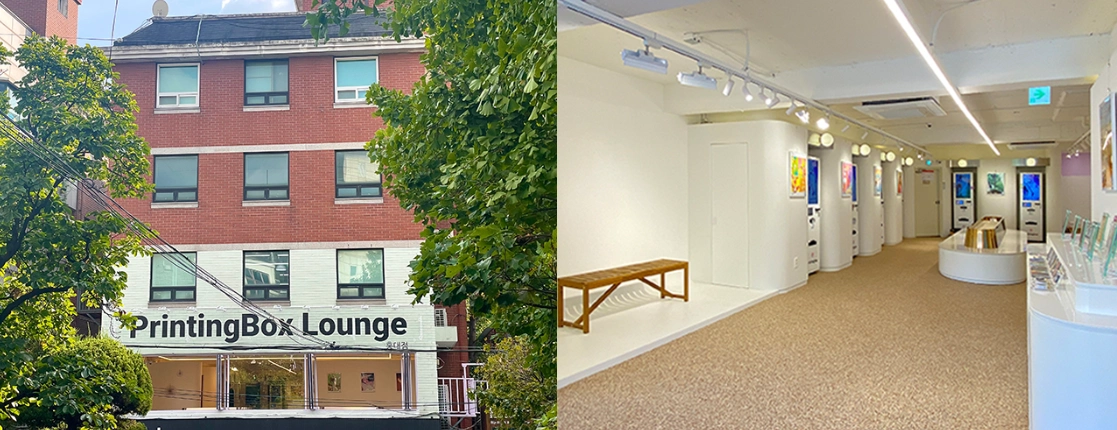
Printing Box Lounge Hongdae, Source: Printing Box Website
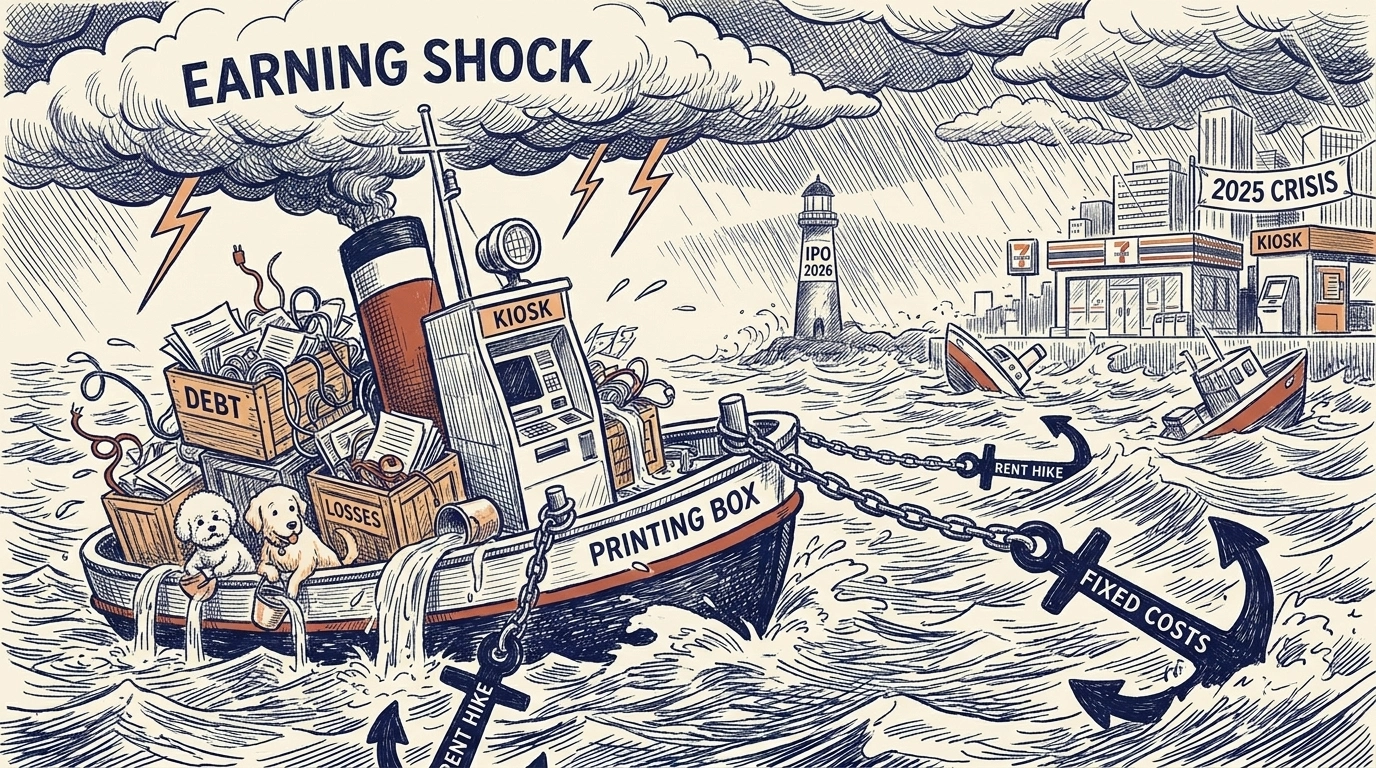
Painful 'Earnings Shock' in 2025... Sales Halved, Operating Margin Plummets to -52.57%
Printing Box announced that it selected Korea Investment & Securities as its listing underwriter and will begin full-scale preparations for an IPO with the goal of entering KOSDAQ in 2026. However, unlike the flashy blueprint, the recently confirmed 2025 financial statements were found to have recorded an 'earnings shock' so fatal that it overshadows the IPO push.
The most painful part is the broken growth potential. Sales, which reached about 9.38 billion won in 2024, plummeted by more than 46% year-on-year to about 5.03 billion won in 2025. Profitability indicators are even more dismal. While sales were halved, the burden of cost of goods sold and SG&A expenses actually increased, sending the operating margin for 2025 plummeting to a despairing figure of -52.57%. Simply put, it has deteriorated into a structure where selling 100 won worth of goods results in a 52 won deficit.
The main reason the company fell into a crisis is its abnormal cost structure, 'the increase in fixed costs such as rent'. Common sense dictates that if sales drop, expenses should be reduced as well, but Printing Box was the exact opposite. Total SG&A expenses actually increased from 2.83 billion won in 2024 to 3.37 billion won in 2025.
Looking at the details of SG&A expenses, the upward trend in rent catches the eye. Rent, which was about 200 million won in 2024, increased more than sevenfold in just one year to about 1.48 billion won in 2025. This is presumed to be due to infrastructure lease contracts incurred during the expansion of offline stores, which are the core of the unmanned printing platform, or changes in the terms of franchise and store entry contracts, and these fixed costs ultimately affected the company's performance.
'Capital Impairment' Crisis Reaching the Brink of Wiping Out Capital... Debt Ratio of 944.5%
The operational slump immediately led to the collapse of the financial structure. With a massive net loss of about 2.94 billion won in 2025 alone, the retained earnings accumulated over the years completely evaporated, accumulating a deficit of -2.44 billion won.
In the aftermath, total equity (net assets), which was 3.31 billion won in 2024, shrank to 660 million won in just one year. This is almost on par with the company's paid-in capital (about 538 million won), meaning that even a slight additional loss in the future will push it into a state of 'partial capital impairment' where even the capital stock is eroded. On the other hand, total liabilities swelled to about 6.28 billion won, exposing financial instability as the debt ratio exceeded the usual safe zone.
Cash Dried Up But 1.13 Billion Won Evaporates Internally?... Short-term Loan Items
While the earnings shock is a problem, there is an unusual point caught in the cash flow. Looking at the 2025 financials, about 880 million won was newly generated under the name of 'short-term loans to shareholders, executives, and employees', and 250 million won as 'short-term loans to related parties'.
Currently, the company is in need of cash as its short-term borrowings that must be repaid within one year have nearly doubled compared to the previous year to about 1.05 billion won. Even if all accounts receivable of about 1.03 billion won are immediately collected in cash, it is a situation of 'working capital insolvency' insufficient to cover the returning debt and interest. Despite this, the fact that about 1.13 billion won of the company's liquid funds (880 million won if only calculating loans) leaked out as loans to internal stakeholders is a point worth noting.
Earnings Shocked Printing Box, IPO Dream Likely to be Postponed for Now
What is even more gloomy is the snowballing interest that must be paid every year. Looking at non-operating expenses, 410 million won was spent on interest expenses alone in 2025. This means the company is in a situation where it has to bear financial costs in the 400 million won range every year while completely failing to generate cash through its core operating activities.
In summary, it may be difficult for Printing Box to escape the crisis on its own without a large-scale injection of external capital. Although it received a flashy spotlight when it selected a lead underwriter in January last year, the dream of a KOSDAQ listing is expected to be difficult to realize for the time being as halved sales, severe operating deficits, and liquidity problems overlap.
Nevertheless, the underlying strength that Printing Box has built up in the unmanned content printing market by successfully constructing an infrastructure of over 1,300 units at major bases nationwide is clear. Their business model, which has established itself as an unrivaled platform by combining with the fandom culture of the 1030 generation, remains valid. Although they are currently facing a painful financial crisis, it is hoped that the company will take this situation as bone-chilling growing pains and a lesson learned. If they reasonably reorganize their excessive cost structure and strictly tighten internal controls, we can expect them to use this crisis as an experience to be reborn as a more substantial and solid company, successfully achieving the goal of a KOSDAQ listing in the near future.
Company financial data, investment reports, and startup analysis — all in one place
Explore PitchdeckCurated news, every week — straight to your inbox
Every Friday · Unsubscribe anytime