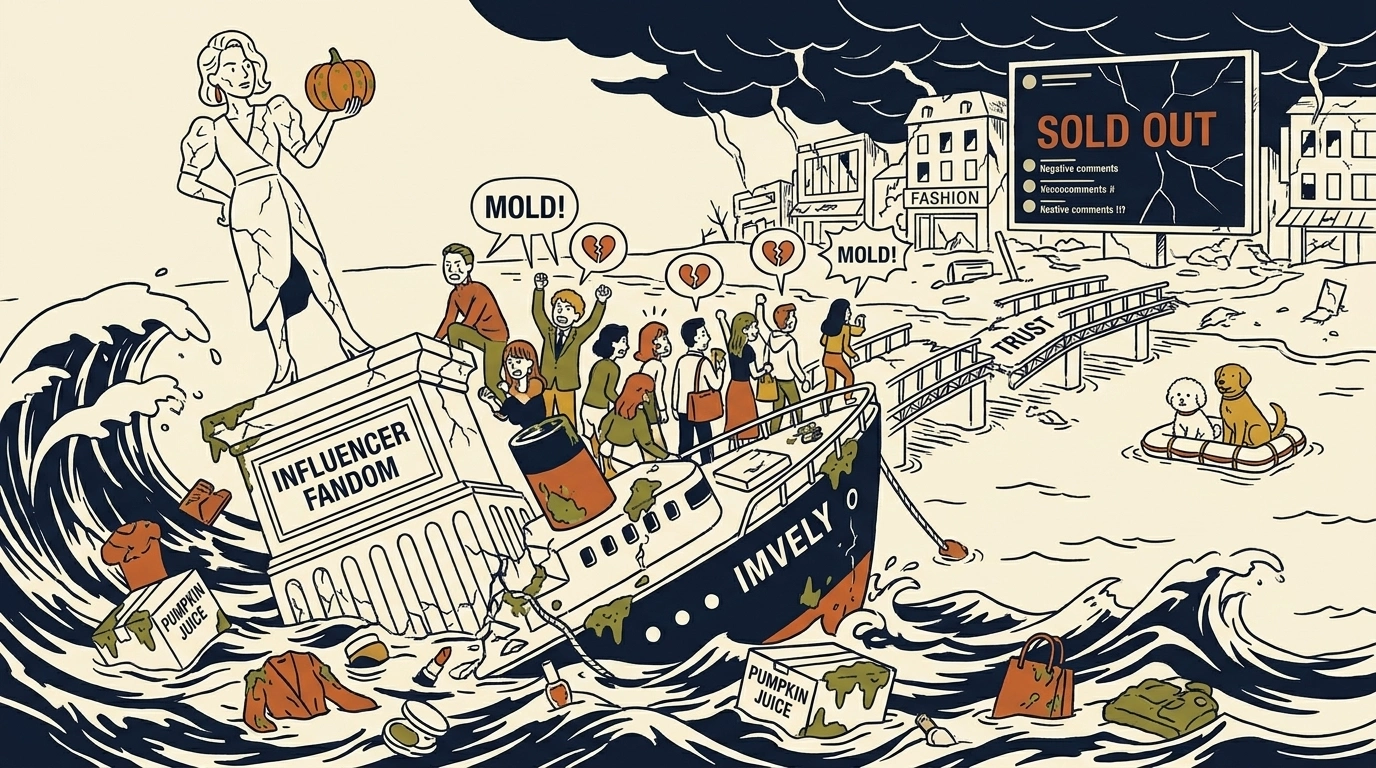
Fronted by first-generation fashion and beauty influencer Im Ji-hyun, 'Imvely (Operator BTG, formerly Bugun FNC)', which once thrived with annual revenues nearing 100 billion won, is ultimately facing a lonely exit. As the limitations of a business model entirely dependent on a specific influencer's fandom collided with the management's failure in crisis management, the company once called a legend in the industry has fallen into the deep swamp of complete capital impairment.
The Birth and Glamorous Heyday of the 'Imvely' Legend
BTG, the operator of Imvely, was established in 2010 under the name 'Bugun FNC'. The women's clothing shopping mall 'Imvely' and the cosmetics brand 'Vely Vely', which featured influencer Managing Director Im Ji-hyun as the face of the brand, gained explosive popularity among women in their 10s to 30s. The clothes Im wore or the cosmetics she applied boasted a massive fandom, leading to sold-out situations as soon as they were posted on social media (SNS).
As a result, the company achieved dazzling growth. Its revenue, which was 66.1 billion won in 2017, surged to 97 billion won in 2018, and operating profit also jumped significantly from 2.3 billion won to 10 billion won during the same period, enjoying the greatest heyday since the company's founding. At the time, it was called one of the two major pillars of first-generation fashion influencer shopping malls along with 'Stylenanda', and a high corporate valuation was discussed.
Diverging Fates... The 'Pumpkin Juice Mold' Incident and the Worst Crisis Management
However, the legend that seemed like it would last forever collapsed miserably in 2019, triggered by the so-called 'pumpkin juice mold incident'. At the time, consumer reports followed one after another that mold was found in the pumpkin juice sold by Imvely.
In this crisis situation, the company's response was a painful mistake. The company drew the public indignation of consumers with an insincere response, stating that it would only provide exchanges for the remaining quantity, excluding what consumers had already consumed. As complaints skyrocketed, they closed the door to communication by switching the official Instagram account to private and deleting critical comments. Furthermore, just a day after posting an apology, they added fuel to the fire by posting a warning that they would actively take legal action against SNS accounts and malicious comments criticizing them.
This received even greater criticism as it contrasted with the crisis management of 'MUSINSA', where the CEO immediately stepped forward to apologize and implemented history education for all employees and visits to victim organizations when a controversy over inappropriate advertising phrases occurred around the same time. The failure of the initial response soon led to a large-scale consumer boycott, and hidden problems such as controversies over copying luxury goods and abuse of power against Dongdaemun merchants continuously erupted.
The Realization of 'Key-Man Risk' and the Swamp of Structural Deficits
The 'Key-man Risk' of a business model entirely dependent on a specific individual's fandom was fatal. When trust collapsed and the fandom turned its back, the performance went into a vertical drop.
Revenue in 2019, hit hard by the pumpkin juice incident, was cut in half to 45.3 billion won, and it shifted to a massive deficit, recording an operating loss of 13.1 billion won and a net loss of 18.5 billion won. Bugun FNC, which faced a public beating, attempted to renew its image by changing its company name to 'BTG' in 2020, but it was not enough to stop the fall. Ultimately, in November 2022, Im Ji-hyun, who had been leading the brand, announced the temporary suspension of the fashion business that had been ongoing for 9 years.
Even in a situation where the brand value had vanished, the massive fixed costs such as offline stores, logistics centers, and large-scale manpower that were vastly expanded during its heyday strongly choked the company. While revenue plummeted to 21 billion won in 2020, 25.2 billion won in 2021, 17.4 billion won in 2022, and 4.2 billion won in 2023, tens of billions of won in cumulative operating losses occurred. As of 2024, revenue is at a virtually extinct level of 2.2 billion won, still recording an operating loss of 1.5 billion won, and the number of employees shows that all employees have resigned as of August 2025. It can be viewed as a state where normal business operations are virtually impossible.
Forced Sale of Core Assets and Complete Capital Impairment... Inevitable Bankruptcy Steps
Trapped in the swamp of structural deficits, BTG was driven into the process of disposing of core assets to pay off debts reaching immediate maturity. BTG's core real estate, which had a book value of 66.7 billion won in 2019, shrank to the size of 9.7 billion won in 2023 as it was sold off for debt repayment. Ultimately, as even the last remaining prime asset was forcibly disposed of to pay off debts in 2024, the book value of real estate that was worth tens of billions of won fell to '0 won' on the financial statements without a trace. Instead of investments to revive the competitiveness of its main business, it sold all its last remaining prime collateral assets, including the company building and real estate, just to prolong the company's life.
However, despite these efforts, the company's independent survival is already in an impossible state. As tens of billions of won in deficits accumulated each year completely ate away the retained earnings, the company's total equity as of 2024 stood at -18.7 billion won, plunging into a state of severe 'complete capital impairment'.
Even after disposing of all high-quality collateral, the company is still left with a massive debt of about 19.9 billion won intact, including long-term borrowings and accounts payable, as of 2024. Among the remaining current assets, cash and cash equivalents are extremely minimal, and most are only bad trade receivables and non-trade receivables with significantly low collection rates. Considering that senior financial institutions have recovered their claims with the proceeds from the real estate sale, the currently remaining debt is highly likely to be temporary advances from the owner family, unsecured credit lines, or payments due to business partners.
With its cash-generating ability completely exhausted, it appears highly likely that BTG will soon undergo complete liquidation steps through corporate dissolution and bankruptcy declaration, leaving behind massive losses for the remaining creditors. Imvely's case leaves an indelible, painful lesson for the domestic influencer commerce industry on how an incorrect crisis response to consumer complaints can lead a promising company that once eyed revenues in the 100 billion won range to complete ruin.
Company financial data, investment reports, and startup analysis — all in one place
Explore PitchdeckCurated news, every week — straight to your inbox
Every Friday · Unsubscribe anytime