
T Scientific's acquisition of management rights to Happy Technology, the operator of the on-demand car wash platform 'Instawash', in July 2024 revealed that the value of the acquired company dropped to 1.8 billion won from a previous valuation of 11.1 billion won. During this period, T Scientific acquired a 70.08% stake based on the face value (5,000 won), the base price of the shares, instead of conducting a separate fair value assessment of the company. However, this face-value-based debt-to-equity swap and the issuance of new shares ultimately caused a downward adjustment (refixing) of the preferred stock conversion price for existing investors, leading to a risk of stake dilution for the parent company.
Corporate value drops from 11.1 billion won to 1.8 billion won… Execution of debt-to-equity swap at face value
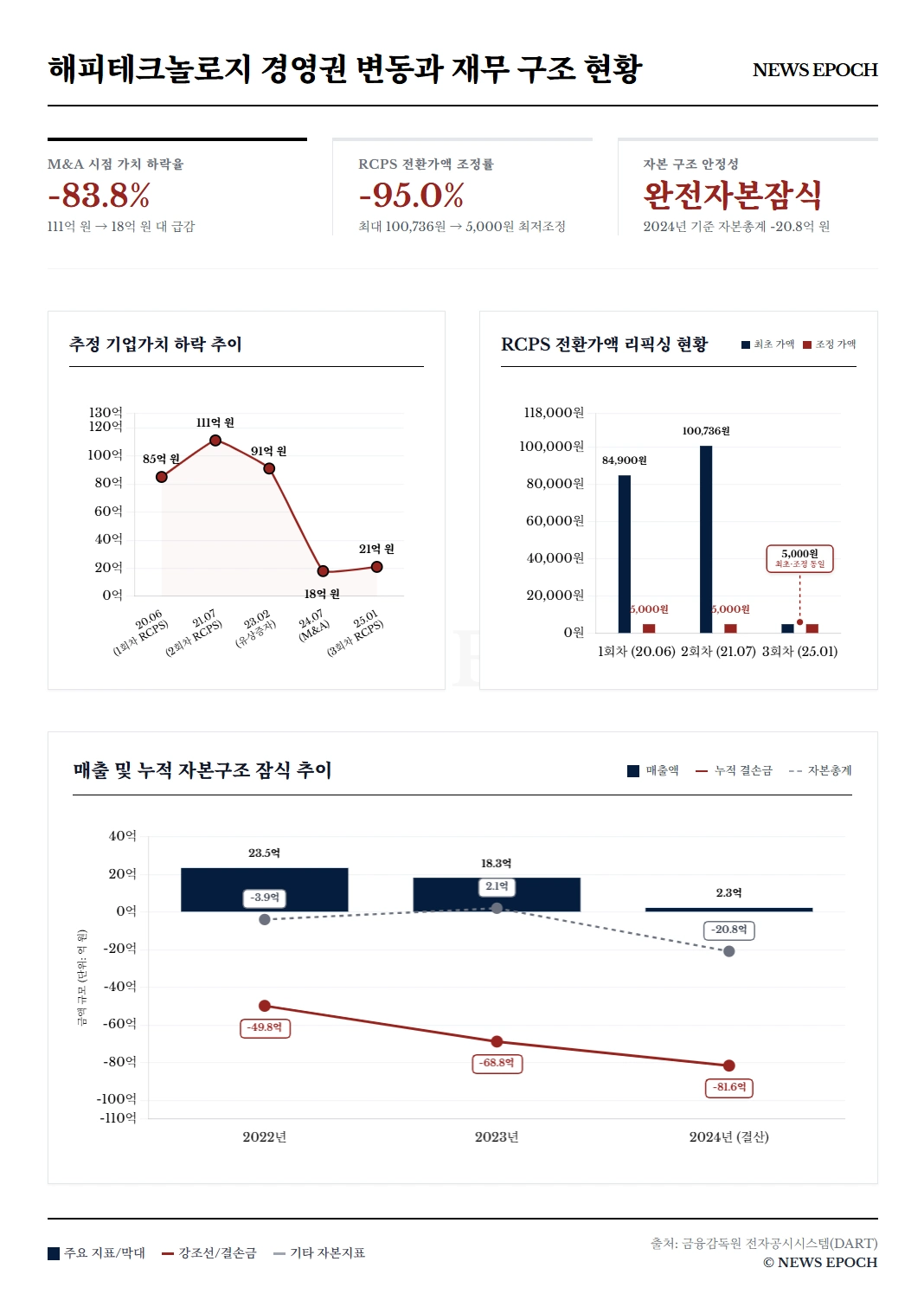
According to past investment attraction records, the estimated corporate value of Happy Technology was 11.1 billion won (issuance price per share of 100,736 won) as of July 2021. When T Scientific invested a total of 2.5 billion won through convertible bond conversion and paid-in capital increase in February 2023 to incorporate it as an affiliate, the corporate value was also evaluated at the level of 9.1 billion won. However, in July 2024, when T Scientific secured management rights by converting 1 billion won of loans into equity, Happy Technology's corporate value had decreased to 1.8 billion won.
Based on the declined corporate value, T Scientific set the conversion price per share equal to the face value of 5,000 won and acquired 200,000 common shares. Unlike a typical debt-to-equity swap where the issuance price is calculated by reflecting the company's fair value, it acquired controlling power at face value without an influx of additional capital such as paid-in capital in excess of par value.
Issuance of 3rd preferred stock and realization of stake dilution risk
The impact of the face-value debt-to-equity swap appeared half a year later as a change in the stake ratio. In January 2025, 300 million won worth of 3rd redeemable convertible preferred stock (RCPS) was newly issued to a third party at face value (5,000 won), adding 60,000 new shares to the market. As the total number of issued shares increased, T Scientific's stake ratio immediately dropped from 70.08% to 59.87%.
The main issue is that as the 3rd preferred stock was issued at 5,000 won, the stock conversion price of the 1st and 2nd preferred stocks, which were previously in the 80,000 to 100,000 won range, was also drastically adjusted downward to 5,000 won due to contract conditions. If existing investors exchange their shares at this lowered price in the future, the number of shares they can secure will increase significantly, which acts as a potential risk that could further impair T Scientific's stake.
87% decrease in revenue and a state of capital impairment where liabilities exceed assets
The main cause of the decline in corporate value stems from worsened performance and financial conditions. The sales revenue of the acquisition target, Happy Technology, was approximately 1.83 billion won in 2023, but it decreased by about 87% year-on-year to approximately 230 million won in 2024. As operating deficits continued, the accumulated deficit expanded to minus 8.2 billion won as of the end of 2024.
As this accumulated deficit impaired the existing capital stock, Happy Technology entered a state of complete capital impairment where total liabilities on the books exceed total assets. As of the end of 2024, the company's total equity recorded minus 2.07 billion won. Consequently, although T Scientific incorporated Happy Technology as a subsidiary through the face-value debt-to-equity swap of its loans, the company is in a state of complete capital impairment.
Furthermore, as the risk of a drop in the stake ratio due to the downward adjustment of the preferred stock conversion price has materialized in the aftermath of the new share issuance at face value, there is a need to objectively check the impact these indicators will have on the parent company's consolidated financial statements in the future.
The financial data analysis and accounting material review for this article were conducted together with intern Bae Yun-sol .
Company financial data, investment reports, and startup analysis — all in one place
Explore PitchdeckCurated news, every week — straight to your inbox
Every Friday · Unsubscribe anytime