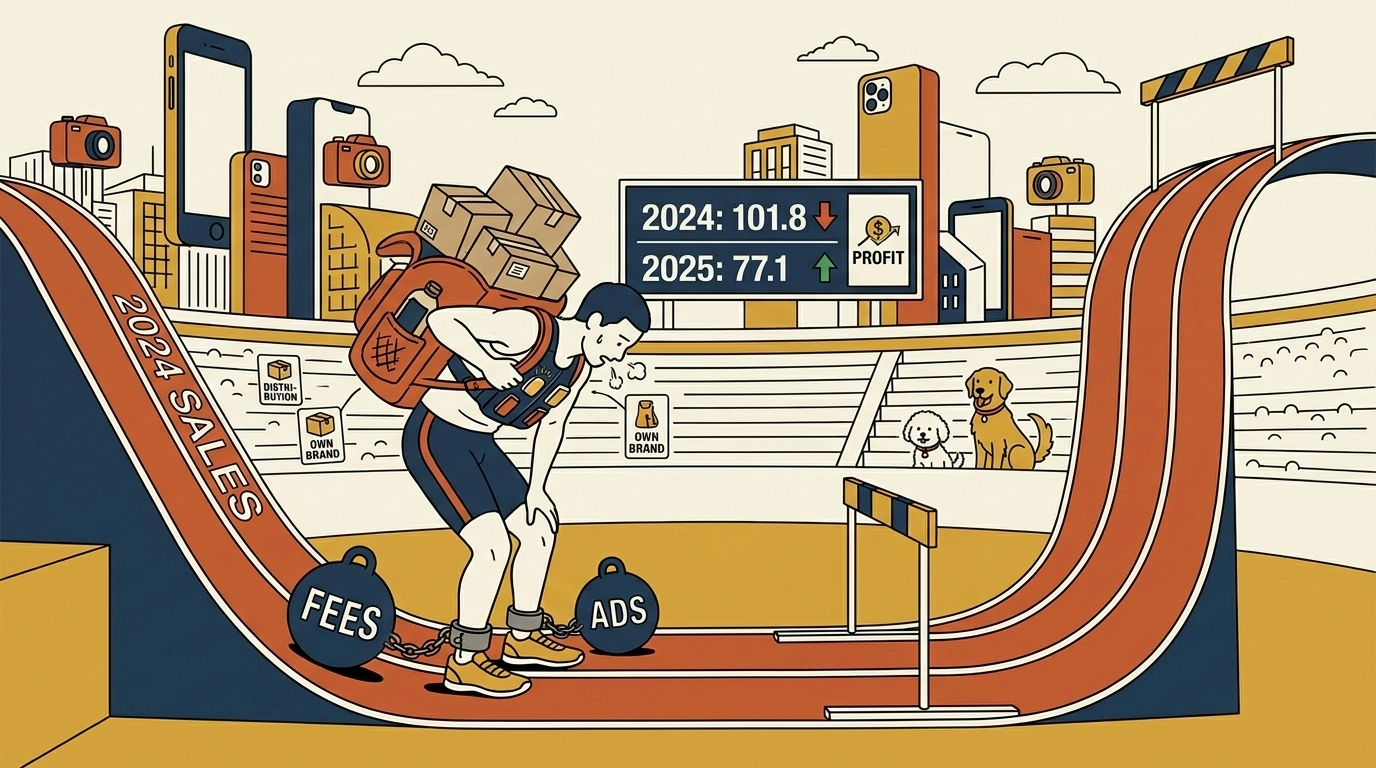
The recent performance trend of ABZ, the operator of the commerce platform 'Inpock'—which helps influencers lacking business or IT knowledge build their own shopping malls in just 30 minutes and easily manage everything from sales to customer care—is intriguing. This is because signs have emerged of the company stepping down temporarily from its trajectory of explosive external expansion to seek a transition toward high-value-added proprietary businesses, thereby promoting qualitative growth. As the creator economy expands globally, is ABZ's 2025 performance a crisis, or a breather for a greater leap forward?
Explosive Growth Until 2024, Sales Downturn in 2025... Net Income Shows an 'Upward Trend'
ABZ's external size had been expanding at a fearsome pace until 2024. Its sales, which stood at around 200 million won in 2021, reached 430 million won in 2022 and 3 billion won in 2023, before peaking and surpassing a staggering 10.18 billion won in 2024.
However, in 2025, total sales amounted to 7.71 billion won, a decrease of about 24% year-on-year, showing that the steep growth trend has somewhat stalled. Interestingly, even in 2025 when sales significantly dropped, profit generation capability actually improved. After successfully turning a profit for the first time with a net income of 5.7 million won in 2023, ABZ's net income has shown a continuous upward trend, reaching 230 million won in 2024 and 310 million won in 2025.
'Qualitative Improvement' by Reducing Size and Focusing on Substance... Financial Strength Fully Normalized
Behind the increase in profit despite the drop in sales lies a qualitative improvement in the sales structure. Looking closely at the details, merchandise sales, which had low margins serving merely as a distribution network, significantly decreased from 9.77 billion won in 2024 to 6.59 billion won in 2025. On the other hand, product sales, which boast higher margin rates through in-house development and production, jumped more than twofold from 410 million won in 2024 to 1.11 billion won in 2025.
This strongly suggests that the company is intentionally reducing the proportion of low-margin distribution businesses that merely grew its external size, and is fundamentally improving its business structure centering on high-value-added proprietary products.
A green light has also turned on for financial soundness. The total equity, which was close to a state of complete capital impairment at -210 million won and -200 million won in 2022 and 2023 respectively, recovered by turning positive (+) to 30 million won in 2024 and 340 million won in 2025. With 860 million won in capital surplus brought in through external investments creating synergy with the accumulated net income, the company has effectively shaken off past financial deficits and completely normalized its strength.
A Rigid Cost Structure Remains a Homework... Commissions in the 1.8 Billion Won Range and Counterproductive Advertising Costs
However, there are also tasks that must be addressed to maximize profitability. These are namely the rigid cost structure and lowered marketing efficiency.
According to the income statement, ABZ has been spending commission expenses in the 1.8 billion won range for two consecutive years in 2024 and 2025. This is highly likely to include platform entry fees, outsourcing service costs, and payment gateway fees, representing a massive scale that accounts for nearly half of the total SG&A expenses (3.82 billion won) in 2025. The fact that commission expenses hardly decreased even in 2025 when sales fell by 24% means that the company's cost structure is very heavy and rigid.
The inefficient expenditure on advertising expenses is also notable. The advertising costs, which were 720 million won when the company generated 10 billion won in sales in 2024, actually increased slightly to 730 million won in 2025 when sales decreased to 7.7 billion won. This is a point that shows marketing efficiency is deteriorating in a phase of external contraction.
A Breather for a Leap Forward? The Future Moves Must Be Watched
Currently, the creator economy market size reaches about 300 trillion won ($250 billion) globally and is a golden fishing ground expected to continue expanding in the future. At the recent Creator Venture Summit (CVS 2025), the synergy between the creator business and fan platforms was heavily highlighted.
Amidst such explosive ecosystem growth, ABZ's sales decrease in 2025 is more likely a strategic breather to evolve from a simple intermediary platform to a highly profitable business structure, rather than falling behind in the market. The market needs to watch with interest whether the company can solve the homework of optimizing excessive commissions and marketing costs, and jump up once again next year based on its improved profit structure.
Company financial data, investment reports, and startup analysis — all in one place
Explore PitchdeckCurated news, every week — straight to your inbox
Every Friday · Unsubscribe anytime