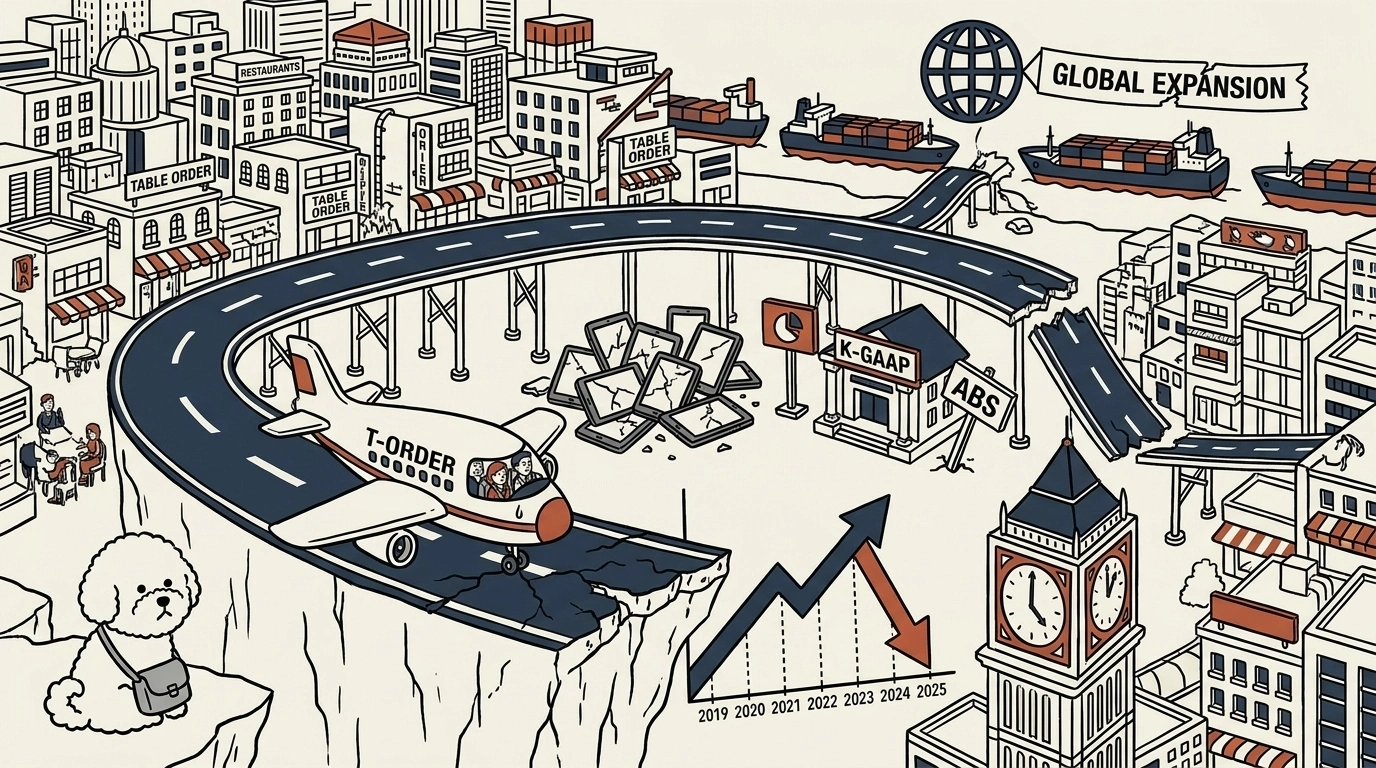
Leading the market as Korea's representative table order company, 'Torder' stands at a critical crossroads of growth. Torder narrowly overcame a recent crisis of massive deficits and capital impairment—triggered by stagnant market penetration and an exacerbated cost structure—through a change in accounting standards and a 10 billion won asset-backed securitization (ABS). Although the immediate fire has been put out, concerns are rising that the company could face difficulties if it fails to achieve a turnaround to profit within the approximately 2-year 'Runway' period it has secured.
'From 400 Million Won to Over 60 Billion Won in Revenue, Followed by Massive Deficits'... Torder's 7-Year Rollercoaster in Numbers
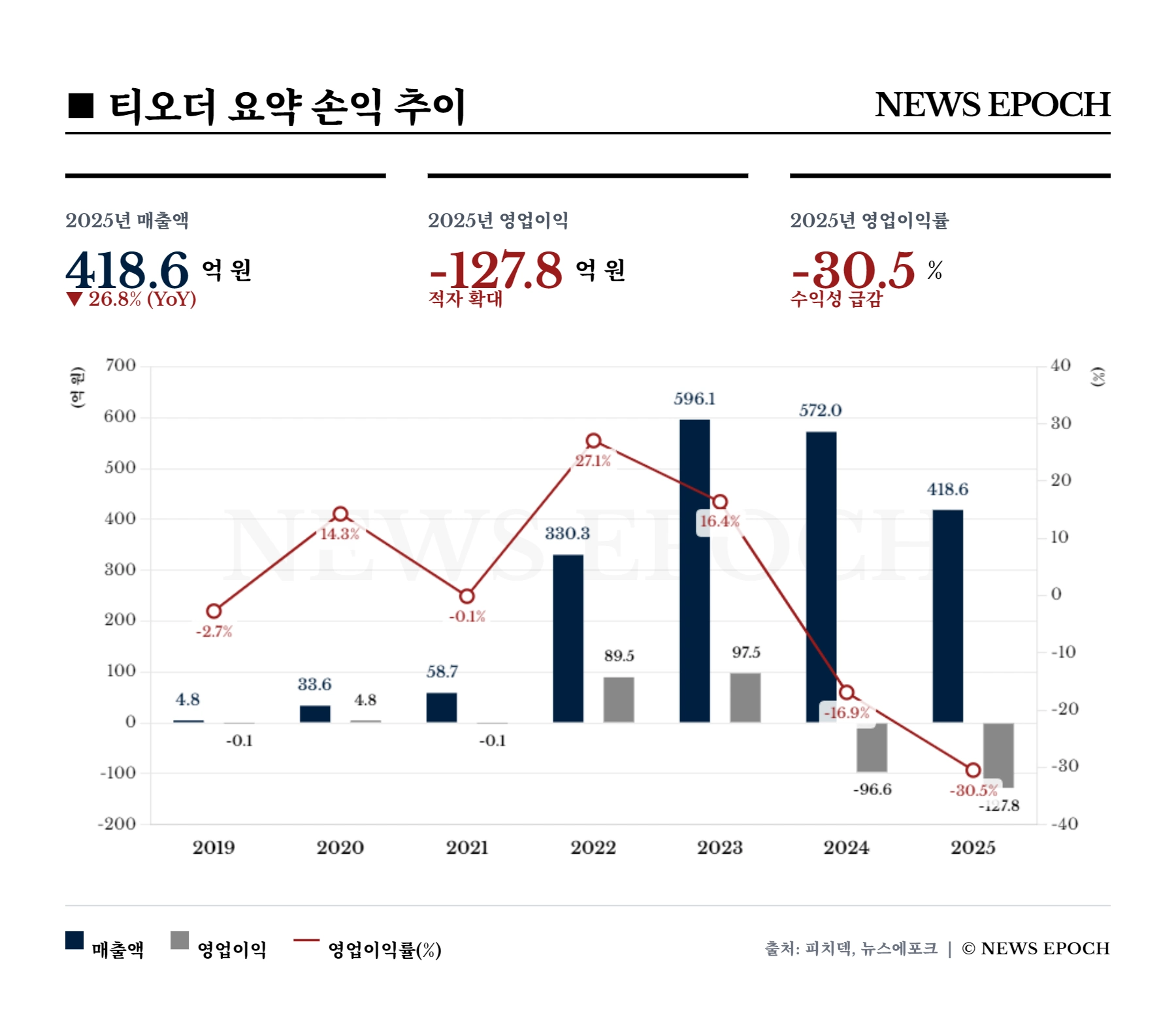
Looking at Torder's separate financial statements from 2019 to 2025, the company's dramatic rollercoaster trajectory is clearly revealed, from its initial struggle to enter the market, through explosive top-line growth, to its recent painful stagnation in growth.
Starting with approximately 400 million won in revenue in its early establishment phase in 2019, Torder recorded 3.3 billion won in 2020 and 5.8 billion won in 2021, successfully settling into the market. During this period, operating profit fluctuated from a deficit of about 13 million won in 2019, to a surplus of about 480 million won in 2020, and a deficit of about 6.5 million won in 2021, going through a process of initial investment and market exploration to expand its size.
Full-scale explosive growth began in 2022. Accurately targeting the food service industry's labor shortages and the demand for digital transformation, Torder boosted its revenue to around 33 billion won in 2022, and achieved about 59.6 billion won the following year in 2023, leaping to the No. 1 position in the industry at once. Profitability also peaked, displaying the aspect of an industry-leading company by recording a solid operating surplus of about 8.9 billion won in 2022 and about 9.7 billion won in 2023.
However, the spectacular growth trend faltered starting in 2024. As the tablet menu board market became saturated and competition intensified, revenue growth stalled at about 57.2 billion won in 2024, and in 2025, it experienced 'negative growth,' dropping by 26% year-on-year to about 41.8 billion won.
Platform businesses aim for an operating leverage effect where profits increase exponentially once initial fixed costs are invested and the revenue scale surpasses the break-even point. However, Torder saw a severe deterioration in its cost structure, as labor costs and depreciation expenses from infrastructure investments skyrocketed during the phase when revenue was declining.
Resolving Capital Impairment on Paper through a Change in Accounting Standards (K-IFRS → K-GAAP)
As profits turned into deficits, the strategic measure chosen by Torder was changing its accounting standards to the Korean Generally Accepted Accounting Principles (K-GAAP) for the year 2025. Under the Korean International Financial Reporting Standards (K-IFRS) in 2024, the Redeemable Convertible Preference Shares (RCPS) issued by the company were recognized as liabilities, and the linked derivative liabilities were accounted for at about 38.3 billion won, causing massive derivative valuation losses. As a result, total equity on a consolidated basis at the end of 2024 was -6.2 billion won, facing complete capital impairment.
However, by adopting K-GAAP for the first time in 2025, the Redeemable Convertible Preference Shares were classified as equity, and the total equity on a separate basis recovered to 28.6 billion won at the end of 2025, allowing the company to resolve the state of capital impairment on paper.
Exposure of Limitations in Growth Momentum... Deterioration of Global and New Businesses and Full Impairment Loss
Torder's greater concern is the stagnation in the growth of its main business and its failure to expand the Total Addressable Market (TAM). The steep revenue growth in 2022-2023 was due to the expansion of initial penetration in the table order market. However, following the stalled growth in 2024, the fact that separate revenue in 2025 plummeted by 26% to about 41.8 billion won compared to the previous year (about 57.2 billion won) suggests that securing new affiliated stores in the domestic F&B market, its core target, has reached saturation or that downward pressure on unit prices has occurred due to intensified competition.
Even attempts at global expansion and cross-industry diversification to break through the growth stagnation have run aground. A massive 'Impairment Loss on Equity Method Investments' amounting to about 8.1 billion won was recognized on the 2025 separate income statement. Looking at the details, the book value of the relevant investment stocks was deemed unrecoverable due to continuous operating losses from overseas subsidiaries such as TORDER AMERICA (USA) and TORDER CANADA (Canada), as well as new business subsidiaries like Torder Stay Co., Ltd. and Check T Co., Ltd., resulting in virtually a full write-off. This indicates beyond the loss of investment funds that the current business model may face difficulties in expanding into global markets or other platforms.
10 Billion Won Asset-Backed Securitization (ABS)... A Structured Finance Strategy to Breakthrough the 'Triple Hardship'
As cash generation capability deteriorates, Torder's reliance on external financing is deepening. Operating cash flow outflows accelerated to about -6.1 billion won in 2023 and -17.8 billion won in 2024 on a consolidated basis, and recorded -9.5 billion won on a separate basis in 2025.
In order to face this triple hardship of 'stagnant top line, worsening operating cash flows, and capital market contraction' head-on, Torder recently succeeded in a 10 billion won Asset-Backed Securitization (ABS) collateralized by future subscription revenue. This is interpreted as a structured finance strategy resulting from the management's deliberations to overcome the company's current financial limitations.
Above all, the primary purpose is an 'immediate liquidity injection' to handle the accelerating operating cash outflow (Burn Rate). Securing working capital right now is essential to withstand the current cost structure, where the proportion of fixed costs has significantly increased due to the expansion of personnel and infrastructure. In a marginal situation where internal cash generation capability through the main business is depleted, the company sought to avert an urgent liquidity crisis by discounting the present value of future subscription fees and converting them into cash all at once.
Furthermore, this could be a bold move to break through the limits of traditional lending channels that have been blocked due to accumulated deficits. In a state where general tier 1 banking credit loans or corporate bond issuances have become impossible due to deteriorating performance, Torder adopted a method of isolating the 'predictable future cash flows' from already secured franchise contracts into a separate Special Purpose Company (SPC). By putting forward the quality of the prime assets themselves as collateral rather than the company's own low credit rating, they essentially achieved credit enhancement that lowers the borrowing rate and maximizes the funding limit.
In addition, it contains the intention to resolve the inherent 'cash flow mismatch' of the hardware subscription business model. The table order business operates on a structure where large-scale capital expenditures (CAPEX) for purchasing and installing a bulk of tablets are made upfront, followed by a gradual recovery through long-term subscription fees. This asset securitization is a measure that forcibly brought forward the timing of investment recovery by pulling in future cash to be generated from assets already installed in the market all at once; it is analyzed as aiming for a virtuous cycle effect of increasing asset turnover and reinvesting it back into operating funds.
About 2 Years Remaining, Torder at the Crossroads of Growth
With this 10 billion won liquidity injection, the company's available cash has increased from the previous approximately 7.79 billion won (as of the end of 2025) to 17.79 billion won. Assuming current spending levels are maintained, the runway has been additionally extended by about 12.5 months, securing a total of roughly 22 months (about 1 year and 10 months). (However, this is contingent on the premise that all 14.68 billion won of existing short-term borrowings are normally rolled over at maturity.)
Torder is now standing at a critical inflection point. In the current cost structure, where the proportion of fixed costs is excessively high, turning to profit is impossible without strict cost controls or revenue growth. As the No. 1 company that changed the landscape of the food service industry with tablets placed on every restaurant table, the industry is watching closely to see if it can wisely overcome these growing pains and be reborn as a solid unicorn company.
Company financial data, investment reports, and startup analysis — all in one place
Explore PitchdeckCurated news, every week — straight to your inbox
Every Friday · Unsubscribe anytime