
Video Village, which grew from a 'creators' playground' into a representative 1st-generation MCN
Video Village is a representative 1st-generation media startup that was established in 2014 and led the early days of the domestic Multi-Channel Network (MCN) market. It was launched with the goal of becoming a 'mobile broadcasting station' by CEO Cho Yoon-ha, formerly of CJ E&M, and young co-founders. Under the vision of 'We live our own lives and film our own dreams,' they poured their efforts into producing original content beyond being a simple agency. As a result, they succeeded with various proprietary channels such as 'Boys Village', 'Girls Village', and 'Studio V', and established themselves as a key player in the industry by managing dozens of creators. Until recently, they have made multifaceted efforts to find a breakthrough in the barren media environment, such as signing an official MCN certification with TikTok, linking YouTube Shopping with Cafe24, and signing an MOU for AI video production with Blink Studio.
The mixed fate of 1st-generation MCNs and Video Village's deepening financial woes
However, unlike its glamorous past, the 1st-generation MCN industry is currently facing fierce survival competition and struggles overall. Yet, while fellow 1st-generation MCN Treasure Hunter recently sold its subsidiary Leferi, generating a capital gain of 22.4 billion won to reorganize its lines and secure the capacity to prepare for a new leap forward, Video Village is analyzed to have practically entered a very difficult financial crisis situation. (Related article: 1st-generation MCN Treasure Hunter starts turnaround after selling 'Leferi' and restructuring... Remaining task is 'cash generating ability of core business' | News Epoch | News Epoch)
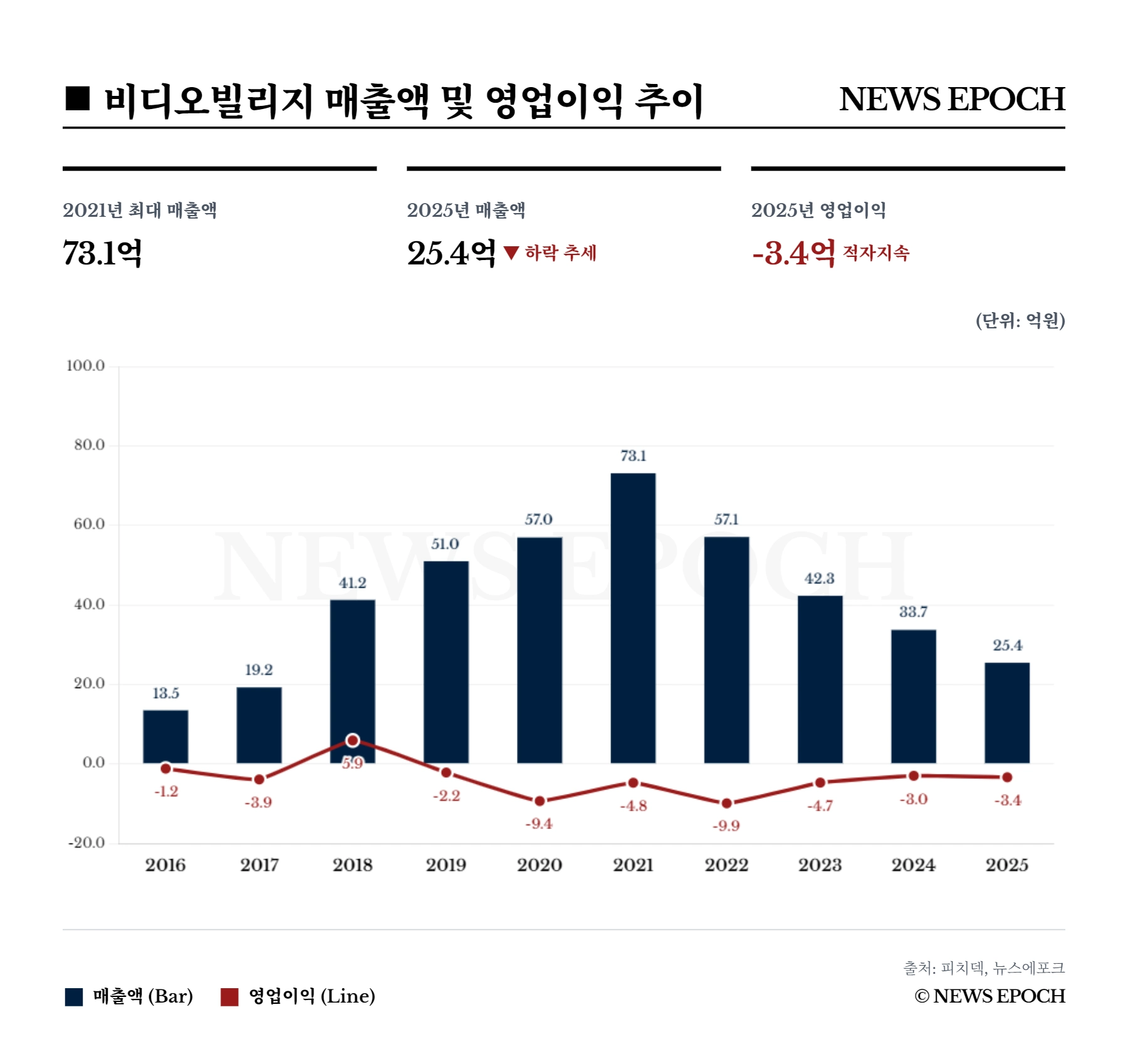
Looking at the profit and loss over the past 10 years, revenue grew from 1.3 billion won in 2016 to 7.3 billion won in 2021, but revenue has continuously declined since then. From a profit and loss perspective, excluding just one instance (2018), the company has recorded operating deficits for 9 of the past 10 years from 2016 to 2025, struggling to secure profitability.
Rapid negative growth in external size... Concerns over loss of business model competitiveness
The most concerning aspect is the rapid negative growth in external size, which can be considered the basic physical strength of a company. The revenue, which peaked at approximately 7.31 billion won in 2021, was slashed to a third, at about 2.54 billion won as of 2025, in just four years. This goes beyond a temporary market slump or a simple failure in cost control, and is a part from which it can be inferred that the market competitiveness of Video Village's business model itself is gradually being lost amidst changes in the new media ecosystem.
The company did not just stand by and watch this crisis. It appears that they carried out bone-crushing, high-intensity restructuring to prevent the entrenchment of structural deficits. Looking at the breakdown of selling, general and administrative (SG&A) expenses, costs that were approximately 1.51 billion won (1,513,855 thousand won) in 2021 were drastically reduced to approximately 770 million won (772,160 thousand won) in 2025. Despite efforts to shed nearly half of fixed costs such as labor costs and commission fees, the top-line (revenue) decline was so steep that it was difficult to turn a profit even with reduced fixed costs. Currently, as of 2026, the number of Video Village executives and employees is identified to be less than 10, indicating that the strategy of reducing the deficit margin by cutting labor and general costs has already reached its limit.
Severe liquidity depletion and materialization of partial capital impairment
The most serious and urgent problem Video Village currently faces is extreme liquidity depletion. 'Cash and cash equivalents,' which stood at approximately 440 million won at the end of 2021, have plummeted steeply every year, amounting to a mere 5 million won at the end of 2025. A cash reserve of 5 million won could mean a situation where it is difficult to smoothly execute even the company's daily working capital settlements or short-term debt repayments.
On top of this, even partial capital impairment, the last line of defense for financial soundness, has approached right under its chin. As of the end of 2025, total equity is approximately 680 million won, whereas capital stock is about 640 million won. The difference (buffer) between the two items is a mere 40 million won. Considering that the net loss incurred just in the single year of 2025 amounted to approximately 340 million won, there is a high possibility that the company will fall into a state of 'partial capital impairment' right from the first half of 2026.
The only breakthrough for survival is 'revenue growth'
In summary, Video Village is currently in a borderline situation where its survival strategy of squeezing costs to hold on is no longer effective. If revenue drops further from its current level, the company could fall into an irreversible financial crisis. Moreover, given the currently chilled conditions of the MCN industry, it is not easy to expect large-scale investment attraction from the outside. Only 'revenue growth' through a solid reconstruction of its business model is the sole way to overcome the current crisis.
It brings great sadness to see that Video Village, which once boldly threw down the gauntlet to change the rules of the game in the 1st-generation MCN market with fresh planning ability and youthful passion, is currently driven into a marginal situation right before capital impairment, with its cash reserves virtually completely depleted at 5 million won.
Company financial data, investment reports, and startup analysis — all in one place
Explore PitchdeckCurated news, every week — straight to your inbox
Every Friday · Unsubscribe anytime