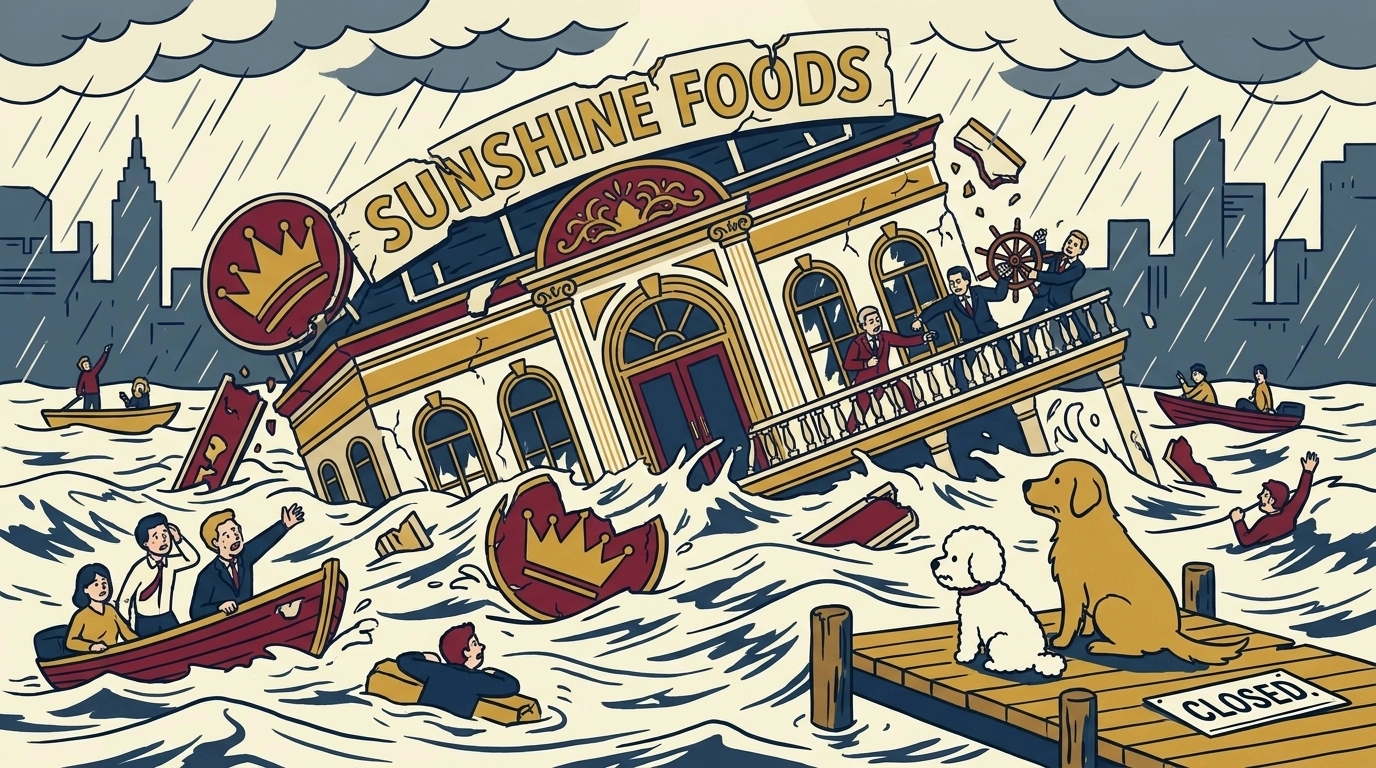
Leading the domestic dining trend with a variety of brands ranging from Korean food like Yeon-an Sikdang, Baekjewon, Mapo Galmaegi, and Gonghwachun, to Japanese, Chinese, and Western cuisines, Sunshine Food (formerly Didim E&F) has ultimately been expelled from the capital market. After flourishing following its KOSDAQ listing in 2017, the company received a final delisting decision in May 2026 amid a collapsed governance structure and severe financial difficulties. Recently, it has been confirmed that the franchise registrations of its major brands were also voluntarily canceled en masse, requiring the attention of the remaining franchisees.
The Crisis Triggered by COVID-19, Structural Deficits, and Complete Capital Impairment
Sunshine Food's crisis began in earnest with the COVID-19 pandemic in 2020. The large-scale operating losses that continued since 2020 rapidly deteriorated the company's financial structure. As deficits from operating activities accumulated, the total equity, which was 10.4 billion won in 2022, plummeted to -5.9 billion won as of 2024, falling into a state of complete capital impairment. The insolvency of the headquarters, suffering from financial difficulties, directly led to a sharp decline in the number of directly managed stores and franchise locations, ultimately jeopardizing the very existence of the company.
A Board of Directors Turned into a Stage for Management Control Speculation, a Collapsed Governance Structure
Behind the financial deterioration lies the core issue of a governance structure that drifted after losing its owner. After founder and former CEO Lee Beom-taek sold the company to Jeongdam Retail in 2021, the largest shareholder changed several times due to unreasonable leveraged buyouts and forced liquidations, making the company's management control extremely unstable.
In particular, in 2023, individual investor Kim Sang-hoon (aka 'Adventurer') invested approximately 5.2 billion won to become the largest shareholder, but conflicts with the existing management exploded. At the time, the management forced a capital reduction without compensation, reducing the number of shares to one-tenth without shareholder consent, and subsequently carried out a paid-in capital increase at a bargain price (381 won per share), creating a farce where the position of the largest shareholder was handed over to Hwang Jung-ah for a mere 200 million won. Enraged by this, Kim filed a criminal complaint against the current management and engaged in a legal battle, but ultimately sold off all his holdings during the clearance trading period in April 2026, stepping down while shouldering a massive loss of over 98%. This is why criticism arises that the company degenerated into a board seat squabble and a speculation arena for management control, rather than its main business of dining franchise management.
Delisting and the Voluntary Cancellation of Franchise Business
Amidst this chaos, the company received a disclaimer of audit opinion due to 'uncertainty about its ability to continue as a going concern' in March 2025, resulting in the suspension of stock trading, and was ultimately expelled from the capital market when its delisting was confirmed in May 2026. Sunshine Food, whose liquidity had dried up, faced a bankruptcy filing from its creditors.
The biggest problem is the franchisees who have continued their livelihood trusting the brands. According to the Fair Trade Commission's list of canceled information disclosure registrations in May 2026, Sunshine Food 'voluntarily canceled' the franchise registrations of its core brands—'Yeon-an Sikdang', 'Shin Mapo Galmaegi', 'Gonghwachun', 'Gorae Sikdang', and 'Gorae Gamjatang'—all at once as of May 6. This is interpreted as officially admitting that it has become impossible to perform its role as a normal franchise headquarters and effectively giving up its franchise business.
The results of the management's pursuit of private interests and irresponsible governance disputes were devastating. Behind the lonely exit of a giant franchise that once led the South Korean dining industry lies the tears of franchisees who are on the verge of losing their livelihoods with only the trademark rights left behind. It is a time when attention and countermeasures are needed to ensure that the damage to innocent franchisees caused by this incident is minimized.
Company financial data, investment reports, and startup analysis — all in one place
Explore PitchdeckCurated news, every week — straight to your inbox
Every Friday · Unsubscribe anytime