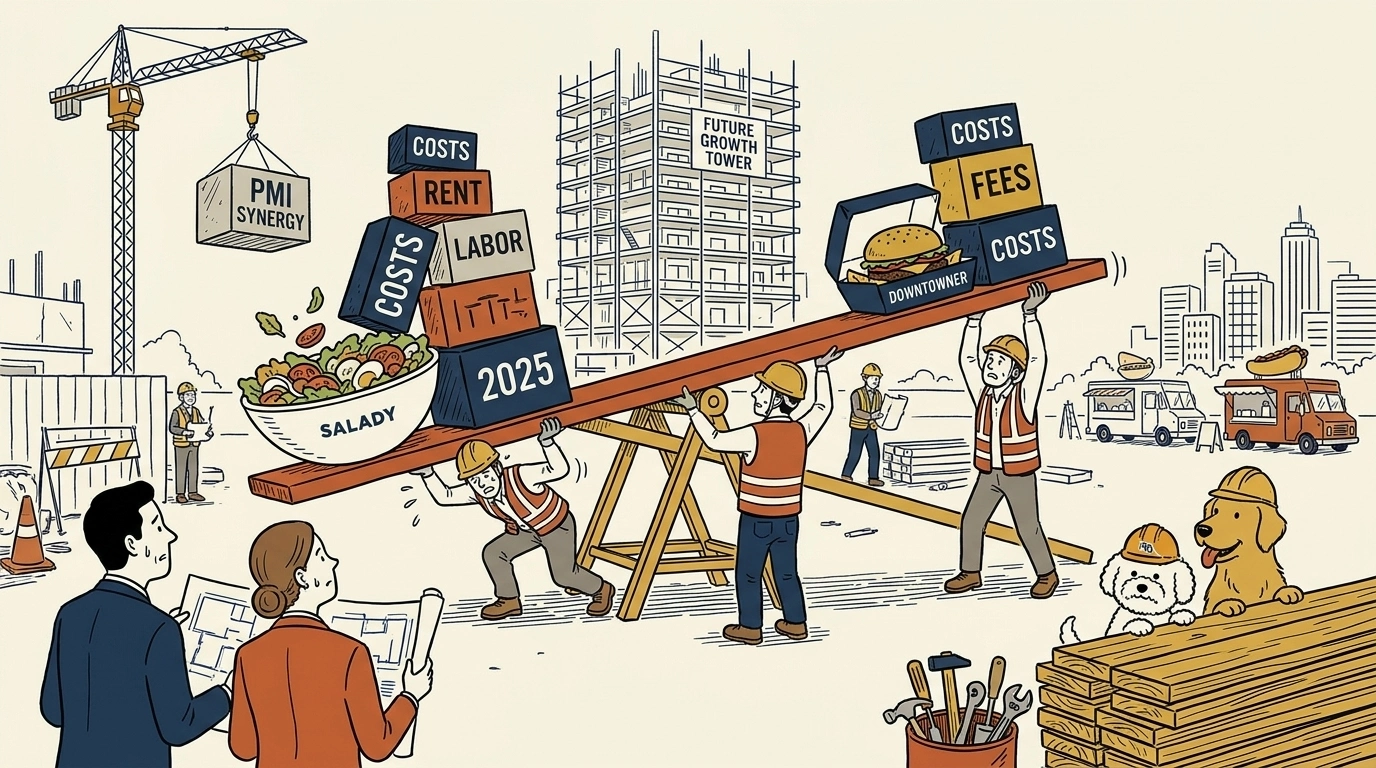
Korea's No. 1 salad franchise 'Salady' and premium handmade burger brand 'Downtowner' have recently taken a breather in performance as both turned to a deficit. Backed by private equity fund (PEF) Highland Equity Partners, Salady embraced Downtowner to expand its outward growth, but both companies have faced the challenges of a substantial increase in costs and a decline in profitability. Moving forward, meticulous liquidity management and whether they can achieve full-scale post-merger integration (PMI) and synergy creation are expected to serve as the key testing ground that will determine the future of the two companies.
The Meeting of Salady and Downtowner, PEF's 'Bolt-On' Strategy
Established in 2013, Salady is an F&B company that has established itself as the No. 1 player in the domestic salad market based on a solid supply chain, building automated pre-processing factories for fresh vegetables and dedicated farms. Highland Equity Partners, which acquired management rights to Salady in 2023, actively pursued a 'Bolt-on' strategy of acquiring additional similar food and beverage companies to overcome the limitations of a single brand and maximize corporate value.
As a result, in December 2024, Salady utilized its own retained funds to acquire an 80% stake in Downtowner, a handmade burger brand, from its existing shareholder GFFG for approximately KRW 8 billion. Launched in 2016, Downtowner is a brand that has gained massive popularity among the MZ generation, spearheaded by its avocado burgers. Salady drew up a blueprint to leap forward as a comprehensive F&B company with simple combined sales of over KRW 50 billion by combining its systematic supply chain know-how with Downtowner's trendy brand power.
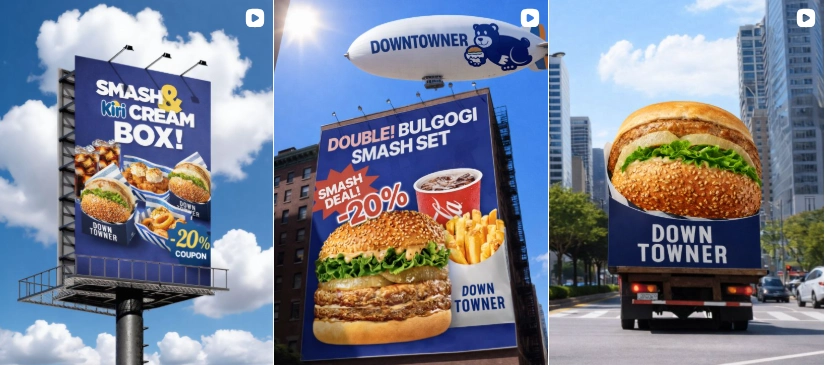
[Source: Downtowner Instagram]
Stagnation After Rapid Growth... 2019-2025 Profit and Loss Flow
However, the two companies, which formerly boasted steep outward expansion, are currently showing a trend of slowing profitability amidst shrinking consumer sentiment and intensifying competition in the food service industry.
Downtowner's sales grew at a frightening pace, starting at the KRW 900 million level in 2019 and peaking at KRW 10.9 billion in 2021 and KRW 15.5 billion in 2022. However, it experienced a slight period of stagnation in 2023 (KRW 12.3 billion) and 2024 (KRW 12.4 billion), and its volume slightly rebounded to KRW 13.1 billion in 2025. Despite the rebound in sales, profitability deteriorated, with the operating profit of KRW 800 million in 2021 turning into an operating loss of KRW 1.6 billion in 2025, recording a net loss of KRW 1.7 billion. As a result, its cash holdings, which amounted to KRW 2.3 billion in 2024, significantly decreased to KRW 400 million in 2025.
Salady is also in a similar situation. On a separate basis, sales trended upward from KRW 6.5 billion in 2019 to KRW 31.1 billion in 2022 and KRW 37.1 billion in 2024, achieving explosive growth. In particular, it enjoyed its heyday in 2022 by recording an operating profit of KRW 4.2 billion. However, entering 2025, the growth trend faltered as sales decreased by approximately 4.4% year-on-year to KRW 35.5 billion, and operating profit turned into a deficit with a loss of KRW 500 million. In addition to this, massive equity impairment losses were added, leaving a disappointing report card of a staggering KRW 6.4 billion in net loss.
The Inside Story of Downtowner's Cost Increase and the Burden of SG&A Expenses on Salady's Main Business
The background to Downtowner's turn to deficit in 2025 is a complex entanglement of accounting cost reclassification and a substantial increase in costs. Until 2024, most (KRW 12.3 billion) of the KRW 12.4 billion in sales was recognized as merchandise sales, and major operational costs such as store labor costs and rent were treated as selling, general, and administrative (SG&A) expenses (KRW 8 billion). In contrast, in 2025, as the revenue structure was reorganized centering on product sales (KRW 12.9 billion), a massive amount of labor costs that had previously been grouped as SG&A expenses was incorporated into the cost of product sales (KRW 11.5 billion). Because of this, Downtowner's SG&A expenses in 2025 outwardly appear to have plummeted to KRW 3.1 billion.
Excluding this reclassification effect, the main cause that substantially lowered profitability is the simultaneous rise in commission fees and raw material costs. Among the detailed items within SG&A expenses, commission expenses sharply increased from KRW 380 million in 2024 to KRW 1.82 billion in 2025. This is the result of reflecting infrastructure construction for developing the franchise business following Salady's acquisition, delivery platform commissions, and consulting fees. Although a portion of these commissions (KRW 450 million) flowed into the parent company Salady, creating an effect where the subsidiary's expenses partially compensated for the parent company's sales, this benefit was offset as the scale of Downtowner's own loss grew.
The parent company, Salady, also struggled to control costs in its main business. While sales decreased, SG&A expenses increased by approximately 24.2% from KRW 7.4 billion in 2024 to KRW 9.2 billion in 2025. This was largely due to an 82% surge in advertising and promotional expenses from KRW 1.7 billion in the previous year to KRW 3.1 billion, as costs were intensively executed on marketing to defend sales.
Moreover, the biggest factor that expanded the size of the net loss was the recognition of a massive impairment loss on the subsidiary's stake. Conservatively reflecting the decline in the subsidiary's value due to sluggish performance after acquiring the stake in Downtowner, Salady wrote off KRW 5.6 billion of the book value all at once in accounting as 'impairment loss on investments in associates' during the 2025 financial settlement. The scale of the equity impairment loss reflected in the accounting accounted for a significant portion of the total deficit, rather than the operating loss of the main business.
Securing Financial Soundness and Materializing M&A Synergy are the Keys
The stagnation in performance is also having a chain effect on the financial structures of both companies. Salady's current liabilities jumped significantly from KRW 6.7 billion in 2024 to KRW 12 billion in 2025. As investment funds such as the acquisition of Downtowner and the provision of loans were required, short-term bank loans were actively utilized, resulting in a surge in short-term borrowings from KRW 1.8 billion to KRW 8 billion. The cash flow from operating activities in 2025 also turned into an outflow of KRW 1.5 billion, making the improvement of cash flows urgent.
Preparation for potential contingent liability risks is also required. Salady is currently providing a joint guarantee up to a limit of approximately KRW 2.4 billion on Downtowner's bank borrowings. Furthermore, there is a put option (right to claim stock purchase) agreement attached to the remaining 20% stake held by Downtowner's existing shareholder (GFFG) that is exercisable after December 2026, so there is a possibility that an additional cash outflow of at least KRW 2 billion may occur upon exercise.
The industry points out that in order for the two companies to overcome their current growing pains and leap forward, they must prove the synergy of a full-scale integration. The fortunate point is that Downtowner has been full-fledged in its franchise business since June 2025 and is actively utilizing Salady's know-how and food ingredient supply chain to enhance business stability. The market's attention is focused on whether Downtowner, which has met a new owner, and Salady, which has thrown the gamble of outward expansion, will be able to prove the true value of M&A through efficient cost control and preemptive liquidity management rather than excessive marketing.
Company financial data, investment reports, and startup analysis — all in one place
Explore PitchdeckCurated news, every week — straight to your inbox
Every Friday · Unsubscribe anytime