
Comprehensive entertainment company 'Antenna', founded by CEO Yoo Hee-yeol in 1997 and currently home to widely loved major artists such as Yoo Jae-suk, Lee Hyo-ri, and Jung Seung-hwan, has been put to a crucial test of improving its financial soundness. As the company recently entered a state of capital impairment, turning on warning lights for its liquidity indicators, the auditing firm has mentioned uncertainties regarding the company's ability to continue as a going concern, drawing the industry's attention to the company's future response plans and potential cooperation from its parent company, Kakao Entertainment.
Concerns Over Profitability Behind Outward Growth
Looking at the overall trends of Antenna's revenue and operating profit/loss over the past four years, the concerns the company is facing between external growth and defending profitability are clearly revealed.
In 2022, Antenna recorded revenue of KRW 20.78 billion and an operating loss of KRW 50 million. In 2023, despite posting revenue of KRW 21.94 billion, the operating loss somewhat expanded to KRW 2.02 billion. Subsequently, in 2024, as the activities of major artists kicked into high gear, revenue grew significantly to KRW 38.92 billion, and the company barely succeeded in turning a profit with an operating income of KRW 50 million.
However, entering 2025, total revenue fell year-on-year to KRW 33.01 billion, and the company swung back to a deficit, recording an operating loss of KRW 2.08 billion. Not only the profit and loss on the books, but also the cash flow from operating activities, which shows the company's actual cash-generating ability, showed a continuous downward trend from KRW 5.08 billion in 2022, to KRW 3.49 billion in 2023, KRW 990 million in 2024, and down to the level of KRW 270 million in 2025.
Behind this overall performance trend lie structural factors unique to the entertainment industry.
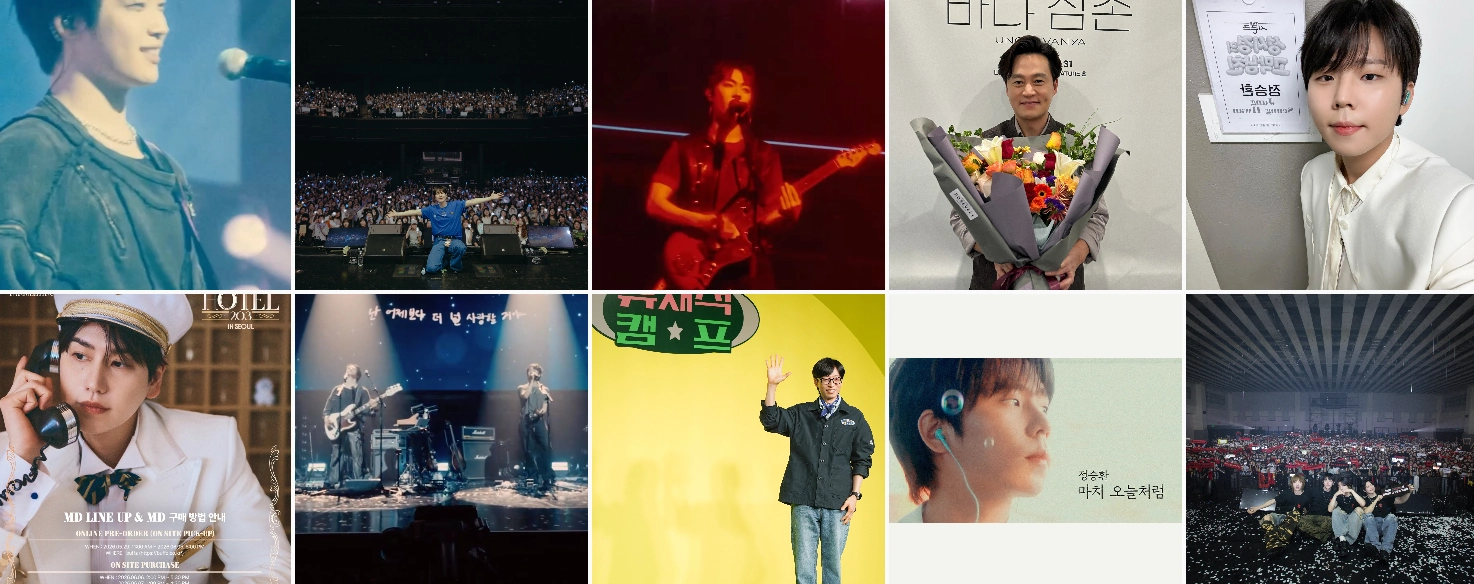
[Source: Antenna Website]
Volatility of 'Advertising Revenue' According to Artist Activities
The volatility of advertising revenue, which accounts for a large pillar of Antenna's sales, is being pointed out as the cause of this deficit. Antenna's advertising revenue surged by more than KRW 10 billion from KRW 9.01 billion in 2023 to KRW 19.25 billion in 2024, reflecting the effect of recruiting top-star artists such as Yoo Jae-suk. The year 2024 is seen as the year when the effects of recruiting Yoo Jae-suk and others were reflected in earnest, and as a result, Antenna's surplus in '24 was also primarily driven by this rapid growth in advertising revenue.
However, advertising revenue in 2025 was KRW 14.03 billion, sharply decreasing by about KRW 5.22 billion in just one year, affecting the company's overall performance. This shows that the company's revenue scale can fluctuate significantly depending on whether its affiliated artists renew their advertising contracts or their activity cycles.
Profit Settlements Exceeding Half and Downward Rigidity of Fixed Costs
The 'profit settlement' item, which is a core operating expense for entertainment companies, is also a factor making it difficult to secure profitability. The profit settlement amount that Antenna distributed and paid to artists after generating revenue reached KRW 18.75 billion as of 2025. This ratio approaches about 56.8% of the total revenue for the year (KRW 33.01 billion), which, if compared to the manufacturing industry, means a cost of goods sold ratio of 56%.
Furthermore, despite revenue decreasing by about KRW 5.91 billion year-on-year, costs showed downward rigidity, not decreasing flexibly. In fact, fixed-cost expenses including severance pay actually increased, such as salary expenditures rising from KRW 2.81 billion in 2024 to KRW 3.33 billion in 2025, thereby widening the scope of the shift to a deficit. In a situation where the cost ratio (artist profit settlement) is fixed (by contract), if SG&A expenses also have downward rigidity, the only way to maintain a surplus is to significantly increase revenue.
Worsening Liquidity Indicators and Auditing Firm's Mention of 'Going Concern Uncertainty'
Along with capital impairment, liquidity indicators are also in need of improvement. As of the end of 2025, Antenna's current assets were KRW 8.97 billion, while its current liabilities to be repaid within one year reached KRW 19.21 billion. This means current liabilities exceeded current assets by approximately KRW 10.24 billion.
Synthesizing these indicators, the accounting firm that audited Antenna stated objective facts through the notes in the 2025 audit report, saying, "Antenna's current liabilities exceed its current assets by KRW 10.24 billion and its accumulated deficit has reached KRW 5.85 billion, raising significant doubts about its ability to continue as a going concern."
Amid Kakao Entertainment's Capital Infusion... Extension of CEO Yoo Hee-yeol's Loan Maturity Leaves 'Regret' Over Liquidity
Even amidst financial challenges, Antenna partially resolved the market's short-term fund repayment concerns. This is because it put out the immediate fire by deciding to extend the maturity of a KRW 8.1 billion short-term borrowing from its parent company, Kakao Entertainment, by one year to April 29, 2027, from the original maturity of April 2026.
However, separately from this, financial transactions with the management leave something to be desired in terms of the company's liquidity. Antenna disclosed maturity extensions for the funds (loans) lent to CEO Yoo Hee-yeol, in two tranches due in April and May 2026. CEO Yoo has repaid part of the existing loan, but the repayment deadline for the remaining balance of KRW 880 million that still needs to be repaid to the company has been pushed back. From the perspective of a company in a state of capital impairment, it means that an immediate cash inflow has been delayed, so attention to cash flow management seems necessary until a solid revenue model, such as strengthening the artist lineup, is established.
Attention is focused on whether it can improve profitability by putting activities into high gear based on its solid lineup of artists representing South Korea, and achieve a healthy leap forward as a substantial agency once again, using its current growing pains as a stepping stone.
Company financial data, investment reports, and startup analysis — all in one place
Explore PitchdeckCurated news, every week — straight to your inbox
Every Friday · Unsubscribe anytime