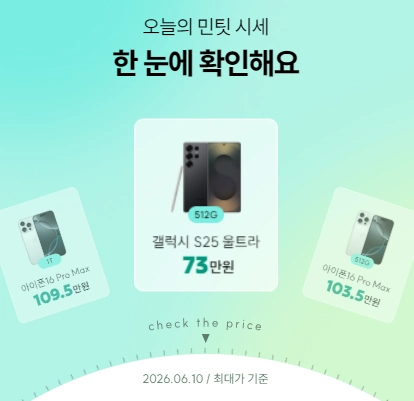
As the burden of household communication expenses increases due to the continuous rise in smartphone factory prices, consumers are flocking to the used phone market in large numbers. The global used phone industry is steadily growing to a size of over 100 trillion won annually, surpassing the growth rate of new products. However, the domestic used phone market lacks a credible quality certification system and suffers from significant information asymmetry, failing to shake off the stigma of being a 'lemon market' where only low-quality goods are distributed. In particular, consumer damage has rapidly increased recently due to a series of long-term non-delivery and non-refundable incidents at some small businesses that sold used phones through SNS group purchases, indicating that the market's trust infrastructure cannot keep pace with its growth.
Amidst this absence of trust, the company that sought to create a transparent distribution structure spearheaded by its artificial intelligence (AI)-based unmanned purchasing machine 'MINTIT ATM' was SK Networks' subsidiary, MINTIT (formerly Geumkang Systems). However, SK Networks recently shifted its vision to an 'AI-centric business holding company' and sold a 90% stake in MINTIT to private equity fund (PEF) operator T&K Private Equity (T&K PE) for 45 billion won as part of its rebalancing of non-core assets.
The Crisis Following Explosive External Growth, and the Dramatic Turnaround to Profitability
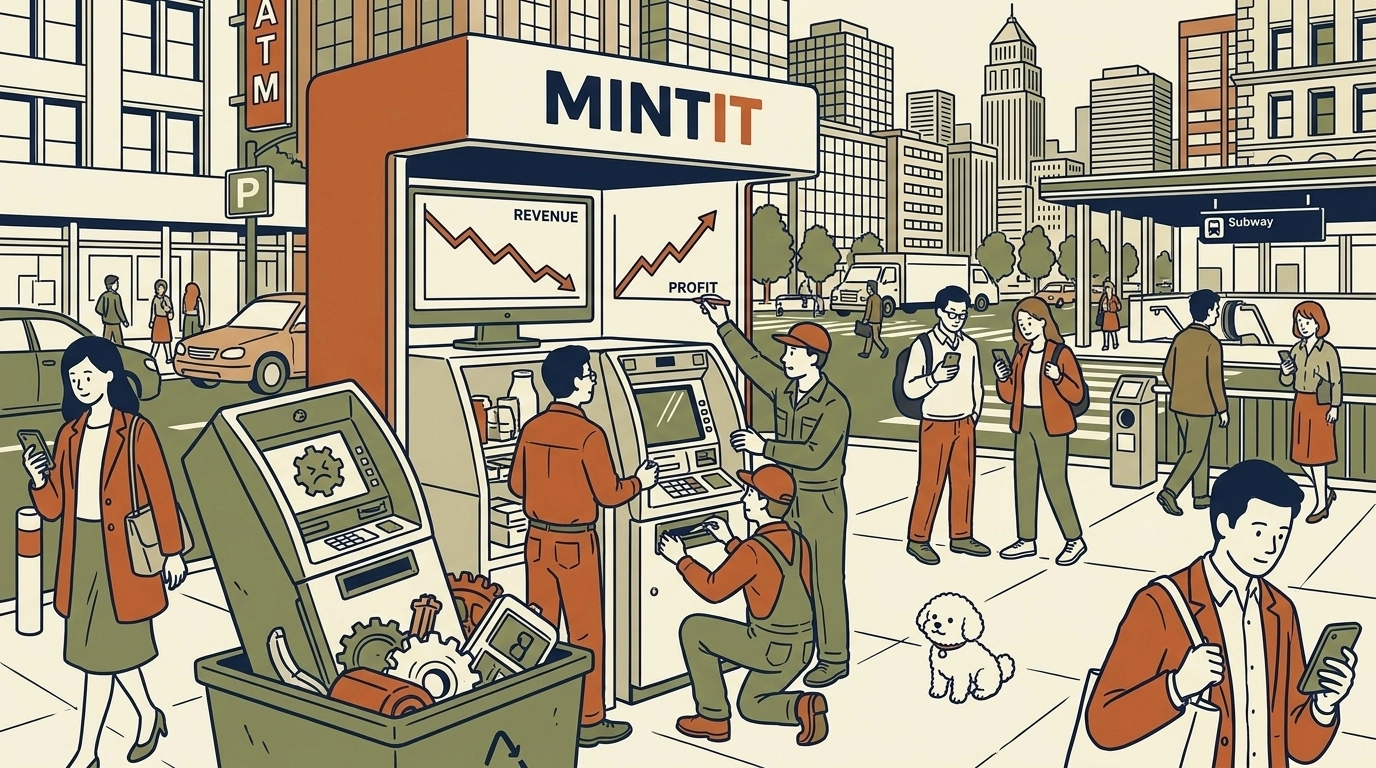
MINTIT achieved explosive external growth before and after its spin-off. Its sales, which were at the level of 46.6 billion won in 2020, expanded in size every year to 157.5 billion won in 2021, 170.3 billion won in 2022, and 179.5 billion won in 2023. However, behind the growth lay a quagmire of slowly accumulating deficits. Particularly in 2024, despite generating a massive sales revenue of 172.9 billion won, it suffered a fatal blow by recording an operating loss of approximately 11.1 billion won and a huge net loss amounting to 11 billion won. However, right before the sale in 2025, MINTIT succeeded in a dramatic turnaround to profitability by recording an operating profit of approximately 700 million won and a net profit of 970 million won, even though its sales shrank significantly year-on-year to 96.3 billion won. This was the result of a 'survival-oriented' structural improvement that squeezed out profits through intensive restructuring instead of pursuing external expansion.
[Source: MINTIT Website]
Significant 7.9%p Improvement in Gross Profit Margin (GPM) by Clearing Out Low-Profit Transactions
The core background for achieving profitability despite the halving of sales is the reorganization of the business structure centered on margin rates. In 2025, the gross profit decreased to 21.6 billion won compared to the previous year (25.1 billion won), but the gross profit margin (GPM) against sales actually rose significantly by 7.9%p, from 14.5% to 22.4%. This is presumed to be the result of boldly cutting off large-scale bulk (wholesale/large) transactions with low profitability and optimizing the portfolio focusing on distribution channels with high margins, such as domestic retail recycling.
High-intensity cost control is also a primary factor in the return to profitability. MINTIT slashed its SG&A expenses, which had reached 36.3 billion won, by a whopping 42.4% to 20.9 billion won in just one year. Breaking it down by category starkly reveals how intense a restructuring the company went through. Salaries and severance pay expenditures, which account for the largest portion, plummeted by about 47% from 8.73 billion won to 4.64 billion won, indicating that large-scale workforce reductions or business division downsizing were carried out.
Scars That Still Remain... 7.8 Billion Won in Punitive Deficit and the Write-Off of Non-Performing Assets
Although the company took a breather by recording a net profit of 970 million won, the aftereffects of its past reckless external expansion still remain throughout its financial statements. Currently, MINTIT has accumulated a punitive undisposed accumulated deficit amounting to 7.84 billion won. With its capital stock being a mere 640 million won, it could have fallen into a severe financial crisis, but thanks to 37.5 billion won in capital surplus secured in the past (such as in 2021), it is in a precarious state barely avoiding formal capital impairment. Furthermore, a 'big bath' to shake off non-performing assets also continued. In the previous term (2024), it massively wrote off assets by recognizing 670 million won in impairment loss on tangible assets and 520 million won in impairment loss on intangible assets, and in the current term (2025), it initiated liquidation procedures for its Vietnamese subsidiary (MINTIT VINA) and cleared out 480 million won in impairment loss on investments in subsidiaries as a non-operating expense.
The New Future to be Drawn in the Arms of T&K PE
Now, the eyes of the market are turning to the value-up strategy of MINTIT's new owner, T&K PE. It is observed that T&K PE will aim for strong business synergy with a company specializing in used phone repair and refurbishment that is already included in its existing portfolio. Currently, the Korean used phone market is full of distrust regarding quality due to the absence of an officially certified refurbishment system. If MINTIT takes the massive volume of used smartphones collected through its ATM network with nationwide coverage and brings them to the market as 'high-quality refurbished phones' after passing through the advanced repair process possessed by Ecomax, it can instantly secure quality credibility and create high added value.
MINTIT, which suffered the shock of a massive deficit in the past while focusing on unreasonable external expansion as a subsidiary of a major conglomerate, has recently rekindled the spark of profit generation through a grueling streamlining process. Market attention is focused on whether MINTIT, newly reorganized under a private equity fund system in 2026, can purify the distrustful domestic 'lemon market' of used phones and achieve a successful sophistication of its profit model through partnerships with its affiliates.
Company financial data, investment reports, and startup analysis — all in one place
Explore PitchdeckCurated news, every week — straight to your inbox
Every Friday · Unsubscribe anytime