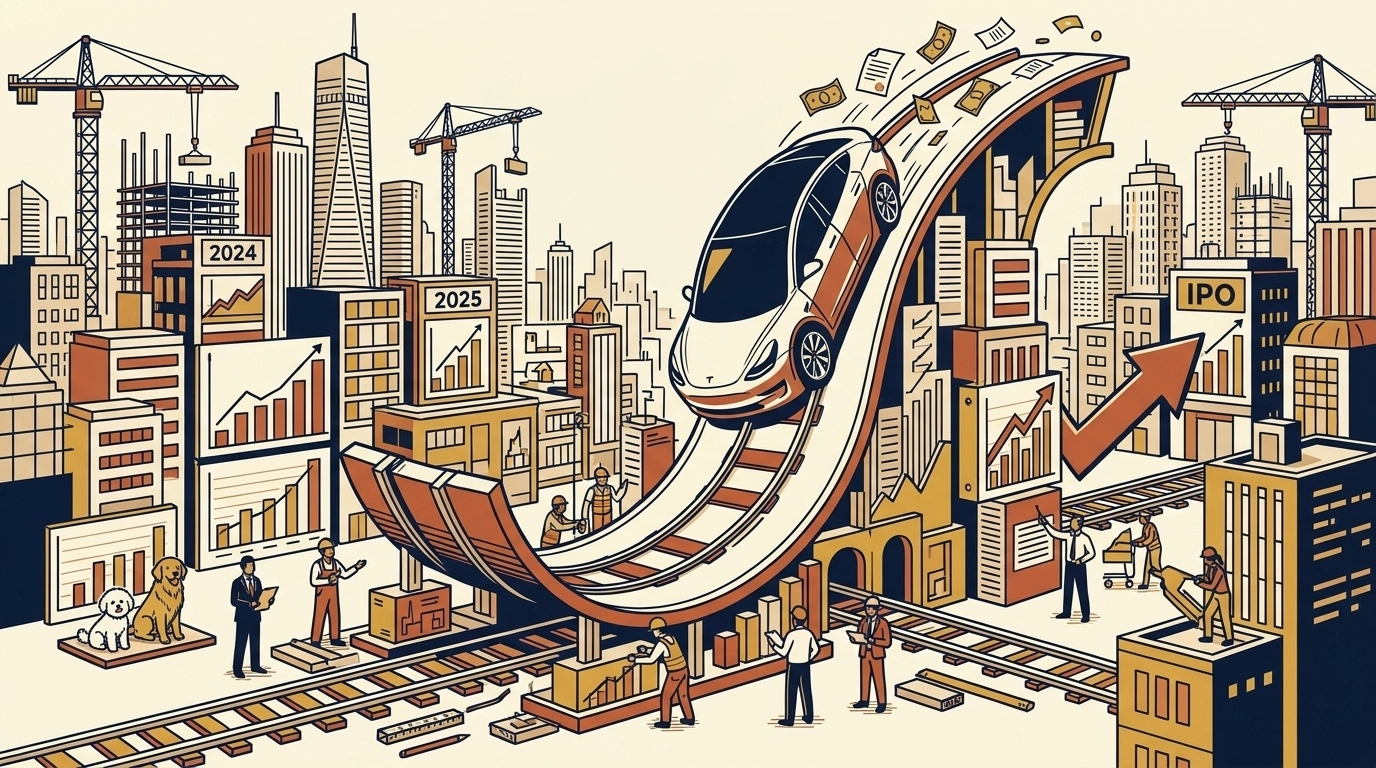
The attention of the capital market is focused on Ride, an auto commerce platform company that has recently selected Shinhan Securities as its KOSDAQ listing underwriter and embarked on a full-scale initial public offering (IPO) process. This is because the company has passed the initial deficit stage since its establishment and laid the foundation for a turnaround to an operating profit surplus along with explosive external growth, properly demonstrating the so-called 'J-curve,' which is the textbook example of startup growth.
A comprehensive mobility innovation company encompassing the automobile life cycle
Ride may still be unfamiliar to the public, but it is a promising company that is changing the paradigm of the automobile distribution and management market. Established in 2020 by CEO Lee Min-chul, a former Tesla Korea employee, the company grew starting with the non-face-to-face new car test drive platform 'Ride Now'.
Currently, Ride has evolved beyond a simple test drive app into an integrated auto commerce platform that provides the entire automobile life cycle at once, from new car test drives to purchasing, visiting maintenance, and automobile finance. In particular, in 2023, it successively acquired 'Sky Auto Service', a vehicle maintenance specialist, and 'GMC', an automobile education and consulting company, overcoming the limitations of an online platform and securing offline maintenance infrastructure. Based on this online and offline convergence competitiveness, it is collaborating with domestic and foreign automobile brands such as KGM and Polestar Korea, expanding its supply chain across both B2B and B2C sectors.
[Source: Ride Homepage]
The 5-year trajectory, explosive 'J-curve' growth proven by numbers
Looking at Ride's financial trajectory, one can see the typical monetization process of a successful platform business.
In 2021, when the initial business foundation was being laid, Ride's revenue was only 190 million won, and it recorded an operating loss of 170 million won and a net loss of 180 million won. In the following year, 2022, revenue slightly increased to 320 million won, but due to the increase in costs for infrastructure construction and service expansion, the operating loss and net loss expanded to 1.22 billion won and 1.23 billion won, respectively. In 2023, although revenue jumped significantly to 3.39 billion won, it recorded an operating loss of 1.5 billion won and a net loss of 1.82 billion won, showing a financial pattern typical of an initial investment stage.
However, starting in 2024, Ride's performance achieved a quantum leap. In 2024, revenue exploded more than sixfold year-on-year to 21.74 billion won, and as its external size grew rapidly, its operating loss plummeted to 270 million won and net loss to 520 million won, turning on the green light for a surplus turnaround. Finally, in 2025, Ride achieved phenomenal results of 82.98 billion won in revenue, showing the potential of nearly quadrupling its revenue in just one year. As a result, it generated an operating profit of 180 million won and finally succeeded in turning to a surplus.
The core secret of the surplus turnaround: Fixed cost control and maximization of operating leverage
Behind this profitability improvement lie strict control over SG&A (Selling, General and Administrative) expenses and the operating leverage effect unique to the platform business.
First, based on the 2023 standard, the cost of sales began to maintain a stable cost ratio at approximately 80% compared to the revenue of 3.39 billion won. The most prominent aspect is the extremely limited SG&A expense increase rate compared to the explosive revenue growth. While revenue surged about fourfold from 21.74 billion won in 2024 to approximately 83 billion won in 2025, SG&A expenses only increased by a mere 4.5%, from 7.28 billion won to 7.61 billion won.
In particular, it is noticeable that labor-related expenditures, which have a strong fixed cost nature, decreased by nearly half from 4.84 billion won in 2024 to 2.62 billion won in 2025. This appears to be the result of efficiently controlling fixed cost-type expenses such as salaries and rent after the initial platform infrastructure construction and core personnel deployment were completed. In other words, the 'operating leverage effect' unique to the platform business, where increased revenue directly leads to the maximization of operating profit without additional cost expenditures, is being fully realized.
Solid basic fundamentals, future task is 'advancement of financial soundness'
Even amidst explosive growth, Ride has stockpiled a significant portion of its assets as cash and cash equivalents (approximately 2.29 billion won as of 2025), possessing excellent basic fundamentals that allow it to respond agilely to future additional R&D, marketing, or market changes.
However, stable cash flow management for trade receivables (KRW-denominated trade receivables of approximately 5.64 billion won at the end of 2025), which rose along with the external expansion, is an important task to manage in the future. In addition, it is analyzed that if the company successfully leads a paid-in capital increase at an appropriate time or a debt-to-equity swap of previously issued convertible bonds (CB) worth 1.99 billion won to escape the partial capital impairment status currently shown on the books, it will be able to build even more perfect financial stability.
Ride aims to enter the stock market in 2027. Having successfully settled into the trajectory of 'J-curve' growth after passing through the swamp of initial deficits, they have taken the first step by selecting a listing underwriter, and attention is focused on what kind of innovation they will continue to bring to the mobility distribution market in the future.
Company financial data, investment reports, and startup analysis — all in one place
Explore PitchdeckCurated news, every week — straight to your inbox
Every Friday · Unsubscribe anytime