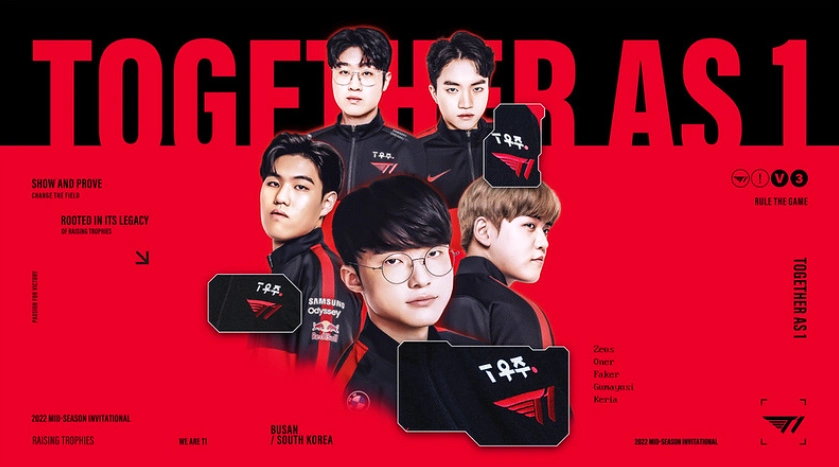
Where the former 'StarCraft Emperor' Lim Yo-hwan once belonged, and where Lee 'Faker' Sang-hyeok, considered the world's best pro gamer, currently plays, SK Telecom CS T1 (hereafter T1) is a global e-sports team boasting such unrivaled awareness that even overseas it is said, "People might not know SK Telecom, but they know T1."
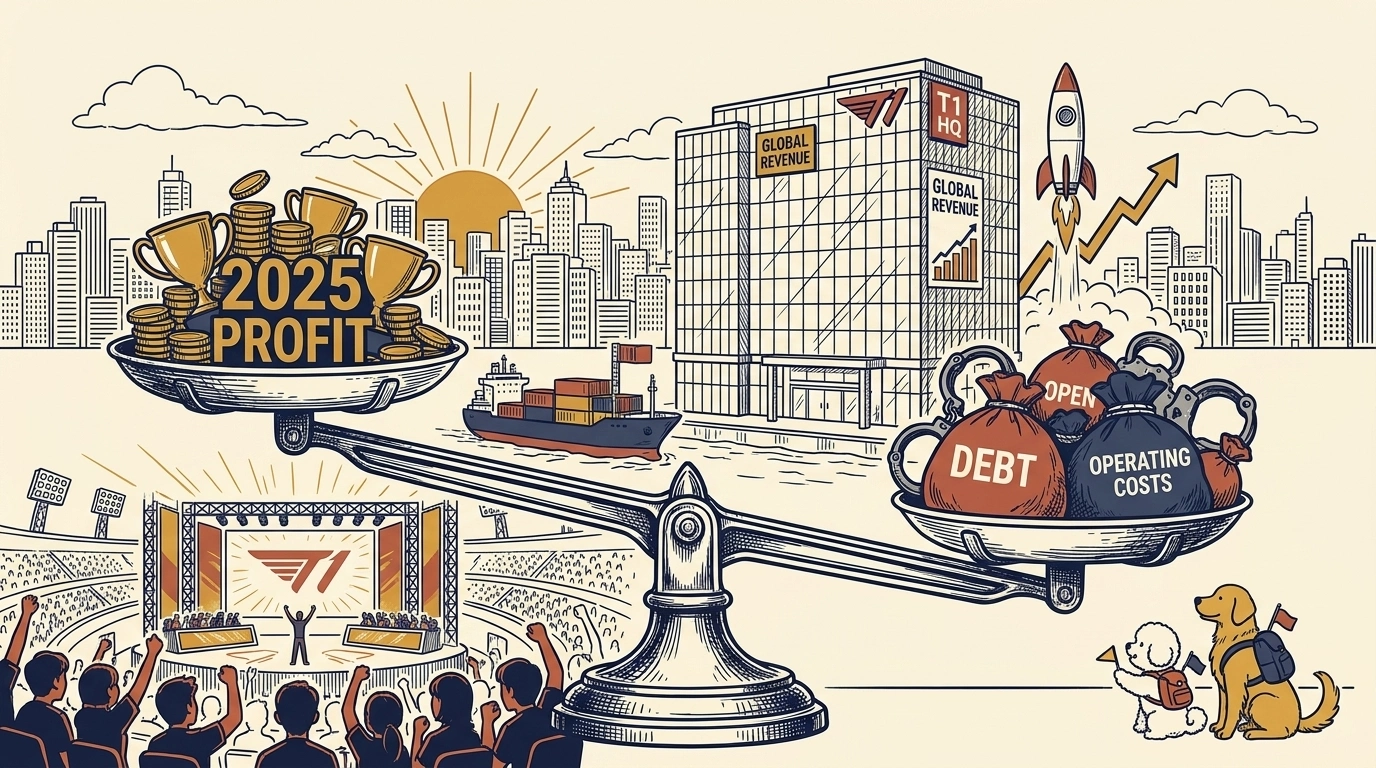
Founded by SK Telecom in 2004, T1 was initially a 'low-cost marketing tool' that could be operated at a relatively small expense. However, as League of Legends (LoL) became a global hit and the salaries of pro gamers skyrocketed into the billions of won, the team's operating costs also increased explosively. Bearing the burden of massive operating costs and consistently receiving capital injections through paid-in capital increases, T1 finally succeeded in turning a profit in 2025, setting a financial milestone. However, securing complete self-sustainability and addressing the losses of overseas subsidiaries are pointed out as core challenges to be resolved in the future.
Breaking the Chronic Deficit and Achieving an 'Earnings Surprise'
The flow of sales and profit from 2020 to 2025 can be summarized as 'explosive top-line growth and dramatic profitability improvement.' T1's operating revenue (sales) drew a steep upward curve every year, recording 12.47 billion won in 2020, 18.51 billion won in 2021, 22.72 billion won in 2022, 32.82 billion won in 2023, and 49.03 billion won in 2024. However, until 2024, it could not avoid massive annual operating losses ranging from 8 billion to 16 billion won due to the skyrocketing salaries of the player roster and the team's operating expenditures.
In 2025, however, the situation reversed 180 degrees. The operating revenue (sales), which was 49.03 billion won in 2024, surged by about 80.8% to 88.64 billion won in 2025, showing fierce growth. Looking at the 2025 sales in detail, domestic sales recorded about 51.78 billion won, and overseas sales recorded about 36.85 billion won, showing that the solid fandom solidarity—such as the distribution of proprietary merchandise through the 'T1 Shop'—directly translated into performance, regardless of whether domestic or overseas.
Driven by this top-line expansion, it also succeeded in turning a profit. T1, which recorded an operating loss of 8.85 billion won in 2024, turned a profit in 2025 by generating an operating profit of 2.51 billion won. The net income also turned positive, shifting from a 6.28 billion won loss to a 1.23 billion won profit, proving its strong revenue-generating ability in its core business.
[Source: SK Telecom CS T1 Homepage]
Significant Decrease in Debt Ratio, but Thin Capital Layer and Limits to Self-Sustainability
Positive changes also appeared in financial health indicators. The debt ratio, which had reached a staggering 1,559.1% at the end of 2024—a crisis of complete capital erosion—decreased by more than half to 713.1% as of the end of 2025. Furthermore, through an amendment to the League of Legends Champions Korea (LCK) team participation contract, it was exempted from the obligation to pay an additional 3.67 billion won that was due in the future, welcoming the favorable news of alleviating a major contingent liability risk.
The company clearly proved its core business competitiveness and sales growth engine as a true global e-sports team in name and reality. However, there is an opinion that the current financial health is closer to a 'virtual fortress' built by continuous capital injections (such as paid-in capital increases and short-term borrowings) from existing shareholders rather than through its own self-sustainability.
As of the end of 2025, out of T1's total assets of 44.39 billion won, total liabilities account for 38.93 billion won, leaving total equity at a mere 5.46 billion won. The capital layer is still very thin. In addition, compared to the cash flow generated by its own operating activities (about 590 million won in operating cash flow in 2025), the scale of expenditure is large, creating a structure where team operations are only possible if paid-in capital increase funds from existing shareholders are consecutively injected, such as in March (about 11.4 billion won) and May (about 5.6 billion won) of 2026.
To overcome this, the company is in the process of conducting a total of three global private placement paid-in capital increases entering 2026. Various investors, including major shareholder 'CS KJV Holdings, LLC', are participating, and among these, the second and third investments utilize a strict milestone method conditioned upon 'meeting financial performance targets for the 2025 and 2026 business years.' Fortunately, thanks to explosive sales growth, it is smoothly securing these conditional investments and overhauling its financial structure.
Unlike the spectacular performance of the headquarters, the overseas business division is in a difficult situation. Its US subsidiary, 'T1 esports US, Inc.', is in a severe state of capital impairment with assets of 1.54 billion won and liabilities of 5.1 billion won, resulting in a net asset of -3.56 billion won. With a net loss amounting to 330 million won annually, the company headquarters eventually recognized an impairment loss on the full book value of its investment shares in this US subsidiary (bringing the book value to 0 won). The deficit in the overseas division is firmly holding back the headquarters.
'Complete Independence' from Shareholder Reliance Needed Going Forward
In conclusion, as a representative team of the e-sports powerhouse South Korea that draws the attention of fans worldwide beyond Korea, T1 has successfully escaped the swamp of chronic deficits by leveraging its formidable core business competitiveness.
The key focal point that the e-sports industry and market should watch in the future will be "how they will restructure and improve the struggling US subsidiary based on the approximately 17 billion won in capital increase funds flowing in successively in 2026, and ultimately when they will complete a self-sustaining financial structure that generates cash on its own without the help of shareholders." This is a time when T1's future performance is even more anticipated.
Company financial data, investment reports, and startup analysis — all in one place
Explore PitchdeckCurated news, every week — straight to your inbox
Every Friday · Unsubscribe anytime