
Makestar is an entertainment platform startup established in 2015 that connects global fandoms with domestic artists. Its main businesses include album and music video production, as well as the sales and crowdfunding of fan meetings (concerts, signing events, etc.) and photobooks (including photo cards). In particular, it has established itself as a powerhouse K-pop platform by scoring successive hits with its 'Poca Album,' which allows users to enjoy digital content via QR codes or NFC instead of physical CDs. It is solidifying a robust position in the global market, to the extent that a significant portion of its total sales is generated overseas.
Explosive Top-Line Growth and Large-Scale Investment Attraction... Profitability Also Vastly Improved
Makestar has achieved steady top-line growth over the past five years. Its sales revenue, which was approximately 29.7 billion won in 2021, drew a steep upward curve every year to about 47.9 billion won in 2022, 95.6 billion won in 2023, and 120.3 billion won in 2024. Subsequently, it recorded approximately 129.8 billion won in sales in 2025, firmly proving its independent growth trajectory. Operating profit also saw remarkable achievements in terms of profitability; starting from about 3.5 billion won in 2021, it took a breather at about 700 million won in 2022, 2.9 billion won in 2023, and 1.5 billion won in 2024, before vastly improving to approximately 6.2 billion won in 2025.
Based on these strong results, the company has consistently infused external funds to increase its size. It has continuously attracted investments since its establishment in 2015, and notably in 2024, it succeeded in attracting a large-scale investment of 30 billion won from existing investors such as Altos Ventures and Korea Development Bank, as well as new investors. The estimated enterprise value evaluated during this investment process is around 280 billion won, and the cumulative investment amount attracted to date reaches 55.6 billion won. Total assets, which indicate the company's weight class, have also swelled rapidly. Total assets, which were only about 23.1 billion won at the end of 2022, increased to 29 billion won in 2023 and 71 billion won in 2024, before nearly quadrupling to approximately 88.3 billion won by the end of 2025.
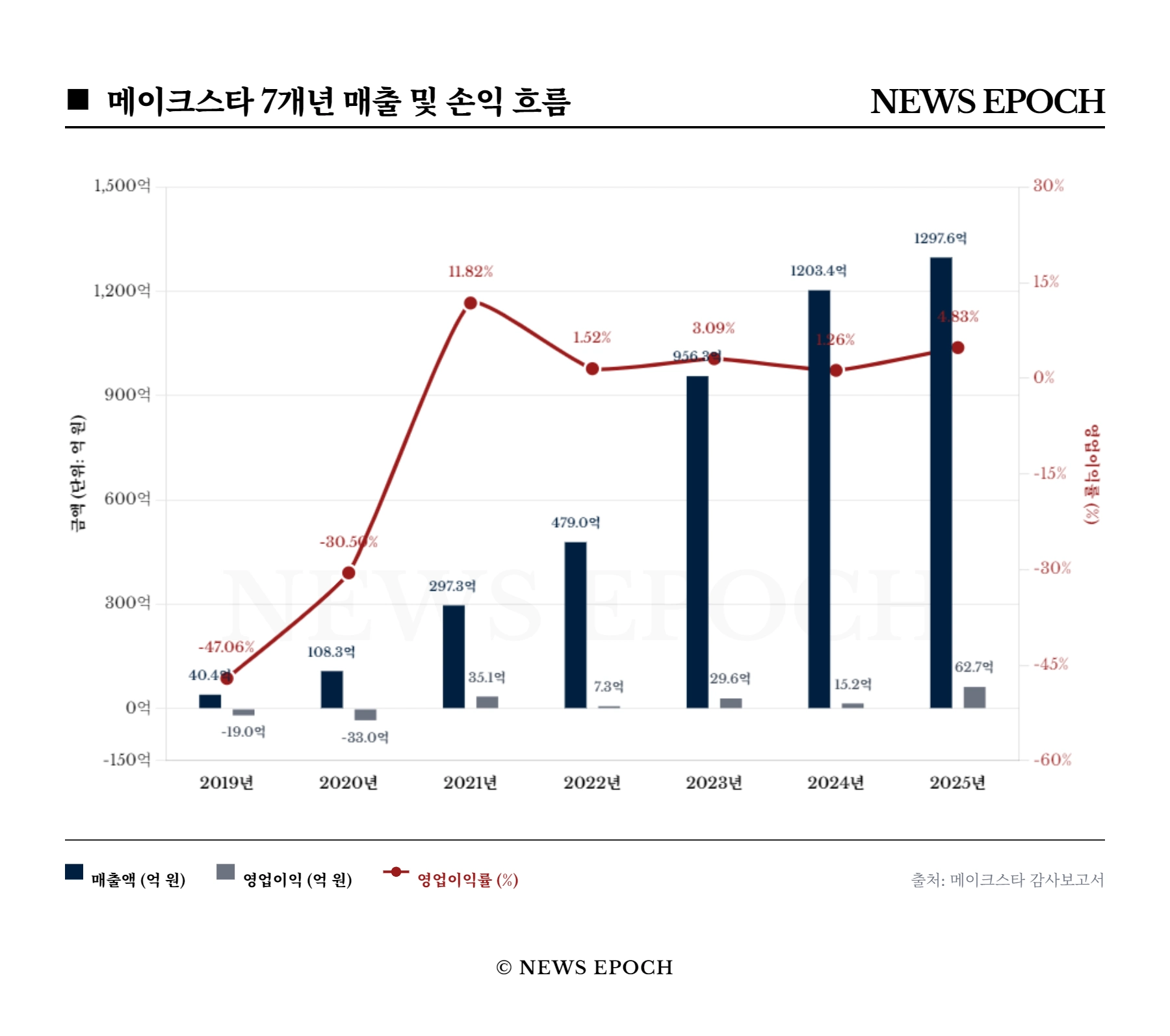
'Profits Generated, But Working Capital Leaves Something to be Desired'... Working Capital Burden Due to Rapid Top-Line Expansion
Although the company caught the two rabbits of profit margin improvement and top-line expansion, it appeared to bear some working capital burden in terms of operating cash flow. While the net income on the books for 2025 showed a favorable trend at approximately 5.96 billion won, the actual operating cash flow recorded a negative 10.6 billion won.
This is because as the sales scale grew rapidly, receivables tied up with business partners and inventory stacked in warehouses increased together, reducing the cash on hand immediately. Looking at the details, during the year of 2025, approximately 12.7 billion won in cash flowed out due to an increase in inventory assets such as merchandise, and about 16.8 billion won in funds was tied up in the form of trade receivables and non-trade receivables. In particular, as merchandise inventory, which was around 16.6 billion won at the end of 2024, surged significantly over a year to about 31 billion won by the end of 2025, the company proactively set up a new merchandise valuation allowance of approximately 1.65 billion won for a conservative evaluation of assets, taking steps to manage its financial soundness.
Securing Floating Shares Through Stock Split and Bonus Issue... Clearing Legal Risks Signals 'Green Light' for Listing
Along with this, Makestar appears to have embarked on full-scale preliminary work for its initial public offering (IPO). The company simultaneously executed a 1-to-5 stock split, dividing the par value per share from 500 won to 100 won, and a 1-to-4 bonus issue. Through this process, the total number of issued shares, which was merely 53,591 shares combining common and preferred stocks at the end of 2024, exploded to 1,078,080 shares as of the end of 2025. This is a typical procedure to resolve the low floating volume characteristic of unlisted stocks and adequately secure the number of floating shares so that they can be traded smoothly in the stock market upon listing in the future.
In addition, it has completely shaken off legal risks that could have been a stumbling block for its IPO. Makestar went through lawsuits related to a patent infringement injunction and invalidation trial filed by another company in late 2022, but after actively countering, it finally won the case in January 2025, terminating the related legal disputes. As the risk completely vanished because the plaintiff did not file an appeal, neatly resolving the uncertainties regarding core technologies that could act as a disqualifying factor during the listing review process is expected to serve as a positive factor in driving a successful listing in the future.
Company financial data, investment reports, and startup analysis — all in one place
Explore PitchdeckCurated news, every week — straight to your inbox
Every Friday · Unsubscribe anytime