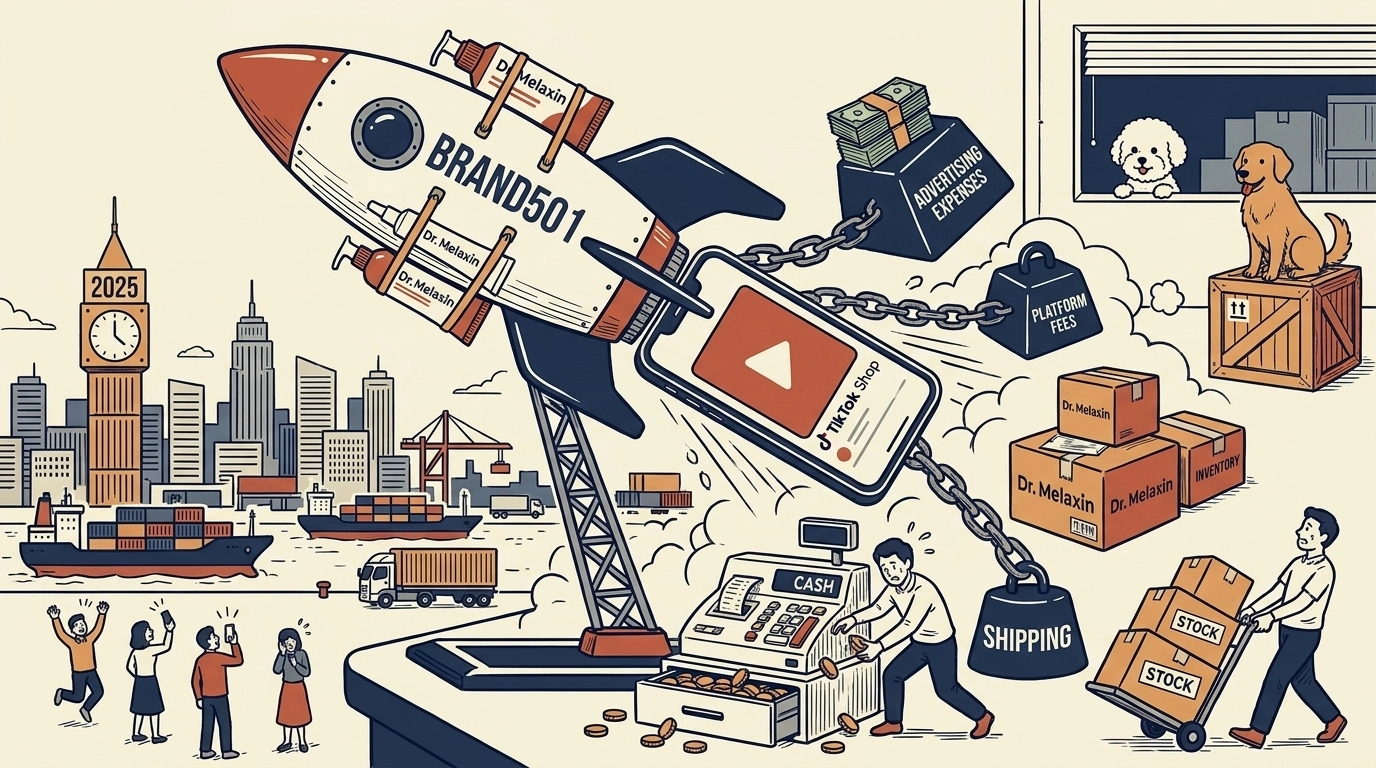
Brand501's recent growth trend is drawing the attention of the cosmetics industry. The company, which had previously faced a management crisis due to accumulated operating losses, laid the foundation for a turnaround to profitability through its men's shaving cream 'Barber501', and then successfully established itself in the market by launching the functional derma skincare brand 'Dr. Melaxin' in 2023. In particular, a contrarian strategy that actively utilized a new digital platform called the US 'TikTok Shop' as a core channel, without being bound by the traditional distribution channels of K-beauty, became the main driving force behind its explosive early growth.
Explosive Revenue Growth, Growing 87-Fold in 6 Years
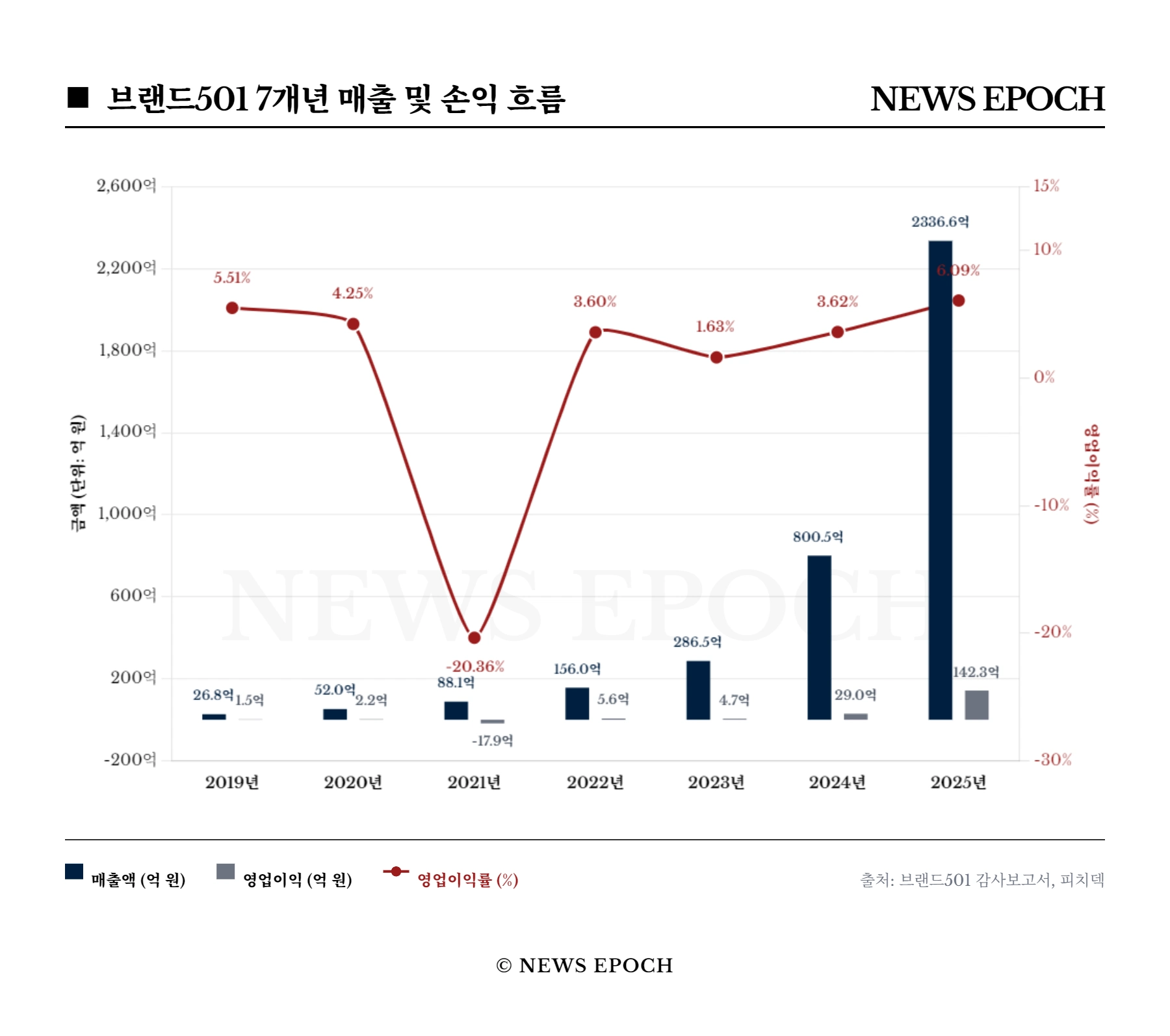
The performance indicators are at an astonishing level. Revenue, which was around KRW 2.67 billion in 2019, surpassed KRW 80 billion in 2024 and jumped to approximately KRW 233.6 billion in 2025. The revenue growth rate in 2025 compared to 2024 reached a staggering 191.9%, meaning that compared to 2019, revenue has grown approximately 87-fold in just 6 years. This clearly shows that it has succeeded in establishing a mega-hit brand in a short period of time within the fiercely competitive cosmetics market. This momentum has carried over into 2026, recording KRW 161.6 billion in revenue and KRW 21 billion in operating profit in the first quarter alone, continuing an explosive sprint that has already surpassed last year's annual operating profit.
The Flip Side of Profitability: Ultra-High Margins and High-Cost Marketing Structure
However, behind the spectacular top-line growth lie financial indicators that need to be examined. In 2025, gross profit was approximately KRW 203.34 billion, with a gross profit margin reaching 87.0%. This means the brand's own margin rate is extremely high, thanks to the low cost of goods sold ratio characteristic of the cosmetics industry.
Nevertheless, operating profit in 2025 was approximately KRW 14.23 billion, and the final operating profit margin remained at around 6.1% (a slight improvement compared to 3.6% in 2024). The reason the profit margin remained in the single digits despite selling ultra-high margin products lies in its inefficient cost structure. Selling, general, and administrative (SG&A) expenses in 2025 amounted to KRW 189.1 billion, eating up most of the revenue. Looking at the detailed expenditures, they consist of KRW 86.9 billion in advertising expenses, KRW 45.6 billion in sales commissions, and KRW 38.3 billion in transportation costs. In other words, approximately 56.7% of the year's revenue is being spent on marketing and platform fees.
Dilemma of a Growing Company: Cash Flow Pressures and Working Capital Burden
The massive gap between book profit and actual cash flow is also worth noting. While a net profit of KRW 11.2 billion was recorded on the books for 2025, KRW 8.84 billion in cash actually left the company's bank accounts (operating cash flow of -KRW 8.84 billion). The main reason for the massive gap of approximately KRW 23 billion between operating profit (+KRW 14.23 billion) and cash flow from operating activities (-KRW 8.84 billion) is the 'imbalance of working capital (trade receivables, inventory)' resulting from rapid growth.
An explosive increase in trade receivables blocked a staggering KRW 22.45 billion in cash flow. Goods were sold in bulk and recognized as revenue and operating profit on the books, but the actual cash did not come in and was tied up as credit, severely pressuring cash flow. Inventories also surged, resulting in a cash outflow of KRW 15.33 billion. This is because the company received an explosive response on platforms like the US TikTok Shop, triggering pre-orders and a mass production system to meet initial volumes, and massive cash was spent upfront on acquiring raw materials and producing products during this process. Ultimately, this is interpreted as a typical 'cash deficiency phenomenon of a growing company', caused by cash being deployed much more heavily upfront into extending credit and piling up inventory at a faster pace than the speed at which money was earned.
Financial burden is also evident in debt indicators. Total liabilities, which were KRW 14.08 billion in 2024, surged to KRW 35.67 billion in 2025. To secure insufficient cash, the company issued unguaranteed private placement bonds worth KRW 5 billion in November 2025, and short-term borrowings also increased significantly from KRW 1.14 billion to KRW 8.92 billion. There are also other borrowings amounting to KRW 4 billion procured from shareholders, etc. As the risk of collecting trade receivables grew alongside revenue increases, the allowance for bad debts as of the end of 2025 was set at KRW 1.66 billion, a ten-fold increase from the previous year (KRW 160 million).
Light and Shadow of Overseas Expansion and One-Hit Wonder Risk
The performance of overseas subsidiaries also varies by country. The US and UK subsidiaries show extremely high net profit margins relative to their revenue size, indicating that they are successfully settling as a high-value-added brand in Western markets. On the other hand, the Taiwan, Europe, Hong Kong, and Japan subsidiaries are all recording deficits. In particular, the Taiwan subsidiary is showing signs of insolvency, as KRW 1.66 billion out of KRW 1.78 billion in trade receivables generated by the headquarters was judged to be uncollectible non-performing loans and treated as an allowance for bad debts, while the Japan subsidiary is only generating deficits with zero revenue.
A significant portion of the current explosive growth appears to be greatly contributed to by the brand 'Dr. Melaxin' and social media viral marketing. This is why concerns are being raised that they may be a marketing-dependent brand where 'revenue does not come in unless money is spent.' If cosmetics trends change or competition intensifies in the future, causing advertising efficiency to drop, there is a lingering possibility that revenue will falter, leaving only a massive SG&A burden intact and negatively impacting profitability.
Nevertheless, Remarkable Growth and Future Value to Prove
Although there are some financial signs and challenges, the current performance achieved by Brand501 is nevertheless highly remarkable and deserves to be highly evaluated. Despite being a latecomer, its execution capability to accurately discern the characteristics of a new platform and set an unrivaled sales record in the global market is drawing the industry's attention.
A short-term cash deficiency is also a rite of passage that high-growth companies inevitably go through. It is encouraging that the company is establishing a stable profit base by confirming its entry into major offline distribution channels such as Ulta in the US and Boots in the UK based on its recent online performance. If it can prove a 'brand lock-in effect' where customers consistently make repurchases even if marketing expenses are gradually reduced, and successfully establish follow-up brands, achieving its 2026 goal of KRW 1 trillion in revenue is well within sight. Anticipation is high for the future moves of Brand501, which has emerged as a newly rising powerhouse in K-beauty.
Company financial data, investment reports, and startup analysis — all in one place
Explore PitchdeckCurated news, every week — straight to your inbox
Every Friday · Unsubscribe anytime