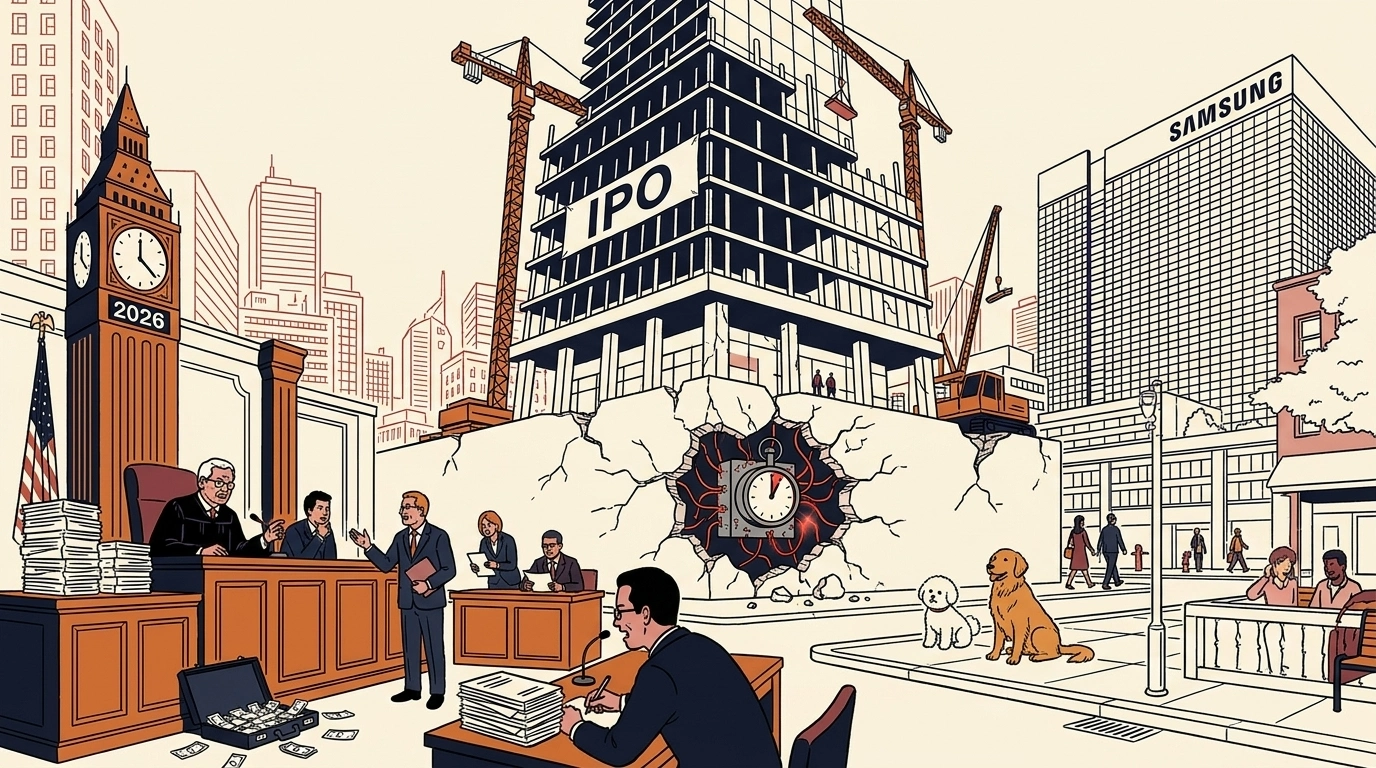
Considered a leading domestic Non-Practicing Entity (NPE), Ideahub has experienced a major disruption to its initial public offering (IPO) schedule, facing the unprecedented situation of its CEO's arrest despite steep earnings growth.
Ideahub is a company specializing in patent monetization (NPE: Non-Practicing Entity). An NPE operates a business model that does not have facilities for direct product manufacturing, but instead generates profits by selling patents acquired through research and development or purchases to manufacturers, or by collecting usage fees (royalties).
According to media reports, on February 2, 2026, the Seoul Central District Prosecutors' Office arrested and indicted the former CEO of Ideahub on charges including handing over 1 million dollars (approximately 1.4 billion won) in exchange for receiving leaked patent-related confidential information from the Samsung Electronics IP Center. This situation appears likely to spread beyond a simple management vacuum into a large-scale litigation risk that could have a significant impact on the company.
Earnings 'Soaring'... Revenue and Operating Profit Trends over the Last 5 Years
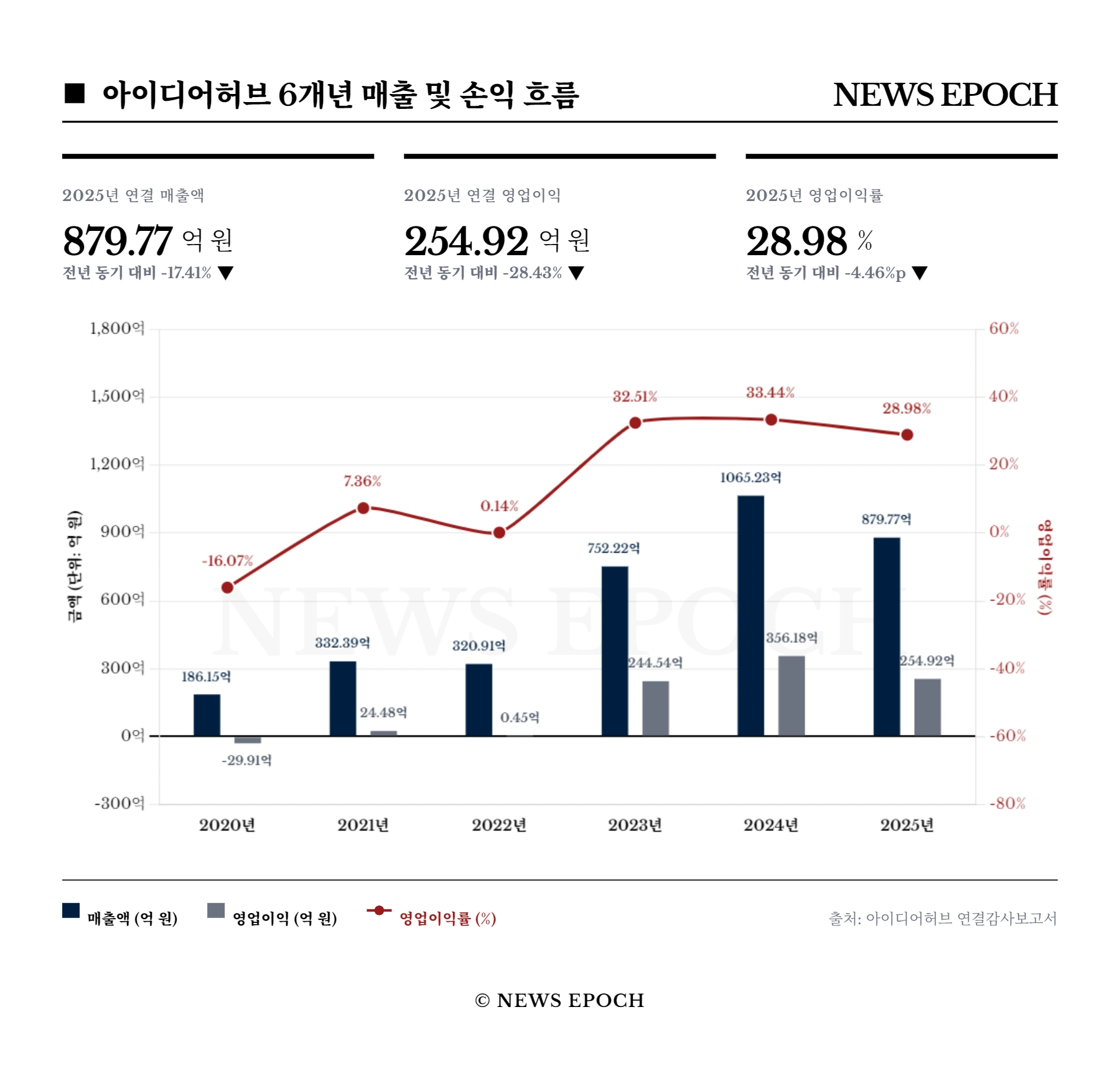
Ideahub has grown significantly in external size over the past five years through its patent monetization business. According to the consolidated audit report, revenue, which was about 33.2 billion won in 2021, briefly faltered to about 29.7 billion won in 2022, but more than doubled to about 75.2 billion won in 2023. Following this, in 2024, it recorded a revenue of about 106.5 billion won, showing remarkable growth by breaking the 100 billion won mark, and in 2025, it maintained a solid external size with a revenue of about 88 billion won.
The operating profit, a profitability indicator, also vastly improved from about 2.4 billion won in 2021 and about 100 million won in 2022 to about 23.7 billion won in 2023. Thereafter, it rode a stable upward trend, recording operating profits of about 35.6 billion won in 2024 and about 25.5 billion won in 2025. Although it has shown such a sound financial flow, the legal risks lurking behind the books are expected to become a major variable for future financial soundness.
Criminal and Civil Litigation Risks Related to Samsung Electronics Patent Sale
The most fatal risk commonly specified in the audit reports is the criminal trial and potential civil litigation risk intertwined with Samsung Electronics.
According to the audit report, Ideahub and its subsidiaries signed patent sale and patent license agreements with Samsung Electronics in November 2021 and in January and May 2023, totaling 30 million dollars (USD 30M). However, the prosecution detected allegations of misconduct, such as leaking trade secrets, during this transaction process and indicted the company's former CEO on February 2, 2026, and the corporate entity was also indicted under joint penal provisions. Subsequently, on March 9, 2026, some executives and employees were additionally indicted, and the first trial is currently underway.
The potential impact on the financial statements is substantial. Along with the possibility of corporate fines being imposed for violating the Unfair Competition Prevention Act, the biggest risk is the possibility of Samsung Electronics filing a civil lawsuit. If Samsung Electronics initiates a civil lawsuit, the company could bear the responsibility of returning the 30 million dollar (equivalent to about 45.1 billion won at current rates) contract amount already recognized as revenue, as well as paying for damages.
However, as of the audit report publication date (July 10, 2026), no civil lawsuit has actually been filed yet, and because the timing and amount of resource outflow cannot be reasonably estimated, not a single won has been reflected as a 'provision for liabilities' in the financial statements. In other words, if they lose the trial, an off-book direct hit worth tens of billions of won could occur.
Status of Global Patent Infringement Lawsuits and Invalidation Trials
Due to the nature of the intellectual property (IP) business operated by Ideahub, numerous global lawsuits are intertwined, and there is a stark difference in the scale of lawsuits between the consolidated entity (including subsidiaries) and the separate entity (headquarters).
As of the end of 2025, the lawsuits pending with the consolidated company as a defendant amounted to 2 cases, and invalidation trials reached 18 cases. Comparing with past indicators, it is confirmed that US subsidiaries (SIPCO, Helios Streaming, Synkloud, etc.) have a history of simultaneously launching numerous patent infringement lawsuits (13 cases as plaintiffs) and invalidation trials against Jasco, Emerson, Vudu, Google, LG Electronics, Samsung Electronics, and others. Due to this, 39.16 billion won was spent on payment commissions (litigation representatives and law firm costs) on a consolidated basis. In effect, massive cash is flowing out as litigation maintenance costs equivalent to the royalties collected.
On the other hand, the litigation cases pending with the separate entity as a defendant are only 1 case, and invalidation trials are a mere 2 cases. The payment commission on a separate basis is also around 3.22 billion won, significantly lower compared to the consolidated entity. Through this, it can be grasped that Ideahub's headquarters handles patent portfolio management and investment, while the actual large-scale patent infringement lawsuits and invalidation battles against major conglomerates are being carried out on the frontlines by overseas subsidiaries such as those in the US. If patents are invalidated in large numbers, there remains a persistent risk that this could transfer into impairment losses on investments in subsidiaries (16.18 billion won).
Risk of Damages and Early Repayment Claims by Redeemable Convertible Preference Shares (RCPS) Investors
The judicial risk of the former CEO related to Samsung Electronics goes beyond a simple cancellation of revenue and has the possibility of spreading into issues with the financial investors (FI) who funded the company.
Looking at the major covenants of the Redeemable Convertible Preference Shares (RCPS) issued by the company, strong investor protection clauses are stipulated stating, "In the event of a breach of representations and warranties, covenants, or other obligations, 15% to 20% of the total share acquisition amount can be claimed as a penalty for breach of contract, and upon the occurrence of events such as violating the investment purpose, a put option can be exercised at an amount adding a 15% annual compound interest to the acquisition price."
As of the end of 2025, the company's RCPS debt scale reached 77.19 billion won identically on both consolidated and separate bases, with large-scale participation from Stonebridge, Premier, Quad Asset Management, and others. In fact, even the recent 2026 audit report explicitly warned of the 'possibility of claims for damages by investors of redeemable convertible preference shares' as a potential impact this litigation situation will have on the financial statements.
If the former CEO's misconduct is confirmed as a result of the criminal trial, it is presumed that investors will consider this a 'breach of representations and warranties' under the contract, leading to rigorous legal steps such as filing lawsuits for recovery with an added 15% annual compound interest or lawsuits for penalty for breach of contract.
Unusual Internal Transactions Linked to Litigation (The Case of ImberaTek)
The unique transaction structure of the litigation cost-sharing agreement with subsidiaries also stands out. According to the separate audit reports and others, in December 2022, the company purchased the non-exclusive license for 'IoT-3D Packaging' related technology from its subsidiary ImberaTek, LLC for 1.29 billion won.
Subsequently, the company provided licenses to customers with this technology and received a massive amount of 20.2 billion won, but according to the contract agreement, it paid a total of 7.81 billion won, including legal representation costs (litigation costs) related to the technology, on behalf of the subsidiary. In other words, the subject of the litigation costs and the subject to which the license revenue is attributed are being meticulously settled and shared through contracts between the headquarters and overseas subsidiaries, establishing a structure where the headquarters' profits fluctuate depending on the success or failure of the lawsuits.
Ideahub's financial statements seemingly present a sound IP company holding about 46.3 billion won in cash-equivalent assets. However, megaton-class ticking time bomb litigation risks, such as the 'risk of returning the Samsung Electronics contract amount and damages (estimated at approximately 45 billion won based on current standards)' and the 'RCPS investor breach penalty risk (77.1 billion won based on the RCPS book value (unable to verify if the entirety is subject), 15% annual compound interest),' which are not recognized on the books, are in a situation waiting only for the trial result (first instance verdict). It is analyzed that for Ideahub, rather than the numbers currently stated in the financial statements, the sentencing results of the trials underway in 2026 will be the core key to the future survival of the company and the repromotion of its listing.
Company financial data, investment reports, and startup analysis — all in one place
Explore PitchdeckCurated news, every week — straight to your inbox
Every Friday · Unsubscribe anytime