
Founded in 2016, WAGTI is a global sports culture content company drawing attention for successfully establishing the sports casual brand 'GOALSTUDIO', niche perfume 'SW19', and premium golf wear 'MADCATOS' in the market one after another. Founder and CEO Kang Jung-hoon is a former sports figure who played as a basketball player. It is known that he worked in the IR team at LG Insurance before moving to Samsung Electronics, where he was in charge of the Chelsea FC sponsorship and global sports marketing for events such as the Olympics.
According to media reports, WAGTI, which recently initiated a Series C investment round of 20 billion KRW aiming for a corporate valuation of 73.5 billion KRW, demonstrated strong potential by overcoming three consecutive years of large-scale deficits and successfully turning a profit for the past two consecutive years. Ahead of a higher-level quantum jump, industry attention is focused on how it will solve the tasks of inventory management and capital structure improvement.
5 Years of Top-Line Growth... Strengthening Basic Fundamentals
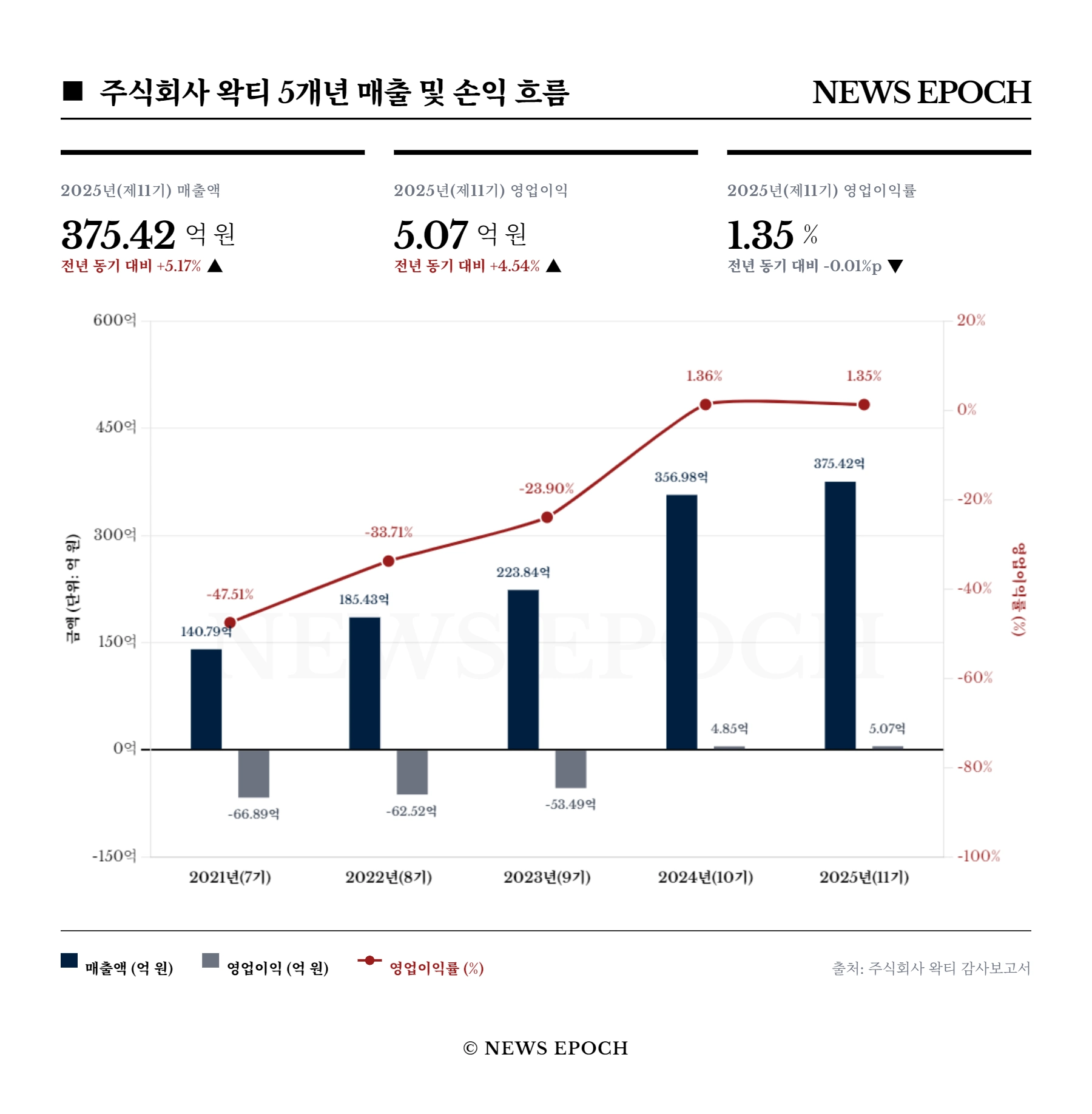
WAGTI's revenue grew robustly by more than twofold in four years, from 14.08 billion KRW in 2022 to 37.54 billion KRW in 2026. Above all, breaking the chain of large-scale operating deficits that lasted through 2022 (-6.69 billion KRW), 2023 (-6.25 billion KRW), and 2024 (-5.35 billion KRW), it recorded operating profits for two consecutive years, generating a profit of 480 million KRW in 2025 followed by 510 million KRW in 2026 (WAGTI has a March fiscal year-end, covering March 2025 to March 2026). (However, it is still in a situation where net losses are continuing due to high interest expenses, etc.) Driven by rising brand competitiveness, the gross profit margin improved to 59.8% in 2026 compared to the previous year. The scale of cash outflow from operating activities also significantly shrank from -9.27 billion KRW in 2023 to -1.17 billion KRW in 2026, showing a trend of gradual recovery in financial soundness.
However, there are also point-outs that optimization of the cost structure is needed to widen the profit margin and consolidate internal stability. In 2026, revenue grew by 5.2% compared to the previous year and gross profit also increased by about 1.9 billion KRW, but selling and administrative expenses according to brand expansion also increased, resulting in an operating profit increase of only 20 million KRW (operating profit margin 1.3%). As of 2026, six major selling and administrative expense items—fees paid (4.47 billion KRW), advertising expenses (4.07 billion KRW), rent paid (2.34 billion KRW), outsourcing fees (2.07 billion KRW), transportation costs (1.47 billion KRW), and sales promotion expenses (1.05 billion KRW)—account for 41% of revenue (about 15.48 billion KRW). This has a strong nature of preemptive investment to expand market share, but this investment must lead to clear revenue growth in the future to safely settle into a stable profit trajectory.
Growing Pains from Brand Expansion: 'Inventory and Receivables Management'
The inventory assets that have inevitably ballooned as various brands are actively developed remain a task that WAGTI must carefully manage. As of the end of March 2026, inventory assets stood at 11.09 billion KRW, accounting for about 81% of current assets and about 60% of total assets (18.57 billion KRW). Since the inventory growth rate (13.8%) was somewhat higher than the revenue growth rate (5.2%) in 2026, the average inventory turnover days are estimated to be about 252 days. The current inventory valuation allowance is 360 million KRW, which is about 3.2% of total inventory. Due to the nature of fashion and perfume products, their value can fluctuate according to trends, necessitating continuous monitoring. As the company plans to expand its offline channels through this investment attraction, the increased sales routes are expected to be the key to depleting inventory.
In addition, qualitative management of trade receivables is required. As of the end of 2026, an allowance for bad debts of 620 million KRW was set against total trade receivables of 2.16 billion KRW, recording an allowance ratio of 28.6%, which is somewhat higher compared to the previous year (13.2%). With bad debt expenses of 330 million KRW occurring in the current period, selective receivables management focused on excellent client companies is expected to be a great help to the company's cash flow.
Liquidity Indicators Greatly Improved Due to Successful Refinancing (Rollover)... Need to Enhance Interest Generation Capacity
WAGTI, which had faced short-term liquidity pressure in the past, recently extended its debt maturities through successful fundraising, breathing financial room. According to the 2026 cash flow statement, the company actually repaid 2 billion KRW in short-term convertible bonds and 2.26 billion KRW in short-term borrowings that had reached maturity, and successfully refinanced them with 6 billion KRW in new long-term convertible bonds and 2.9 billion KRW in long-term borrowings. As a result, the company's current ratio improved from 125% in 2025 to 293% in 2026.
However, the interest burden caused by borrowing-nature liabilities still amounting to 12.7 billion KRW remains a homework assignment to be solved. While the interest expenses incurred in 2026 were 1.18 billion KRW, the operating profit recorded was 510 million KRW, indicating an interest coverage ratio of about 0.43 times. Even considering the cash generating capacity (EBITDA) including depreciation, it is a somewhat overwhelming situation to fully cover the interest expenses. In preparation for the repayment schedule of the 3rd CB (3 billion KRW) maturing in November 2027 and the 4th to 7th new CBs (6 billion KRW) maturing in May 2029, it is time to further elevate the operating cash generating capacity inherent to the business.
Overseas Business is About 'Selection and Concentration'
A part worth noting is the major shareholder's willingness to support the company. Following a capital injection of 3 billion KRW via a paid-in capital increase by the CEO's family in 2024, the company also received a financial blood transfusion in 2026, including a long-term borrowing of 2.9 billion KRW from related parties. The CEO himself also appears to be practicing responsible management by providing personal joint guarantees for bank borrowings, among others.
Meanwhile, the subsidiaries in Japan and China, which were the initial bases for global expansion, have entered a breather for efficiency. The Japanese corporation is currently closed after writing off 990 million KRW in long-term loans as a loss between 2023 and 2024, and is in a state of net debt of 520 million KRW. The Chinese corporation also has identical asset and liability sizes of 130 million KRW, leaving it with absolutely no equity. This is interpreted as a strategic move to block risks through selection and concentration rather than unreasonable expansion.
Will 20 Billion KRW Funding Become the Priming Water for the Next Leap?
WAGTI, which has successfully raised funds through redeemable convertible preference shares (RCPS) of approximately 28 billion KRW based on principal so far, aspires to secure offline strongholds and embark on full-scale profitability enhancement through this 20 billion KRW funding.
Although still in the 'growth company' stage relying on external funds, cultivating its brands and bringing about two consecutive years of surplus even amidst a poor consumption slump environment is WAGTI's clear competitive edge. Market expectations are gathering on whether the large-scale fund attraction currently underway will be successfully concluded, allowing it to compensate for the vulnerabilities in its financial structure and soar as a global content group equipped with true viability.
Company financial data, investment reports, and startup analysis — all in one place
Explore PitchdeckCurated news, every week — straight to your inbox
Every Friday · Unsubscribe anytime