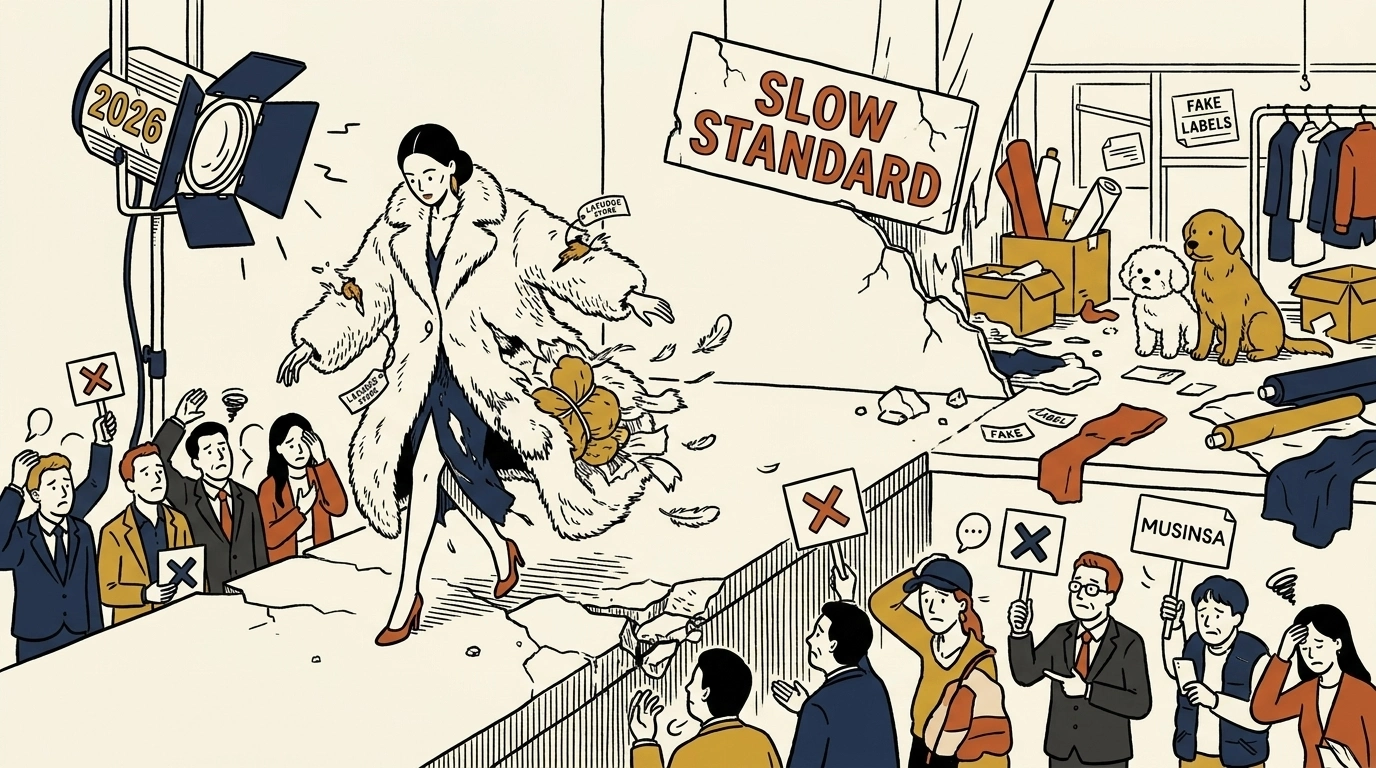
Slow Standard, which operates the fashion brand 'Lafudgestore', has entered bankruptcy proceedings. As an associate company in which a fund affiliated with Musinsa holds a 45.5% stake, it once exceeded 47 billion won in annual sales, but management appears to have rapidly deteriorated due to worsening profitability and cash flow, followed by its exit from key sales channels Musinsa and 29CM.
The Seoul Bankruptcy Court declared Slow Standard bankrupt on August 7 and designated it for summary bankruptcy. Summary bankruptcy is a procedure that can be applied when the court acknowledges that the assets belonging to the bankruptcy estate are less than 500 million won.
Sales Increased, but Profitability and Cash Flow Worsened
Slow Standard is an apparel company established in 2018. Growing rapidly with a focus on Lafudgestore, it boosted its sales from 29.43 billion won in 2021 to 47.56 billion won in 2022.
The problem is that profit and cash did not keep pace with external growth. Operating profit, which was 3.6 billion won in 2021, plummeted to 220 million won in 2022. During the same period, the gross profit margin also dropped from 55% to 37.5%. Sales increased by more than 60%, but the profit left from selling products decreased significantly.
Operating cash flow also recorded deficits of 1.62 billion won in 2021 and 3.14 billion won in 2022. It is analyzed that the actual cash situation deteriorated faster than the book profit as funds injected into inventory and trade receivables increased to expand sales.
Operating deficits went into full swing starting in 2023. In 2023, sales were 42.13 billion won, and operating loss was 2.07 billion won. In 2024, sales increased again to 47.83 billion won, but the operating loss expanded to 3.01 billion won. Net loss also reached 3.24 billion won.
In particular, cash that flowed out of operating activities in 2024 amounted to 6.08 billion won. Ending cash stood at only 360 million won, while short-term borrowings increased to 5.95 billion won. Total equity, which was 7.51 billion won at the end of 2022, also shrank to 2.05 billion won at the end of 2024, entering a state of partial capital impairment.
The cost structure also acted as a burden. In 2024, advertising and promotional expenses were 7.66 billion won, and sales commissions were 7.81 billion won. The combined total of the two costs is 15.47 billion won, which accounts for about 80% of the gross profit of 19.31 billion won. Sales in 2024 increased by 13.6% from the previous year, but advertising and promotional expenses rose by about 75%. The costs invested in advertising and platform sales to maintain revenue appear to have increased rapidly.
Despite 11.4 Billion Won in Book Assets, Cash was Only 360 Million Won
At the end of 2024, Slow Standard's total assets were 11.41 billion won. However, among this, advance payments accounted for 4.86 billion won, trade receivables for 2.8 billion won, and inventory assets for 2.05 billion won. The sum of these three items accounts for about 85% of total assets.
This means there was a high proportion of assets with relatively low liquidity or uncertain recoverability. On the other hand, financial liabilities to be repaid within one year were about 9.42 billion won, greatly exceeding the responsive financial assets of about 3.86 billion won.
An audit opinion was also not issued for the 2024 financial statements. Going concern uncertainties were raised due to partial capital impairment, operating cash outflows, and exits from major sales channels, but the auditor declined to express an opinion because the management failed to sufficiently submit going concern assessment materials and written representations.
Considering it was designated for summary bankruptcy in 2026 despite having 11.4 billion won in book assets at the end of 2024, it is highly likely that advance payments, trade receivables, and inventory assets were not recovered to their book values or were largely depleted during the process leading up to bankruptcy.
Exits from Musinsa and 29CM Appear to Have Accelerated Management Deterioration
The exit from core sales channels is also presumed to be a factor that accelerated the deterioration of liquidity.
In December 2024, Musinsa decided to suspend sales and remove Lafudgestore, citing that the brand had violated safe trading policies more than three times through the use of counterfeit subsidiary materials, design theft, and false labeling of filling mixture ratios. Sales were suspended from January 1, 2025, and it officially exited Musinsa and 29CM on April 1 of the same year.
The padded jacket in question was labeled as using 80% duck down, but external testing revealed the actual ratio was less than 5%. Musinsa subsequently filed a police complaint against the CEO of Slow Standard on charges including fraud and obstruction of business.
In Slow Standard's 2024 financial statements, the exit from the related-party platform that generated most of its sales is listed as a major cause of going concern uncertainty. With profitability and cash flow already worsening, it appears that continuing business operations became difficult as its most important sales channel was blocked.
However, it is difficult to explain the cause of bankruptcy solely by the exit. A decline in the gross profit margin, increases in advertising costs and sales commissions, and repeated operating cash outflows and borrowing expansions preceded it, and it is analyzed that the platform exit was more of a catalyst that rapidly materialized accumulated financial problems.
Accumulated 4 Billion Won Invested in Musinsa's Stake Acquisition
The cumulative amount of Musinsa's acquisition of stakes in Slow Standard is estimated to be 4 billion won.
According to Musinsa's consolidated financial statements, the investment amount in Slow Standard was 1 billion won in 2021 and 3 billion won in 2022. The 3 billion won investment in 2022 is identically indicated as a prior-period transaction in the following year's report. Since the same transaction is repeated in both reports, there is no need to add the two amounts separately.
In Slow Standard's statement of changes in equity, paid-in capital increases of 1 billion won each were executed in 2021 and 2022. The total amount for new shares that went directly into the company is 2 billion won.
There is a difference of 2 billion won between Musinsa's 4 billion won investment and the 2 billion won in capital increase proceeds that flowed into Slow Standard. Out of the 11,806 shares held by the Musinsa Mutual Growth Fund, 3,750 shares were acquired through two rounds of paid-in capital increases. The remaining 8,056 shares are presumed to have been acquired from old shares held by existing shareholders.
Taking this together, it is estimated that Musinsa invested 1 billion won in the acquisition of new shares in 2021, and spent 1 billion won for new shares and 2 billion won for additional stake acquisitions, such as old shares, in 2022. However, it is currently difficult to confirm whether the entire 2 billion won out of the 2022 investment was for the purchase of old shares.
As of the end of 2024, the shareholder composition was CEO Son Jun-ho at 54.5% and the Musinsa Mutual Growth Fund Limited Partnership at 45.5%. Since CEO Son holds a majority stake, Slow Standard is not a subsidiary or a consolidated subsidiary of Musinsa.
Instead, in Musinsa's consolidated financial statements, Slow Standard is classified in the related party category of 'associates and joint ventures, etc.'. Musinsa directly holds a 99.5% stake in the Musinsa Mutual Growth Fund, while the remaining 0.5% is held by its subsidiary, Musinsa Partners. It is a structure in which the Musinsa Group controls the fund, but the fund exerts significant influence rather than control over Slow Standard.
Loans Recovered... Size of Equity Loss Difficult to Confirm
In addition to equity investments, Musinsa provided a substantial amount of financial support to Slow Standard.
At the end of 2023, Musinsa held 3 billion won in other receivables against Slow Standard. Slow Standard processed the same amount as an advance from Musinsa. This appears to be in the nature of funds paid in advance for product transactions and the like, rather than an equity contribution. The relevant advances and other receivables completely disappeared from the books at the end of 2024, suggesting they were offset against transaction amounts or returned.
Musinsa separately loaned 2 billion won to Slow Standard in 2024. This loan was fully recovered in 2025, and both the ending balance and the allowance for bad debts were displayed as 0 won. Therefore, there are no direct bad debt losses confirmed from advance payments and loans.
The issue is the equity investment. The individual book value and valuation loss of the Slow Standard stake were not disclosed in Musinsa's consolidated financial statements. The total fair value through profit or loss (FVTPL) financial asset valuation loss recognized by Musinsa in 2024 was 4.77 billion won, but it cannot be confirmed how much of this amount originated from Slow Standard. The total valuation loss in 2025 was 240 million won.
Regarding Slow Standard's bankruptcy declaration, if Musinsa has already evaluated the equity value significantly lower, the additional loss due to bankruptcy may be limited. Conversely, if a residual book value remains, there is a possibility that an additional loss will occur in the 2026 financial statements.
Given that shareholder equity is subordinate to general claims in the order of repayment and Slow Standard has been designated for summary bankruptcy, it is expected that the possibility of the Musinsa Mutual Growth Fund actually recovering its equity investment is low.
Company financial data, investment reports, and startup analysis — all in one place
Explore PitchdeckCurated news, every week — straight to your inbox
Every Friday · Unsubscribe anytime