Kurly's valuation in the over-the-counter (OTC) market has recovered to 1.2 trillion won. After dropping to the 300 billion won range in October 2024, it remained at the bottom until January of last year, but has since steadily rebounded. Following its rise to the 800 billion won range at the end of last year, it surpassed 1 trillion won again early this year, and is currently trading at around 1.2 trillion won.
Its financial performance also moved in the same direction. Kurly, which had been narrowing its deficit by reducing logistics and promotional costs, began attracting external customers and products through Naver starting last year. The assessment that the company has entered a phase of simultaneously increasing both revenue and profit, moving past simply rushing to reduce its deficit, appears to have been reflected in its OTC price.
Saetbyeol Delivery Ventures Outside the Kurly App
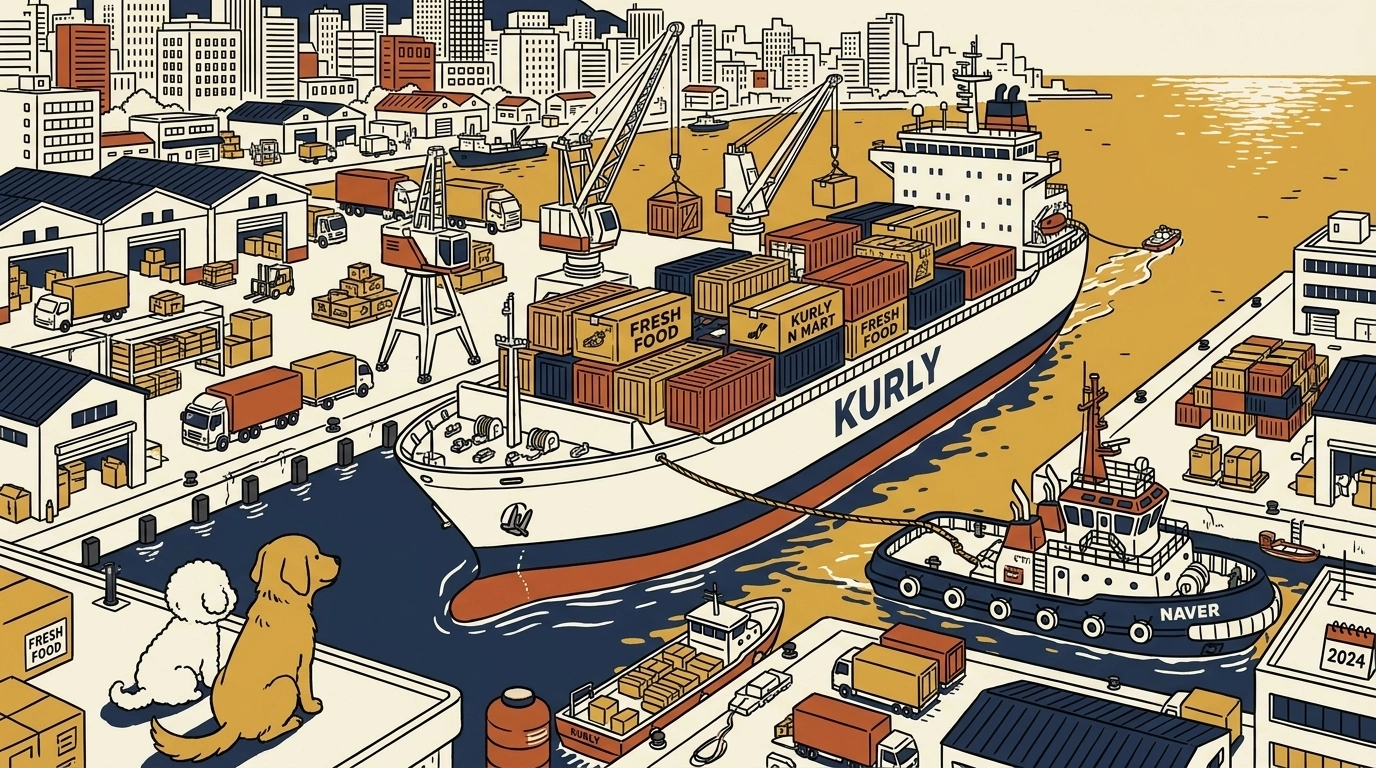
Kurly and Naver announced a strategic alliance in the e-commerce sector in April of last year, and opened 'KurlyN Mart' in the Naver Plus Store in September of the same year. This marked the first time Kurly launched its grocery shopping service on an external platform. KurlyN Mart operates under a structure where Naver gathers customers and Smart Store products, while Kurly handles product curation, refrigerated and frozen logistics, and Saetbyeol Delivery. The company has expanded its business scope from selling directly purchased products within the Kurly app to connecting the products and logistics of external sellers.
The collaboration between the two companies did not stop at a simple store entry. Kurly developed a system that links product display, ordering, and discount functions with Naver's Smart Store. This year, it also added a feature that issues Kurly coupons linked across both Kurly and KurlyN Mart. In January of this year, the transaction amount of KurlyN Mart increased more than sevenfold compared to its launch month in September of last year. The repurchase user rate rose to 60%, and over 90% of the users were Naver Plus Membership subscribers. For Kurly, this effectively created a channel to attract Naver users without incurring separate, large-scale customer acquisition costs.
However, it is difficult to attribute Kurly's turnaround to a surplus entirely to the Naver effect. Kurly began generating operating profits in the first quarter of last year, before the launch of KurlyN Mart. Calculated from its financial statements, its operating profit in the first quarter of last year was 1.76 billion won, and 1.31 billion won in the second quarter. The annual operating loss, which was 18.33 billion won in 2024, also turned into a 13.1 billion won surplus last year. It is more accurate to view that the company first built a foundation for surplus by increasing the efficiency of its existing fulfillment centers and lowering the cost of sales, and subsequently, KurlyN Mart added top-line growth.
Revenue Increases by 27.7% While Inventory Grows by 4.2%
Kurly's consolidated revenue for the first half of this year was 1.4805 trillion won, up 27.7% from the same period last year. Operating profit increased more than 16-fold from 3.07 billion won to 51.63 billion won. Net profit also swung from a 7.14 billion won deficit to a 45.7 billion won surplus. Looking solely at the second quarter, revenue was 734.76 billion won and operating profit was 27.38 billion won, both record highs on a quarterly basis. The transaction amount for the second quarter was 1.0786 trillion won, a 25.1% increase from a year ago. Third-party (3P) transaction amount, which includes seller-delivered products and the fulfillment business, also increased by 32.1% in the second quarter.
Profitability has also improved as the proportion of commission and logistics revenue grew larger than that of the direct product purchase and sales method. The gross profit margin for the second quarter was 35.3%, up 1.5 percentage points from a year ago. Changes are also confirmed in the inventory flow. While revenue increased by 27.7%, inventory assets only grew by 4.2%, from 68.94 billion won at the end of last year to 71.85 billion won at the end of June this year. The inventory turnover ratio rose from 23.1 times to 25.8 times. The company expanded its revenue without significantly increasing its inventory burden.
Operating cash flow for the first half was 98.99 billion won, 3.8 times the 26.24 billion won recorded during the same period last year. Cash and cash equivalents increased from 145.39 billion won at the end of last year to 201.94 billion won at the end of June this year. Net working capital also turned positive, shifting from -44.68 billion won at the end of last year to +30.16 billion won at the end of June this year.
Total equity more than doubled from 78.69 billion won to 160.46 billion won. This reflects both the first-half net profit of 45.7 billion won and a 32.99 billion won paid-in capital increase targeting Naver. The debt ratio dropped from 946.3% at the end of last year to 494.4% at the end of June this year. There is also a difference between consolidated and separate financial performances. The consolidated operating profit for the first half was 51.63 billion won, while the separate operating profit was 46 billion won, showing a gap of 5.63 billion won. This is the result of reflecting the effects of eliminating internal transactions and consolidated subsidiaries such as Kurly Nextmile, Kurly Pay, and its US subsidiary. However, as the profit and loss of each subsidiary are not disclosed, it is difficult to determine which company led the profit increase.
From the 300 Billion Won Range to 1.2 Trillion Won... Naver's Investment Values It at 2.8 Trillion Won
Looking at the enterprise value based on OTC transactions compiled by PitchDeck, Kurly's valuation dropped to the 300 billion won range in October 2024. This level persisted until January of last year. The trend began to shift in February of last year. The enterprise value rose steadily without any sharp spikes, passing through the 700 billion won range in the second half of last year and reaching the 800 billion won range by year-end. Early this year, it surpassed 1 trillion won again, and recently climbed to around 1.2 trillion won. Compared to the low point at the end of 2024, the enterprise value has effectively more than tripled.
The valuation Naver assessed for Kurly is significantly higher than that of the OTC market. At the end of last year, Naver held 2,151,776 shares of Kurly, but this increased to 2,650,658 shares by the end of June this year. The increment of 498,882 shares exactly matches the number of new shares Kurly issued through a third-party allocation in May. Naver acquired all of the new shares. The issue price was 66,148 won per share, and the investment amount was 32.99 billion won. Based on this, Kurly's enterprise value is approximately 2.8 trillion won.
The current OTC price is about 43% of Naver's investment price. It is difficult to compare the strategic investment price and the OTC price, which is centered on small-volume transactions, on the same standard. However, it is clear that Naver valued the collaboration with Kurly at a price more than twice as high as the OTC market.
In the OTC market, Kurly has, for now, escaped its low point in the 300 billion won range. It has also largely resolved its weakness of chronic deficits. What the market now seeks to verify is not a one-off rebound, but the sustainability of its surplus. Furthermore, Kurly's future moves related to a potential public listing are also drawing market attention.
Company financial data, investment reports, and startup analysis — all in one place
Explore PitchdeckCurated news, every week — straight to your inbox
Every Friday · Unsubscribe anytime