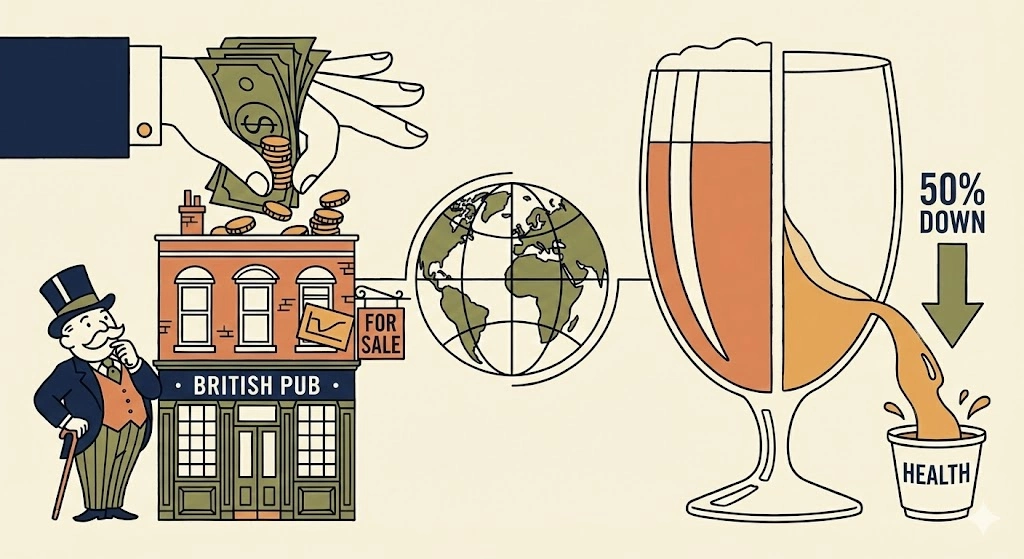
The global trend of declining alcohol consumption is changing the landscapes of countries around the world. In the UK, a bizarre phenomenon is occurring where billionaires are stepping up as 'relief pitchers' to save centuries-old pubs closing down due to financial difficulties. The situation in South Korea is no different. With a growing emphasis on health and changes in corporate dining culture, per capita alcohol consumption has plummeted to half of its past peak, shaking the landscape of the liquor industry.
The Financial Times (FT) recently reported, "Instead of buying a pint of beer, Britain's wealthy are buying the whole pub." As alcohol consumption among British adults has plummeted due to high inflation and the spread of health trends, financially struggling local pubs are being put up for sale, and there is an increasing number of cases where they are being acquired as an act of 'noblesse oblige.'
As a prime example, Lady Loretta Rothschild of the Rothschild financial family acquired 'The Seven Stars', a pub located in Wiltshire outside London. Stefan Persson, a major shareholder of H&M with a net worth of $25 billion (approximately 33 trillion won), and Charlene de Carvalho-Heineken of the Heineken family have also sequentially purchased local pubs.
At the root of this phenomenon lies a severe decline in alcohol consumption. As of 2024, the average weekly alcohol intake of British adults recorded 10.2 glasses, the lowest level since relevant statistics began in 1990. Michel de Carvalho stated in an interview with the FT that the acquisition was "'100%' for community purposes to prevent the disappearance of the pub, which is the focal point of the local community, rather than for profitability."
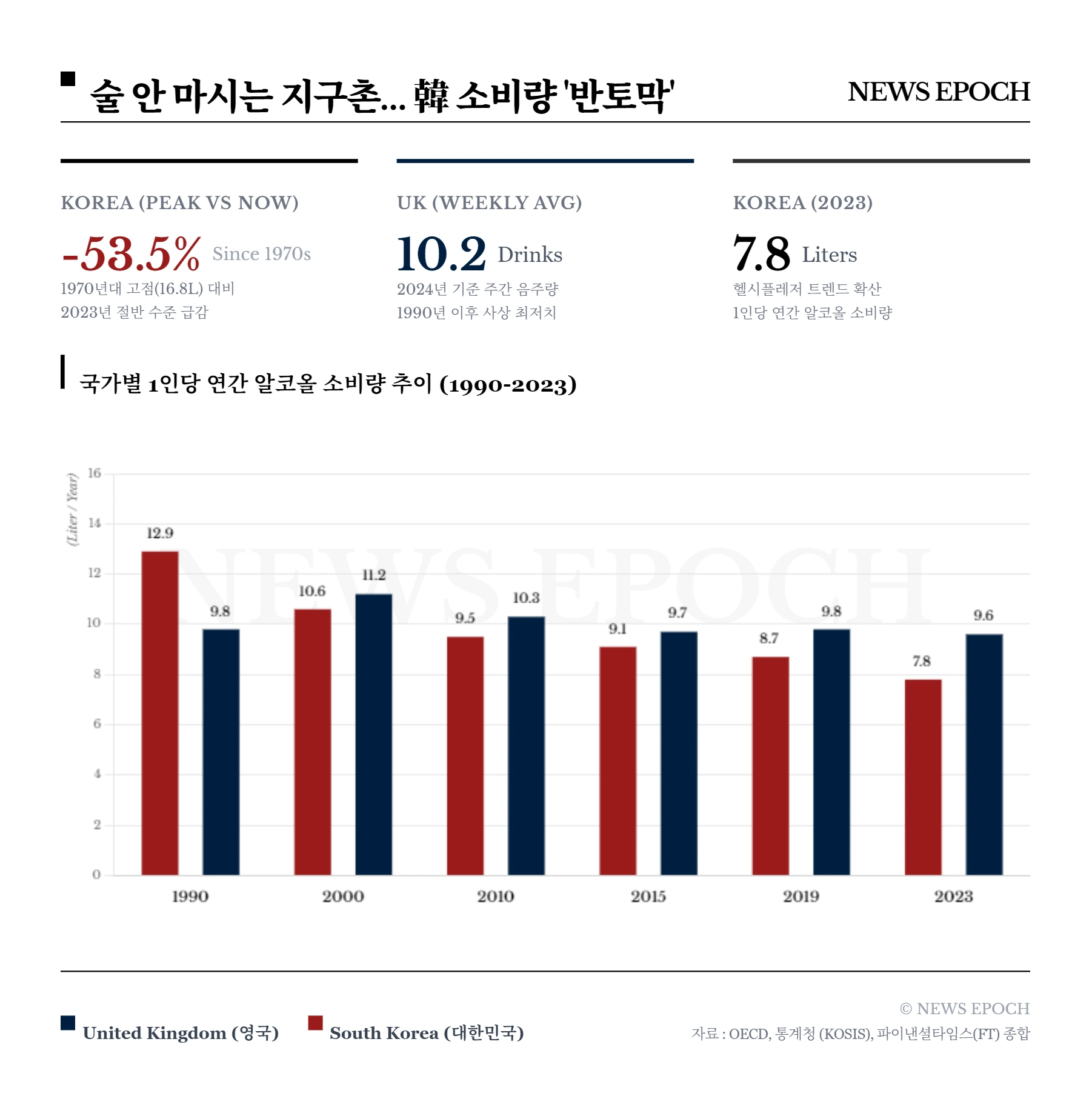
The situation in South Korea is also on the same track. According to data provided by Statistics Korea and the OECD (Organisation for Economic Co-operation and Development), the annual alcohol consumption per capita for the South Korean population aged 15 and over reached a maximum of 16.8 liters during the period of high economic growth in the 1970s, but dropped to a level of 7.8 liters in 2023. This is interpreted as the effect of the disappearance of the past "pour and drink" binge drinking culture and the spread of the 'Healthy Pleasure' trend, which advocates managing health enjoyably.
Experts analyze that this change is not a temporary phenomenon but a structural shift. Although UK Chancellor of the Exchequer Rachel Reeves hinted at a business rate relief package to support pubs, the prevailing outlook is that it will not be easy to reverse the fundamental change in consumption patterns.
The era of socializing dominated by alcohol is coming to an end. While British pubs struggle to maintain their existence through the philanthropic investments of billionaires, South Korea's liquor market is also rapidly being reorganized into low-alcohol and non-alcoholic markets. It is a time that requires deep contemplation on the changing methods of social communication, which are shifting as much as the decreasing number of drinks.
Company financial data, investment reports, and startup analysis — all in one place
Explore PitchdeckCurated news, every week — straight to your inbox
Every Friday · Unsubscribe anytime