19,100 Units Shipped in the First Half... AgiBot Overtakes Unitree with 44%
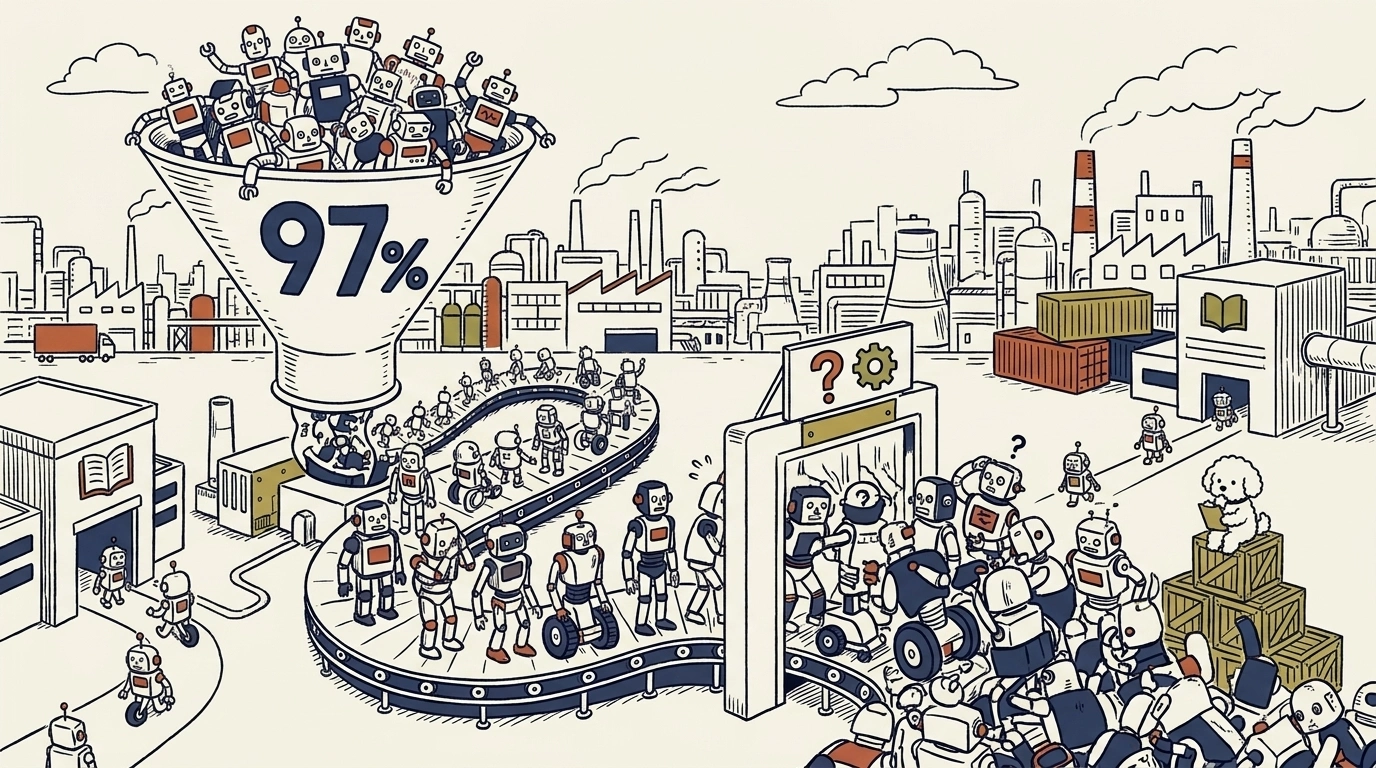
It was reported that Chinese companies accounted for over 97% of global humanoid robot shipments in the first half of this year. Shanghai's AgiBot surpassed Hangzhou's Unitree Robotics to take the global number one spot in terms of shipment volume. The Chinese government expects the country's humanoid production to exceed 100,000 units this year. Following electric vehicles and drones, there are assessments that China has begun to lead the mass production competition in humanoid robots as well.
However, this does not mean that the shipped robots are working stably as replacements for humans in factories or logistics sites. In the case of Unitree, over 70% of its humanoid revenue came from the research and education sectors until the third quarter of last year. There is still a significant gap between "how many can be made" and "how usefully they can be used."
The Chinese Humanoid Market by the Numbers
Category | Figure | Standard/Notes |
|---|---|---|
Global Shipments | Approx. 19,100 units | SAG tally, H1 2026 |
YoY Growth Rate | 272% | Approx. 5,100 units in H1 2025 |
Chinese Companies' Share | Over 97% | Based on SAG's H1 shipment units |
AgiBot | Approx. 8,400 units · 44% | Global No. 1 based on SAG |
Unitree | Approx. 5,900 units · 31% | Global No. 2 based on SAG |
Combined Total of the Two Companies | Approx. 14,300 units · 75% | Three-quarters of global shipments |
2026 Global Shipment Forecast | Approx. 60,000 units | SAG forecast |
China's 2026 Production Forecast | Over 100,000 units | Forecast by China's Ministry of Industry and Information Technology |
According to market research firm Smart Analytics Global (SAG), global humanoid robot shipments in the first half of 2026 were tallied at approximately 19,100 units. This is a 272% increase from the approximately 5,100 units during the same period last year. SAG analyzed that the share of products from Chinese companies exceeded 97% of this total. Bloomberg, the South China Morning Post, and others also cited this survey result, reporting that Chinese companies are dominating the humanoid mass production competition.
In other surveys, China's share appears lower than this. In July, the Associated Press reported China's global humanoid market share to be about 85%. However, the article did not provide specific calculation criteria, such as the research institution, period, or whether it was based on shipment volume or installation volume.
Therefore, it is difficult to conclude that the market share of Chinese companies surged from 85% to 97% in a short period. This is because the scope of humanoids and the standards for shipment and installation differ by research institution. However, the overarching trend that Chinese companies account for the majority of global humanoid production is consistent across different surveys.
AgiBot Overtakes Unitree, Pushing Forward Even with Wheeled Types
AgiBot shipped approximately 8,400 units from January to June this year, accounting for 44% of the global market according to SAG's tally. Shipments increased by 562% compared to the same period last year.
Unitree ranked second with approximately 5,900 units, holding a 31% share. The combined shipments of the two companies amount to approximately 14,300 units, reaching 75% of the global total. AgiBot's rapid growth is related to its diverse product lineup. The company sells the human-sized bipedal A-series, as well as the small bipedal X-series and the wheeled G-series. In spaces with flat floors, such as factories and logistics warehouses, wheels can be more advantageous than two legs in terms of stability and cost. Unitree's shipments were relatively concentrated on its flagship small bipedal robot, the G1. It was understood that a significant number of products were also supplied for educational institutions, research institutes, and performances/exhibitions. Although it gained public attention with its running, dancing, and martial arts movements, it has not yet reached the stage of autonomously performing diverse tasks for extended periods.
Attention is also needed regarding the definition of a 'humanoid.' SAG's tally includes not only robots that walk on two legs like humans but also wheeled products equipped with human-shaped upper bodies. Therefore, it should not be interpreted that Chinese companies accounted for 97% of the global market with bipedal robots alone. The 97% is not based on revenue or technological level, but rather the proportion of shipment units tallied within the product scope set by SAG. The humanoid market still lacks a unified product classification and shipment tally standard.
Competition Between the Two Companies Expands to the Capital Market
The competition between AgiBot and Unitree is also extending into the capital market. However, Unitree is one step ahead in the listing process.
Unitree passed the listing committee review of the Shanghai Stock Exchange's STAR Market on June 1, and subsequently received listing registration approval from Chinese securities authorities in early July. The offering price was set at 150.8 yuan per share, and the public subscription took place on August 10. The company plans to issue approximately 40.45 million shares to raise 6.1 billion yuan. The post-listing market capitalization, based on the offering price, is approximately 61 billion yuan. Once the listing is completed, Unitree is expected to become the first specialized humanoid robot company to be listed on the Chinese mainland stock market.
Unlike many humanoid startups, Unitree is already generating profits. Its 2025 revenue was approximately 1.7 billion yuan, an increase of more than four times from the previous year, and its adjusted net profit recorded about 600 million yuan. Revenue in the humanoid sector was approximately 868 million yuan, surpassing quadruped robots for the first time.
Chinese artificial intelligence startup DeepSeek also participated in this IPO. DeepSeek invested 140.8 million yuan to strategically receive an allocation of 933,399 shares of Unitree. This corresponds to 2.31% of the strategic allocation volume, not 2.31% of Unitree's total equity. The two companies decided to combine DeepSeek's AI model with Unitree's mechanical engineering and motion control technology. The core of their cooperation is the 'robot's brain,' which enables the robot to understand unfamiliar environments and translate instructions into actual movements. AgiBot also began preparations for listing on the Hong Kong stock market in July. It has not yet reached the listing review and public subscription stages, so it is at an earlier stage than Unitree.
Two 'Robot Schools' Emerge in Hangzhou
Chinese media have recently introduced a series of scenes showing robots receiving vocational training in Hangzhou. The facility, officially named 'Hangzhou Robot School,' opened on June 29 at Yunmen Park in the Hangzhou Chengxi Sci-Tech Innovation Corridor. It was jointly established by the Zhejiang University Robotics Institute and the Zhejiang Institute of Quality Science, among others, and 30 robots from the industrial, service, security, and cultural sectors were enrolled as the first 'students.' This is a facility that trains robots in sector-specific skills and evaluates their performance, just as humans receive vocational education. It is divided into four fields: a technical school, a health school, an art school, and a sports school. Robots that pass the training and evaluation are issued skill grade certificates.
The facility described as a 'robot vocational school' by Xinhua News Agency and overseas media citing it is not this school, but the 'National Artificial Intelligence Application Pilot Test Base (Embodied Intelligence)' located in Binjiang, Hangzhou High-Tech Zone. This pilot test base held a plaque-unveiling ceremony on May 16 and officially launched. 'Pilot test' refers to the stage of testing and verifying technologies and products in environments similar to reality before putting R&D results into mass production. Rather than a demonstration school, it is closer to a national-level pilot verification platform connecting laboratories and production sites.
Xinhua News Agency likened the robots learning by repeating the same tasks to a school. As of the time of the report, over 140 robots were being trained in more than 40 environments, including smart kitchens, logistics warehouses, agriculture, and underground mining operations. It was reported that about 40 companies and more than 10 universities and research institutions are also participating in the development and training.
The training is conducted by having humans remotely operate the robots to repeat precise movements while sensors record this data. Humans also wear data gloves and motion capture equipment to collect movements for the robots to learn. The reason such facilities are necessary is due to the difference between simulation and reality. Even robots that operate well in virtual environments may fail at tasks if the position or shape of an object changes slightly, or if the lighting varies.
If China's strength lies in its ability to produce robot hardware quickly and cheaply, the robot schools and pilot test bases serve the role of accumulating the data and skills necessary to work in actual sites. This shows that China's robot competition is shifting from the number of units produced to operational capabilities.
70% are for Industrial/Commercial Use, But... Unitree is 73.6% for Research/Education
SAG analyzed that among the global humanoid shipments in the first half of this year, products classified for industrial and commercial use exceeded 70%. The explanation is that this share increased significantly from about 50% during the same period last year. However, this should not be taken to mean that 70% of shipped robots are actually replacing labor in factories. Even if purchased for industrial use, they may still be in the stages of testing, data collection, and pilot projects. Commercial use also includes applications such as performances, exhibitions, and store guidance.
Unitree's securities registration statement concretely demonstrates this gap. From January to September 2025, 73.6% of Unitree's humanoid revenue came from the research and education sectors. Commercial and consumer uses accounted for 17.4%, while industrial applications stood at only 9.0%. The two statistics may seem diametrically opposed, but their tally standards are different. The SAG statistics are figures that combine industrial and commercial classifications based on global shipments in the first half of 2026. The Unitree data is the result of dividing one company's humanoid revenue from January to September 2025 into research/education, commercial/consumer, and industrial applications. Nevertheless, Unitree's revenue structure illustrates where the primary sources of demand lie in the current humanoid market. While demand to replace humans in industrial settings is increasing, the market is still currently supported by R&D and secondary development demand from universities, research institutions, and technology companies.
SAG also evaluated that the mass production speed of robot hardware is outpacing the maturity of foundational technologies such as AI models, reliability, and operation accuracy. Actual operational data, safety, and cost were also cited as factors restricting large-scale deployment.
The Difference Between 'Producing 100,000 Units' and 'Shipping 60,000 Units'
Gan Xiaobin, Deputy Director General of the Science and Technology Department at China's Ministry of Industry and Information Technology, predicted at the World Artificial Intelligence Conference press conference on July 7 that China's humanoid production would exceed 100,000 units in 2026. The Wire China also noted that China is preparing to produce a record number of humanoids, asking the question, "Where will all those robots go?" The outlet cited the fact that the combined sales volume of AgiBot and Unitree, which represent China, fell short of 11,000 units in 2025.
The Chinese government's production forecast is higher than the roughly 60,000 global shipments SAG projected for this year. The two numbers are difficult to compare directly due to different product definitions and survey scopes. Production volume refers to the number of units manufactured in factories, while shipment volume is the quantity delivered to customers or distribution networks. Unsold inventory and test products may be included in production volumes, and a company's secured production capacity might not necessarily translate into actual capacity utilization or sales volume.
For humanoids to handle objects delicately and respond to unforeseen situations, issues such as judgment, safety, and battery life must be resolved. Showing off demonstration movements for a few minutes is a different matter from working for long hours every day on a production line.
U.S. Sets Market Entry Barriers for New Models
A new variable—U.S. regulation—has also emerged for the overseas expansion of Chinese companies. In late July, the U.S. Federal Communications Commission (FCC) added foreign-produced humanoids and quadruped robots to its list of regulated items. For robots with wireless communication capabilities to be sold in the U.S., they require FCC equipment authorization. Consequently, new foreign-made models that have not yet been approved will face difficulties entering the U.S. market unless they receive a separate exemption. While the regulation targets foreign products, the practical impact is expected to be concentrated on Chinese companies. It would be inaccurate to describe this as a "comprehensive import ban on Chinese-made robots." Models that have already received FCC authorization can continue to be imported, sold, and marketed in the U.S. It is also not applied retroactively to products that consumers have already purchased and are using.
The federal government's purchase and use of Chinese robots is also not an area directly governed by this FCC action. In the U.S. Congress, a separate bill is being pushed forward to restrict the federal government from purchasing or using robots produced in adversary countries such as China. U.S. regulations are a non-trivial variable for Unitree, which has a high proportion of overseas revenue. During each period subject to disclosure, Unitree generated over 40% of its total revenue from overseas. In 2025, the U.S. accounted for 13.3% of its revenue.
While Unitree's existing products can continue to be sold having received FCC authorization, new models to be launched in the future may be blocked from entering the U.S. The company also cited U.S. regulations as a risk factor during its listing process, noting that they could affect future overseas business.
Manufacturing Capabilities Proven... The Next Test is Actual Demand
It is clear that China is ahead in the mass production competition for humanoid robots. It possesses a supply chain for components such as motors, sensors, and batteries, and can utilize various manufacturing sites as testing grounds. Government support, local government demonstration projects, and active investments are also backing companies' production expansion. However, 97% of shipments does not equate to ultimate victory in the humanoid technology competition. The market size is still small, and definitions of humanoids and shipment tally methods differ across research institutions.
Above all, they must secure customers who will continually use the produced robots, along with economically viable tasks. For Unitree to prove the high expectations reflected in its offering price, it must expand demand centered around research and education into actual industrial sites. AgiBot, too, must show whether its rapidly increasing shipments lead to repeat purchases and stable profits. The future battle will not depend on how many robots were built, but on how long, accurately, and independently the shipped robots can work in factories and logistics warehouses without human assistance.
Company financial data, investment reports, and startup analysis — all in one place
Explore PitchdeckCurated news, every week — straight to your inbox
Every Friday · Unsubscribe anytime