UK's The Economist: "Pop Market at Its Most Depressed in 30 Years…
Surge in 'Anxiety' Keywords" Korean Research Team: "K-Pop is the Exact Opposite…
'Negativity' Decreasing While 'Positivity and Self-Esteem' Words Trend Upward" Recent Korean Trend is 'Harmless Sorrow'…
Choosing the Comfort of 'Easy Listening' Instead of Displaying Pain...
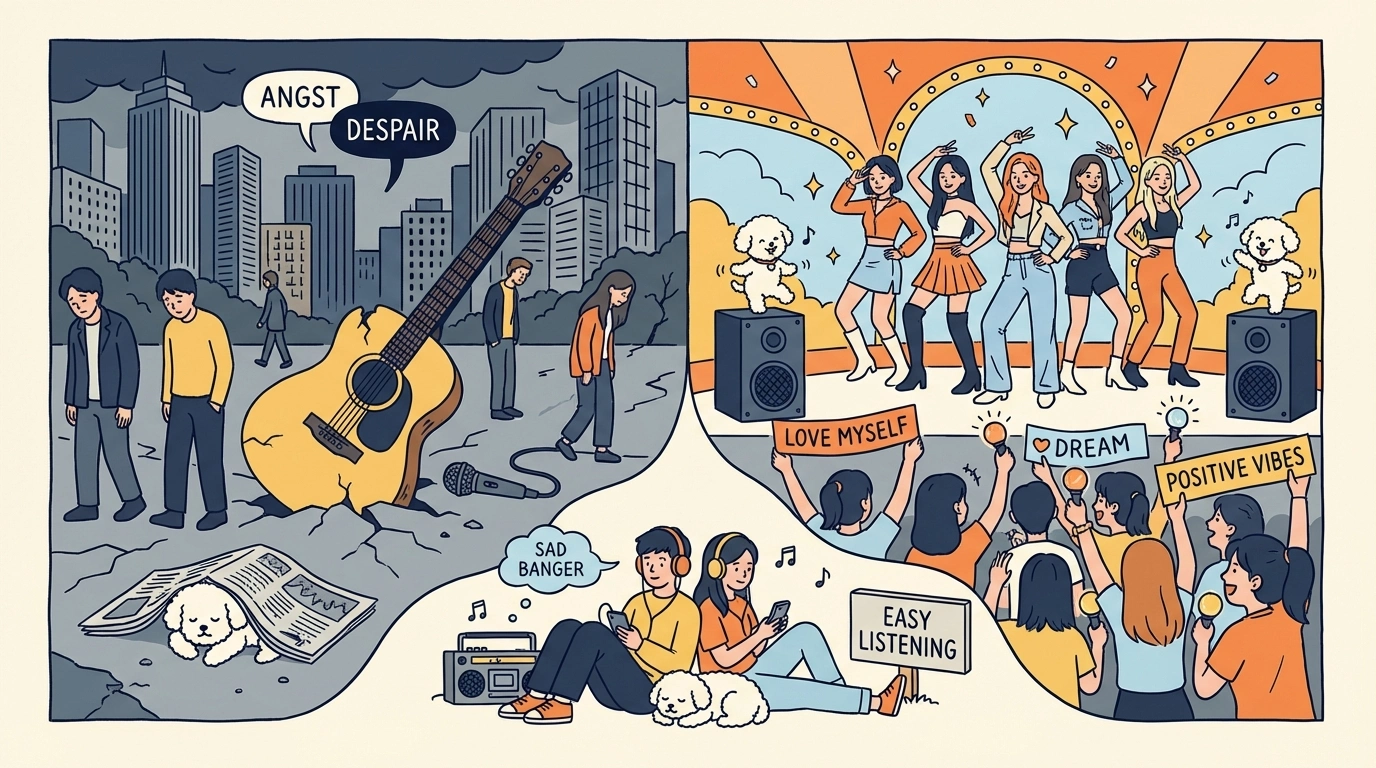
While songs by global pop star Billie Eilish sweep the charts, the languid melodies of NewJeans fill the streets in Korea. Recently, the British weekly magazine The Economist diagnosed through data analysis using AI (Artificial Intelligence) that the Western pop music market has become unprecedentedly depressed. However, the Korean popular music (K-POP) market was found to have drawn a completely different trajectory. The analysis suggests that while the West 'recorded' the anxieties of the times by projecting them into lyrics, Korea grew by selling 'fantasy' and 'positivity' that make people forget reality. We looked into the stark differences in how the two markets handle 'sadness' through data.
The West: "The World is Sick, So the Songs are Sick Too"
According to analyses by publications such as The Economist and the scientific journal Scientific Reports, Western popular music has shown a trend of steadily becoming darker for more than the past 30 years. As a result of analyzing the lyrics of top-ranking songs on the Billboard Hot 100 chart, the frequency of mentioning 'Angst' increased by 13 percentage points since the 2000s. In particular, expressions implying 'Despair' surged after the 2020 pandemic, accounting for about a quarter of the top-ranking songs on the chart.
This is not merely a change in artists' tastes, but a projection of the historical background. The 'Raw Pain' faced by modern people, such as the fear of the climate crisis, economic inequality, and a sense of social isolation, has been directly transplanted into popular music. The gloomy, bizarre, and sometimes dreamy sentiments shown by artists like Sam Smith and Billie Eilish are serving as a kind of 'mirror' that speaks for the anxieties of the Western public.
Korea: "The Harder Reality is, The More Confident We Are"
On the other hand, Korean popular music draws the exact opposite graph to the West. According to a paper published in 2022 in the international academic journal Emotion by researcher Cho Won-kwang of the Graduate School of Public Health at Seoul National University and Professor Kim Min-woo's team from the Department of Psychology at Sungkyunkwan University, an analysis of the top 2,962 songs on the Melon annual chart over 30 years from 1990 to 2019 showed that in Korean popular songs, words indicating 'negative emotions' decreased while the use of 'positive words' distinctly increased.
The research team analyzed that the sentiment of tragic ballads that dominated the Korean music scene in the 1990s, the so-called sentiment of 'Han' (deep sorrow or resentment), was replaced by 'Love Myself' and 'confidence' alongside the growth of the idol industry since the 2010s. In the midst of rapid economic growth and a competitive society, the Korean public wanted to consume 'fantasies that overcome reality' through music, rather than confirming the depression of reality. If Western music is a reflection of reality, Korean music has acted as a compensation for a sense of lack.
Changes Post-2020: 'Sad Bangers' and Harmless Comfort
What is noteworthy is the subtle change detected in the Korean market as well since the 2020 pandemic. A melancholic sentiment has begun to permeate the K-POP market, which was once 'one-sidedly positive,' but its method differs in texture from the 'direct despair' of the West.
The trend that has recently dominated the Korean charts is so-called 'Easy Listening.' NewJeans' 'Ditto' is a prime example. Unlike in the past, it does not appeal to sadness by belting out high notes, nor does it inject excessive energy. Instead, it conveys a 'harmless melancholy' through mid-to-low toned, mumbled-sounding vocals and a 'Lo-fi' sound with intentionally muffled audio quality.
An interesting paradox is also found in the data. Recently, the BPM (beats per minute) of K-POP girl group songs has been trending faster to 130-150 and above. Breaking the formula that sad songs are slow, the 'Sad Banger' genre—which overlays lyrical and melancholic melodies on top of fast and exciting beats—has emerged. This is a way of hiding sadness within a sense of speed that gives no time to think, reflecting the psychology of the youth generation that wants to consume the dual emotion of being "excited yet sad."
Ultimately, if Western pop has served as an 'indicator' that records and expresses the mental pain of the times, Korean popular music can be seen as having performed the role of a 'painkiller' that makes one briefly forget the exhausting reality.
The recent trend of 'calm depression' observed in the Korean market shows the fatigue of the public, who find it increasingly difficult to be comforted by unconditional positivity or fantasies alone. Faced with a reality that is too burdensome to confront directly and too large to ignore, the Korean public is choosing 'undisturbed comfort.'
Company financial data, investment reports, and startup analysis — all in one place
Explore PitchdeckCurated news, every week — straight to your inbox
Every Friday · Unsubscribe anytime