![[Feature] From the 1st Generation Craving 'Connection' to the 4th Generation Seeking 'Godsaeng'... The History of South Korea's Digital Culture Evolution](https://d1gl51xbrxoj65.cloudfront.net/uploads/2026/01/30/1769752167174-ruoew.webp)
The 25 years of South Korea's digital trends are more than just the rise and fall of services; they are a record of fulfilling the psychological hunger of Korean society. From the desire to restore relationships after the IMF Asian financial crisis in the late 1990s to the enjoyment of hyper-personalized AI technology in the 2020s, we analyzed the context of digital trends alongside the socio-cultural backgrounds of each era.
1. Late 1990s to Early 2000s: Finding 'Us' Again
Key Trends: Sticker photos (1998), I Love School & Damoim (1999), Haduri (1999)
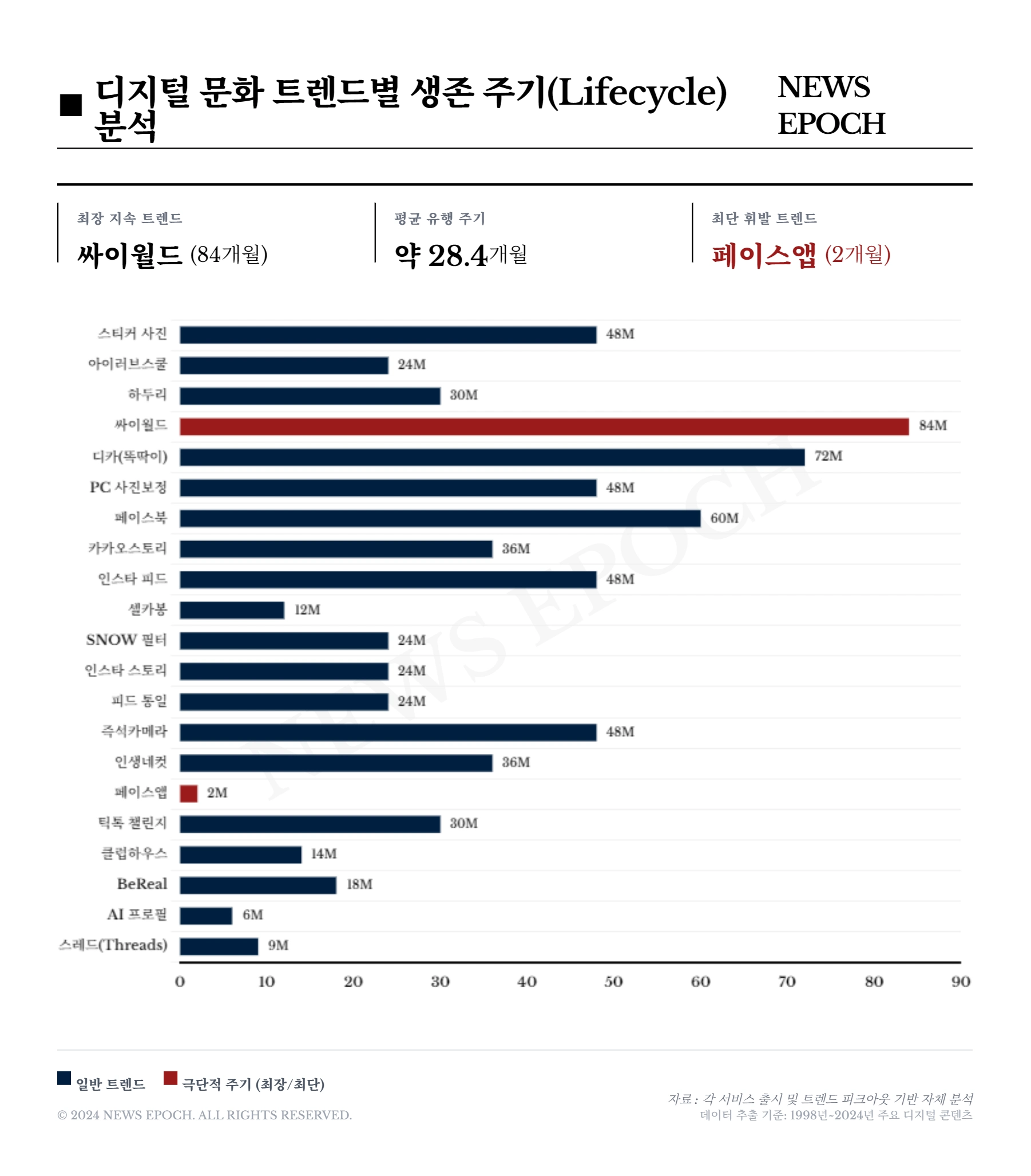
This period immediately followed the IMF Asian financial crisis, marking the point where longing for dismantled communities met digital technology. The reason I Love School and Damoim left such powerful memories despite peaking and disappearing within 24 months of their launch was the zeitgeist of the time, which sought to confirm a 'social safety net' by restoring disconnected elementary, middle, and high school networks online. I Love School digitally transplanted the unique emotional code of Korean society known as school ties. The act of finding alumni went beyond simple socializing; it served as a psychological defense mechanism to confirm one's roots amidst an uncertain future. This became the prototype for all subsequent Korean-style community services.
Offline, sticker photos took over bustling streets. As non-face-to-face communication like PC communication increased, paradoxically, the desire to physically prove and possess 'being together' drove a 64-month trend. The webcam culture, represented by Haduri, also gave birth to the neologism 'Ulzzang' (best face), heralding a shift in media power once monopolized by mass media, showing that ordinary individuals could also become the protagonists of media.
2. Mid-2000s to Early 2010s: Building the World of 'Me'
Key Trends: Cyworld Minihompi (2001), Popularization of digital cameras (2000), PC photo editing (2006)
As the high-speed internet penetration rate reached the highest level in the world, the digital space transformed from a place for 'information search' to one of 'self-exhibition.' Cyworld established the digital communication grammar of Koreans, enjoying the longest heyday of 84 months. 'Dotori' (acorns) and 'BGM' were not merely paid items, but components of a persona that revealed one's tastes. The core of Cyworld's success was the combination of 'conspicuous consumption' through the cyber currency called 'Dotori.' The act of decorating a Miniroom and setting background music (BGM) simultaneously satisfied the desire for real estate ownership in the digital space and the desire for self-exposure. The concept of 'Ilchon' (close digital friends) is evaluated as the device that most perfectly implemented the closed and tight-knit Korean-style networking culture online.
During this period, the trend of digital cameras (point-and-shoots) and PC editing programs sparked the 'Pposyasi' (soft and bright filter) craze. This was a reflection of the desire to cultivate a 'digital self' better than the real me. Facebook, which landed in 2009, and KakaoStory in 2012 expanded the scope of this exhibition from the closed structure of 'Ilchon' to 'acquaintances and the unspecified masses,' spreading the influence of social networks throughout everyday life.
3. Mid-2010s: The Golden Age of Mobile and 'Proof Shots'
Key Trends: Selfie sticks (2014), SNOW (2015), Instagram Stories (2016)
As smartphone performance advanced dramatically, social media became an 'exhibition hall that must be perfect.' The center of trends shifted completely from PC to mobile. The background to the selfie stick enjoying a short and bold 12-month heyday was the combination of the atmosphere of liberalized overseas travel and the SNS 'proof shot' culture. It was the point where leaving a record of 'myself being there' became more important than the experience at the travel destination itself.
The 'aesthetic' trend led by Instagram also generated social fatigue over 'show-off consumption.' As a reaction to this, the public went wild when the Story feature, which disappears after 24 hours, emerged in 2016. The goal was to ease the burden of communication by sharing light and volatile daily lives rather than perfectly edited photos (feeds). This meant that digital communication had changed from 'recording' to 'playing,' resulting in lowering the threshold of communication and maximizing time spent on the platform.
4. 2018 to Early 2020s: The Revival of Retro and the Routinization of AI
Key Trends: Life Four Cuts (2018), TikTok Challenges (2020), Clubhouse (2021), AI Profiles (2022)
Recent trends are characterized by the polarization of 'technological advancement' and 'analog experiences.' The revival of photo booths like Life Four Cuts provided Generation Z, who are digital natives, with the novelty of 'tangible records,' establishing itself as a long-term trend lasting over 36 months.
On the other hand, the COVID-19 pandemic abnormally accelerated the pace of change in digital trends. As face-to-face contact was banned, short-form challenges spearheaded by TikTok exploded for 30 months, altering the media consumption structure, and Clubhouse, which communicated solely through voice, delved into human loneliness and garnered attention for 14 months. AI profiles and AI avatars that appeared later peaked in just six months, suggesting that technology has now reached the stage of reinventing even human identity.
In the 2020s, dominated by the craze for living a 'Godsaeng' (God+生, exemplary life) and the obsession with self-improvement, the public wanted to materialize an 'ideal self' that was much more capable or beautiful than their actual selves. AI profiles are in the realm of 're-creation,' going beyond simple photo editing. They satisfied an 'efficient vanity' by obtaining results better than studio shoots for a cost of just a few thousand won. This shows that digital trends no longer remain merely features of a platform, but have evolved into an 'event-type trend' where users instantly transform and consume their identities utilizing AI technology.
Looking back at the records of the past 25 years, the trend is that the lifespan of technology is shortening while its cultural afterimage is deepening. Even if a service disappears, the human desires that the service satisfied reappear in mutated forms. The text-centric loose solidarity currently attempted by Threads is also interpreted as an attempt to modernly reinterpret the nostalgia for the 'essential communication' held during the days of PC communication and Cyworld.
Company financial data, investment reports, and startup analysis — all in one place
Explore PitchdeckCurated news, every week — straight to your inbox
Every Friday · Unsubscribe anytime