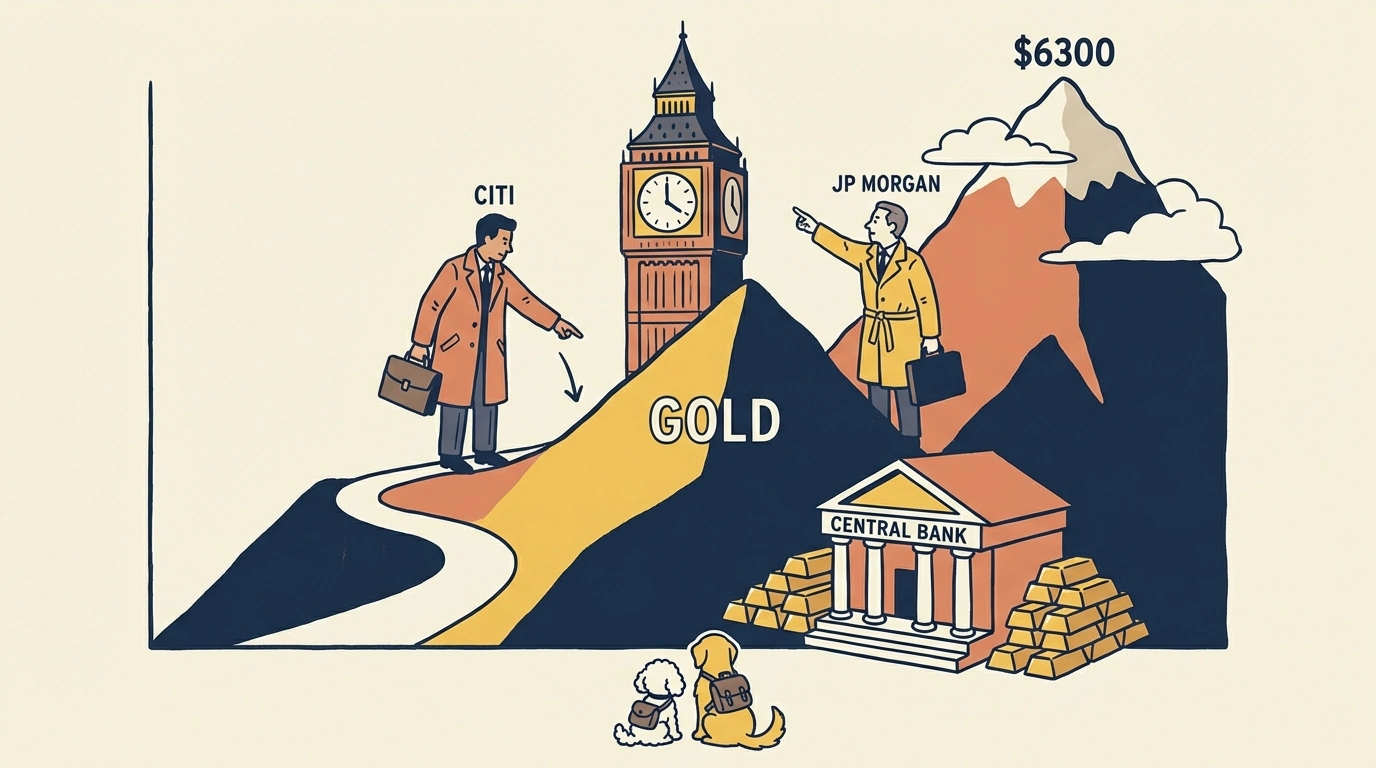
Citi and JPMorgan offer mixed short-term outlooks following the nomination of the next Fed Chair
Citi "Turning point in the second half of 2026, possibility of a crash if geopolitical risks ease"
Investment demand is the key variable in price determination amid continuous central bank buying
While major global investment banks (IBs) are successively raising their gold price forecasts, they are presenting sharply divided views on short-term volatility and the timing of reaching future peaks. While Citi Research has warned of a steep downside risk starting in the second half of 2026, JPMorgan reaffirmed its 'structural bull market' for gold by presenting an unconventional target price of $6,300 for the end of 2026.
The global gold market has recently reacted sensitively to the news of former Fed Governor Kevin Warsh's nomination as the next Fed Chair. Gold prices, which were threatening the $5,100 per ounce mark, experienced a correction, being pushed below $5,000 following Warsh's nomination as a dollar rebound and expectations of strengthened Fed independence were priced in. However, experts are engaged in a fierce debate over whether this correction is a departure from the long-term upward trend or a breather.
In a recent report, Citi Research strongly criticized the gold market for being in an 'overheated state' that is extremely detached from marginal mining costs. Citi notes that the geopolitical and economic risks currently supporting gold prices will largely be resolved starting in the second half of 2026. In particular, it analyzed that if the Trump administration pursues a low-growth, low-inflation 'Goldilocks' economy aiming at the 2026 mid-term elections, and the end of the Russia-Ukraine war and easing of tensions with Iran materialize, the massive risk premium reflected in gold could evaporate in an instant.
Citi likened this to the 'Sword of Damocles.' Currently, about 4% of global household net worth is concentrated in gold, and the valuation gains generated over the past three years alone amount to $20 trillion. Citi stated, "Even if a tiny fraction of these massive gains is reallocated to other assets, it will create a supply shock that overwhelms current demand," and did not rule out the possibility of gold prices plummeting to the $2,500~3,000 level if asset allocation normalizes. In particular, the observation is that if Fed Chair nominee Kevin Warsh strengthens the Fed's independence, it will act as additional downward pressure on gold prices.
On the other hand, JPMorgan shows confidence that despite short-term volatility, gold's structural bull market has just entered its midpoint. JPMorgan analyzed that strong central bank buying and investors' diversification demands are far exceeding initial expectations. Accordingly, it aggressively raised its gold price target for the end of 2026 to $6,300 per ounce. JPMorgan assessed, "In a regime where the superiority of real assets over paper assets is firm, gold remains the most dynamic and multifaceted portfolio hedge instrument," and diagnosed that the risk of the current rally collapsing under its own weight is still low.
JPMorgan particularly cited as a strength the fact that gold, unlike silver, has a strong structural dip-buying entity in the form of 'central banks.' Although silver showed signs of overheating in the process of chasing gold in the short term, the outlook is that gold will draw an upward curve throughout 2026, driven by persistent supply shortages and a massive global asset rotation.
Goldman Sachs also added weight to this bullish view by selecting gold as a top recommended asset for 2026. Goldman Sachs analyzed that private investors have a stronger tendency to hold onto their gold positions long-term (Sticky) in response to macroeconomic policy risks such as fiscal sustainability, and raised its end-of-2026 target price to $5,400. Goldman Sachs specifically forecast that central banks will steadily purchase a monthly average of more than 60 tons of gold, keeping the market's supply and demand in a tight balance.
Another variable in the gold market is artificial intelligence (AI) and the concentration of asset allocation. Citi pointed out that while uncertainties over AI's impact on economic growth and concerns about a stock market bubble are supporting gold demand, the proportion of gold in household net worth currently exceeds 4%, recording a historical high. Citi's view is that even if a tiny fraction of the estimated $20 trillion in valuation gains generated over the past three years shifts to other assets, it could cause a supply shock that overwhelms current demand.
Ultimately, the future success of the gold market is expected to be determined by whether risks are actually resolved at the 'turning point in the second half of 2026' pointed out by Citi, or whether the 'structural shift to real assets' as forecast by JPMorgan overwhelms this. It is a time for investors to closely watch the trajectory of the $20 trillion in valuation gains along with whether geopolitical tensions will ease.
Company financial data, investment reports, and startup analysis — all in one place
Explore PitchdeckCurated news, every week — straight to your inbox
Every Friday · Unsubscribe anytime