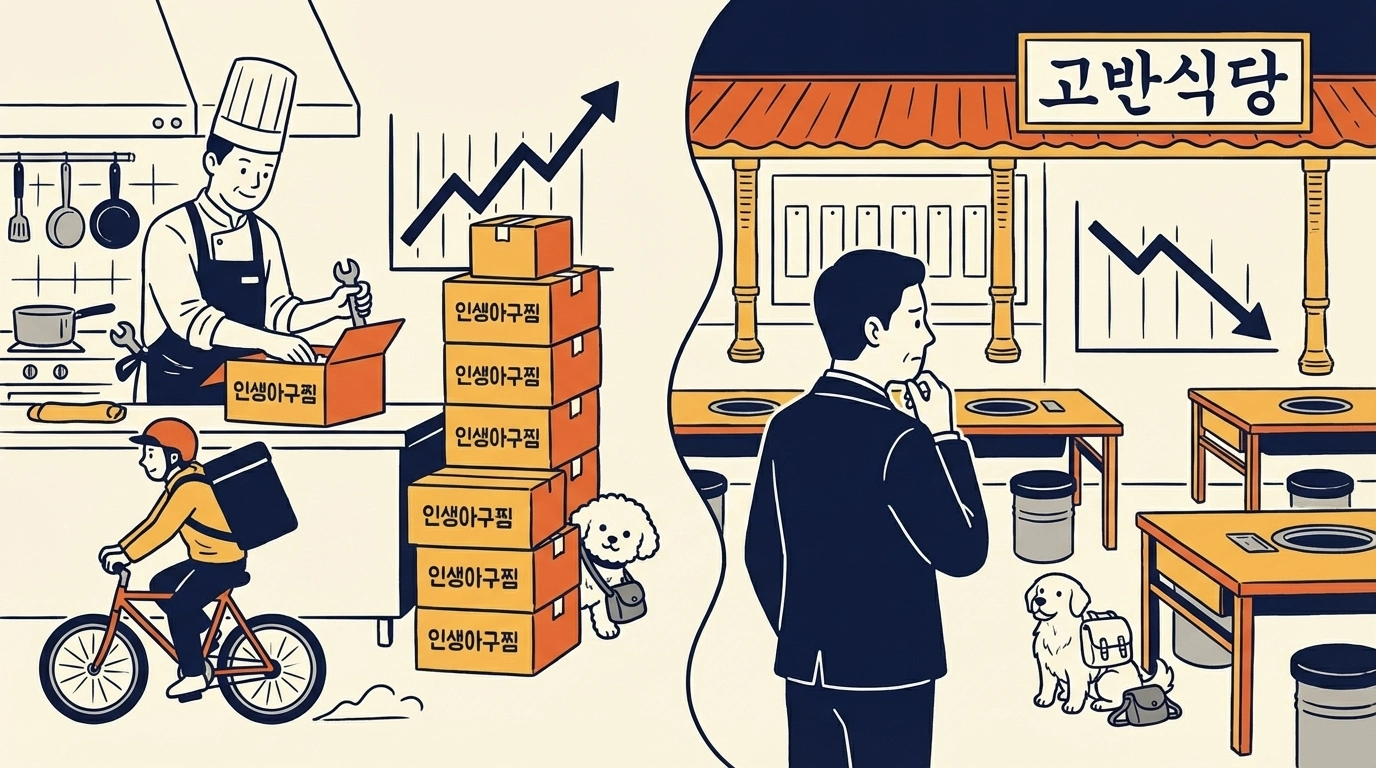
Recently, the paths of two mid-sized brands in the domestic food service franchise industry are diverging. While Insaeng Food, which operates the delivery-specialized 'Insaeng Agujjim', is taking over the market with rapid growth, Goban Holdings, which operates the premium Korean pork barbecue restaurant 'Goban Sikdang', appears to have entered a period of declining performance due to the departure of franchisees. In particular, both brands drew attention for the unique backgrounds of their founders, but the report cards they currently hold show opposite situations.
■ Goban Sikdang Created by a 'Large Corporate Manager' vs Insaeng Agujjim Crafted by an 'Aircraft Mechanic'
The founders of both companies share the commonality of having boldly given up stable jobs to jump into the food service industry.
Han Ji-hoon, CEO of Goban Holdings, was an office worker who had been smoothly promoted to the position of manager at a leading domestic shipping conglomerate. However, he could not abandon his dream of entering the food service industry, which he had harbored since his college years, and resigned at the age of 35 despite fierce opposition from his family. Inspired by the traditional fermented sauces and side dishes made by his mother, who was an excellent cook, CEO Han envisioned a 'meat restaurant like a Korean table d'hôte' rather than an ordinary pork belly restaurant. With the meaning of serving an 'excellent meal,' he used the Chinese characters 'Go (高, high)' and 'Ban (飯, meal)' to found Goban Sikdang in 2016, entering the premium pork belly market.
On the other hand, Lee Sang-hoon, CEO of Insaeng Food, was a young man working as an aircraft mechanic at Asiana Airlines. Wanting to earn more money, he quit his stable job and dabbled in an academy business, but lost all his investment money in just six months and even suffered from depression. Afterwards, to get back on his feet, he worked three jobs—loading and unloading packages at dawn, delivering by bicycle at lunch, and working in a restaurant kitchen in the evening—while analyzing the market. Noting that the core consumer group in the delivery market was women in their 30s and 40s, he selected 'agujjim (braised spicy monkfish)'—an item with a high average check and barriers to entry—as his product, and started Insaeng Agujjim in a small store of just over 8 pyeong (approx. 26 square meters) in Bucheon in 2020.
■ Explosive Growth of 'Insaeng Food' vs Flashy but Empty 'Goban Holdings': Diverging Realities
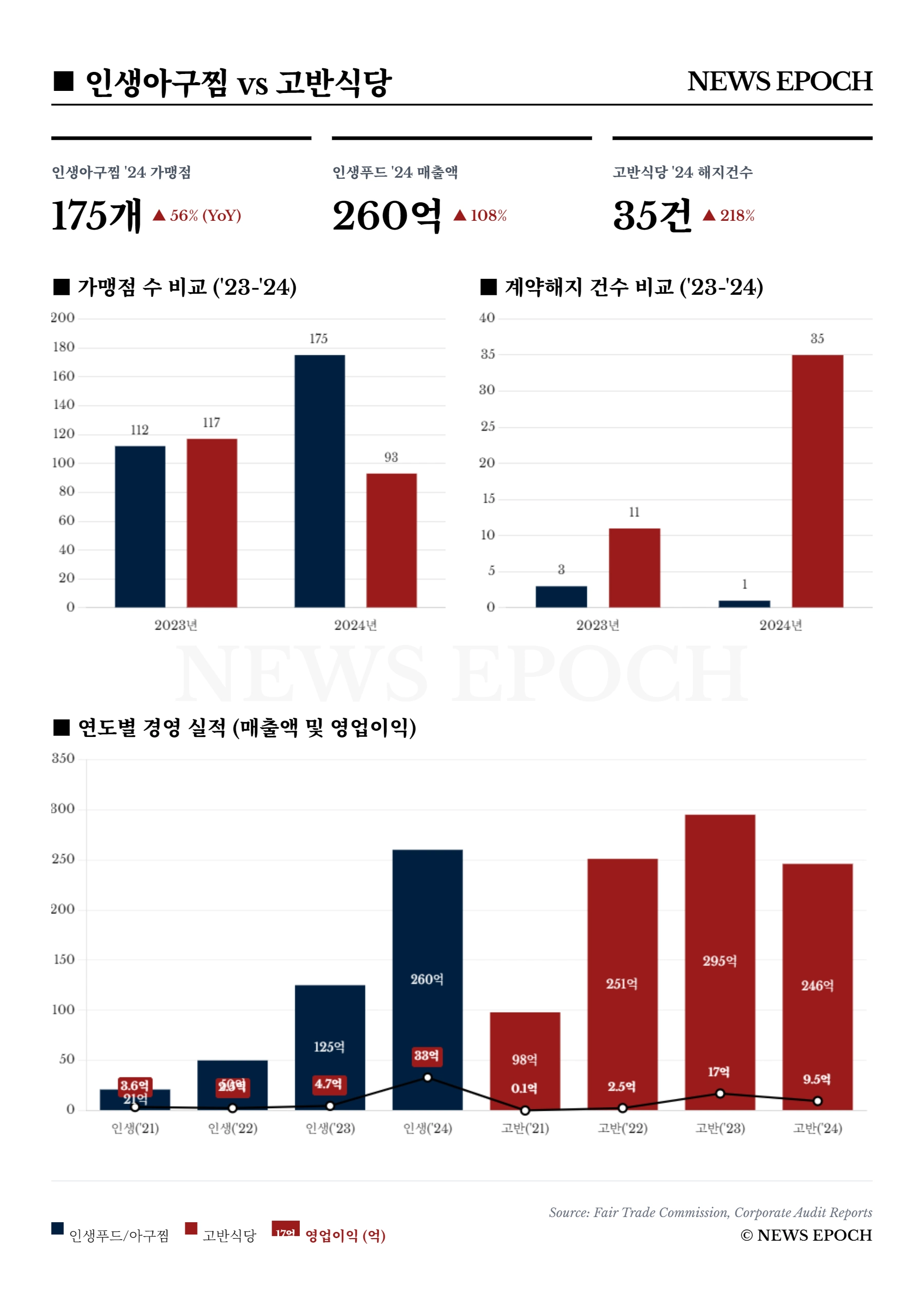
Although their beginnings were different, both brands once achieved rapid growth in the fiercely competitive food service industry. However, recent management indicators shown in Fair Trade Commission data reveal a stark contrast between the two companies.
The number of Insaeng Agujjim franchise stores is showing an explosive annual increase, from 52 in 2022 to 112 in 2023 and 175 in 2024. What is noteworthy is that the number of contract cancellations is continuously decreasing—9 in 2022, 3 in 2023, and 1 in 2024—despite the surge in franchise stores. This is because the head office's win-win strategy of focusing on maximizing the profit margins of franchisees, such as lowering logistics costs through its own sauce factory and fully covering marketing expenses, has been successful. As a result, Insaeng Food's revenue, which was at the level of about 5 billion won in 2022, surged to 12.55 billion won in 2023 and about 26.04 billion won in 2024, and its operating profit also skyrocketed from 250 million won in 2022 to about 3.39 billion won in 2024, achieving a robust quantum jump.
In contrast, Goban Sikdang, which once rode high by surpassing 100 stores even during the COVID-19 pandemic, saw negative growth as its number of franchise stores fell from 117 in 2023 to 93 in 2024. The most serious problem is that the departure of franchisees is accelerating, with contract cancellations more than tripling from 11 in 2023 to 35 in 2024. Performance indicators are also trending downward. Goban Holdings' revenue in 2023 was approximately 29.51 billion won with an operating profit of 1.77 billion won, but in 2024, both revenue and profit dropped significantly to about 24.65 billion won in revenue and 950 million won in operating profit. Although it once achieved rapid external growth, it failed to solidify its internal foundation, leading to a lingering sense of crisis about potentially turning a deficit.
■ Intensifying Survival Competition in the Franchise Industry: What are the Implications?
The contrasting results of the two franchises perfectly reflect the tough business environment currently facing the food service industry. Rapidly changing food service industry trends, unyielding high inflation, continuously emerging new popular restaurants, and the upwardly standardized public palate due to the recent increase in the production of cooking competition shows are demanding higher innovation from franchise headquarters and store owners.
The cases of Insaeng Food, which started again from the bottom and is drawing a solid upward curve with the operation of its own sauce factory, hygiene management, and thorough franchisee-centered support policies, and Goban Holdings, which rested on past external expansion and now faces the painful reality of franchisee departures, clearly indicate what the 'sustainable survival method' for franchise companies should be going forward.
Company financial data, investment reports, and startup analysis — all in one place
Explore PitchdeckCurated news, every week — straight to your inbox
Every Friday · Unsubscribe anytime