![[Ski Resort Industry ①] The Disappearance of Winter and the Structural Crisis of the South Korean Ski Industry on the Brink](https://d1gl51xbrxoj65.cloudfront.net/uploads/2026/03/19/1773901219842-qe3ewu.webp)
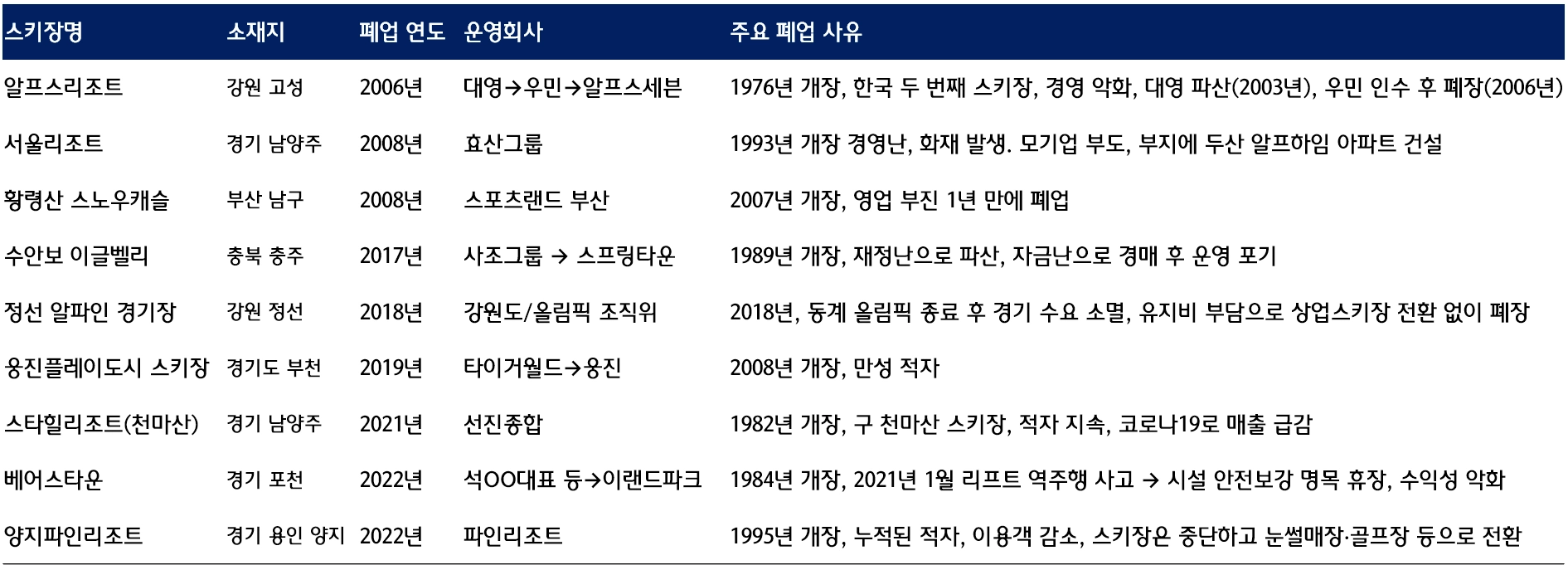
South Korea's ski resorts, once called the 'flower of winter sports' and anticipating an era of 10 million annual visitors, now stand at a massive crossroads of survival. The number of ski resort visitors nationwide, which reached about 6.86 million in 2011, plummeted to around 1.46 million during the COVID-19 pandemic, and stayed at the 4.43 million to 4.58 million mark as of 2023, recovering to only 60% of its peak. Out of the 17 ski resorts that once existed, five have closed since 2010 due to accumulated deficits. In particular, places such as the Alps Ski Resort in Goseong-gun, Gangwon Province, which closed due to financial difficulties, have been left neglected and turned into eyesores with demolition costs reaching billions of won. Consequently, the local commercial districts and economic communities formed around the ski resorts are also taking a direct hit from this chain collapse.
The 'Disappearance of Winter' Proven by 113 Years of Climate Data
The most fatal and fundamental cause of the ski industry's collapse is precisely 'climate change.' According to the '113-Year (1912-2024) Climate Change Analysis Report on South Korea' published by the Korea Meteorological Administration, the annual average temperature has clearly risen by 0.21℃ every 10 years over the past 113 years. In particular, the trend of seasonal temperature increases is steepest during spring (+0.28℃) and winter (+0.24℃), which are the most important periods for ski resort operations.
For a ski resort to make a profit, there is a so-called '100-day rule,' which dictates that there must be at least 30 cm of accumulated snow for a minimum of 100 days a year. However, over the past 113 years, the number of snow days has shown a clear downward trend, decreasing by 0.74 days per decade, and the number of snow days in the last 10 years (2015-2024) has dropped by a whopping 5.5 days compared to the 113-year average. All extreme low-temperature climate indices indicating cold, such as cold wave days (-1.2 days), frost days (-17.3 days), and freezing days (-4.5 days), have plummeted over the past decade, meaning the very winter environment where it should snow and freeze is fundamentally disappearing.
The Impact of Non-linear Climate Risks on Ski Resort Revenues
This climate change is directly destroying the economic profit structure of ski resorts. According to an analysis by a Seoul National University research team using big data on credit card expenditures from 2018 to 2019, ski tourism demand was found to have a distinct 'non-linear relationship' with weather factors. Daily ski resort expenditures increased steeply when the daily maximum temperature was between -13℃ and -4℃, maintaining a maximum value in the -2℃ range, but revenues gradually decreased as temperatures rose above that.
In addition, expenditures increased until the maximum depth of fresh snow, which means the amount of snow accumulated within 24 hours, reached 1.2 cm, but when more snow accumulated and reached 4.8 cm, revenues actually showed a decreasing trend due to difficulties in securing visibility and traveling on roads. Furthermore, an increase in daily precipitation (rain) acted as a decisive factor in sharply dropping ski resort expenditures across all ranges. Modern winters, characterized by frequent rain instead of snow and repeated above-zero temperatures, are dismantling the entire complex revenue structure, including not only ski resort admission tickets but also equipment rentals and food and beverage consumption.
The Dilemma of 90% Reliance on Artificial Snow and Snowballing Variable Costs
As natural snow becomes scarce due to global warming, South Korean ski resorts have developed an anomalous structure of relying on artificial snow for 90% of their slope maintenance. This is an overwhelmingly high figure compared to overseas ski resorts with abundant natural snow resources, such as northern Japan (20%), Switzerland (53%), and Austria (70%). The problem is that in order to efficiently manufacture artificial snow, strict conditions of temperatures below minus 3 degrees Celsius and humidity below 50% must be met. When the temperature rises, the snow melts easily, increasing the frequency of having to lay artificial snow again. In Europe, an enormous cost of about 40 million to 60 million won is consumed just to lay snow on a 1 km slope.
South Korea is also suffering from soaring electricity rates, massive water resource consumption, and increased snow management costs. Moreover, as the proportion of artificial snow has become excessively high, the quality of the snow has sharply deteriorated, which increases the risk of injury on icy slopes, leading to a vicious cycle that causes customer dissatisfaction and turns them away. Coupled with the inherent limitation of the past when large conglomerates and major construction companies built resorts and relied solely on a real estate model of 'condo sales profits' rather than investing in the essence of 'ski content,' operational costs are exploding exponentially while the qualitative growth needed to offset this has stagnated, bringing them to a perfect structural crisis.
Company financial data, investment reports, and startup analysis — all in one place
Explore PitchdeckCurated news, every week — straight to your inbox
Every Friday · Unsubscribe anytime