![[Ski Resort Industry ②] Millennials and Gen Z Leave for YouTube and Gourmet Restaurants... 'Four-Season Wellness Resorts' Suggested as an Alternative](https://d1gl51xbrxoj65.cloudfront.net/uploads/2026/03/19/1773904455329-d37v3.webp)
If the climate crisis and the explosion of variable costs are destroying the 'supply' of the ski industry, a massive earthquake is occurring on the demand side, characterized by the 'departure of the core target, the 20s and 30s demographic,' and 'rapid tectonic shifts in leisure consumption trends.' For the ski industry to survive, an urgent cultural and structural paradigm shift is needed beyond simple facility repairs.
"I'd rather travel abroad with that money"... Ski Resorts Lose Cost-Effectiveness and Fall Behind Substitutes
Today's youth must pay tremendous opportunity costs for a day trip to a ski resort. Combining a daytime lift ticket, ski and clothing rental fees, transportation, and food expenses results in a high cost ranging from a minimum of 190,000 won to a maximum of 290,000 won per person. For the Zalpha generation (Gen Z + Gen Alpha), who prefer 'short, intense experiences and SNS sharing' for their money, this amount is enough to choose fine dining, top-tier luxury hotel staycations, theme parks, or even overseas travel to Japan or Southeast Asia using low-cost airlines. Conversely, ski resorts have devolved into a low cost-effective leisure activity where one must endure the cold, carry heavy equipment, and waste time in long lift queues.
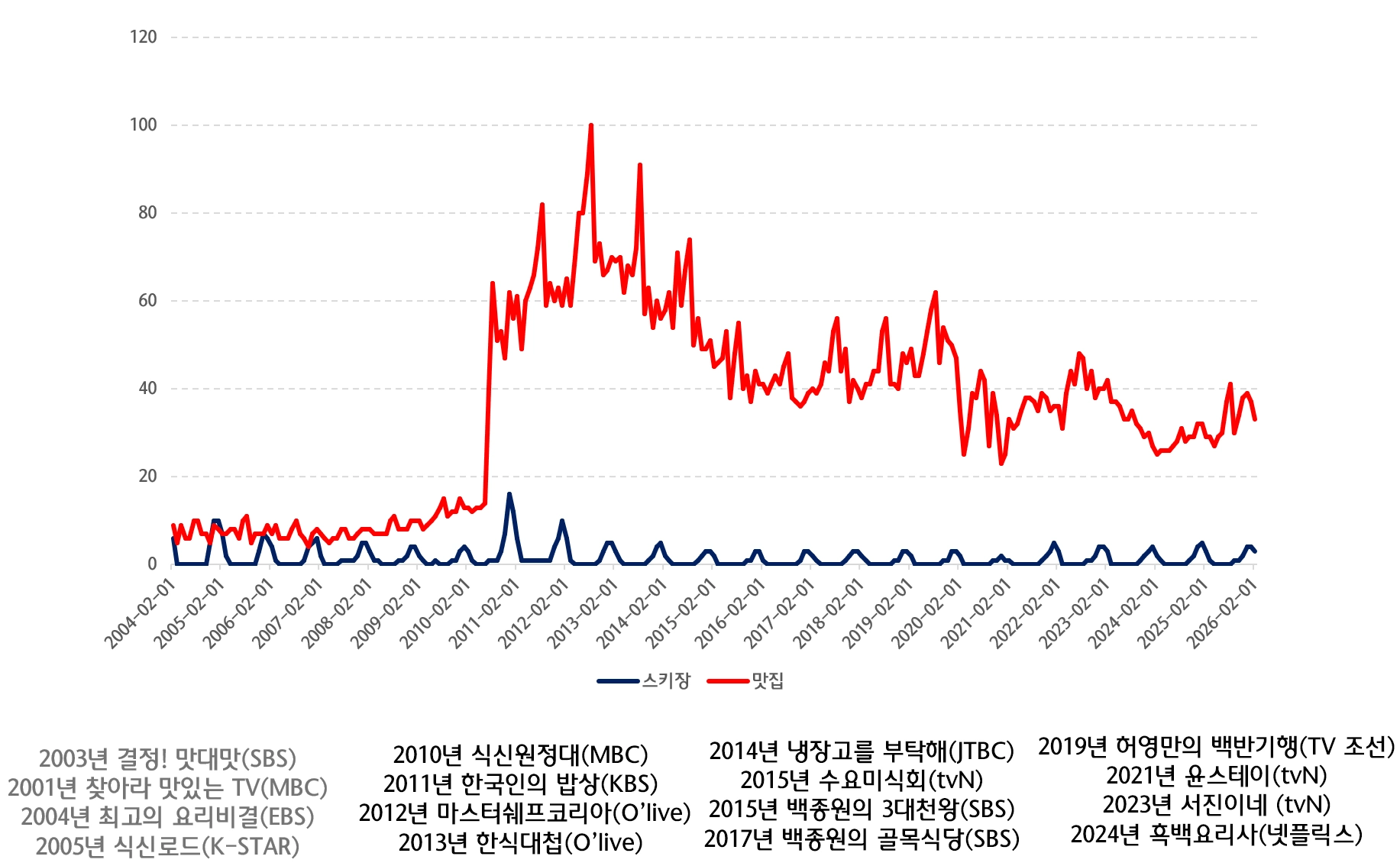
This shift in public interest is clearly reflected in the data. Starting in 2009, search volume for 'ski resort' in portal site search trends stagnated, whereas search volume for 'gourmet restaurants' surged explosively, coinciding with the cooking show trend. Additionally, according to the Ministry of Culture, Sports and Tourism's 2025 National Life Sports Survey, the sports people most want to participate in if they have financial leeway were golf (1st), swimming (2nd), and yoga/pilates (3rd); skiing, an outdoor winter sport, has completely fallen out of public favor.
The Worst First Experience Created by a Closed Ski Culture and 'School Groups'
Korea's unique ski culture and the collapse of its educational infrastructure are also fatal limiting factors hindering new entry. Most Korean ski resorts rely on artificial snow and thoroughly block both sides of the slopes with 2m-high orange net fences, completely preventing 'off-piste' riding through unmaintained nature. As a result, a closed and rigid club-centric culture has become entrenched, obsessing only over honing short-radius turn skills (short turns) on narrow slopes rather than gliding amidst diverse natural landscapes.
The most painful problem is the qualitative decline and disappearance of student group programs, which used to serve as an entry point for potential customers. Countless teenagers experience skiing for the first time through school camps, but to lower program unit costs, massive crowds are crammed onto narrow slopes, and the ratio of students per instructor is abnormally increased. The uncomfortable memories of being cold and controlled on crowded artificial snow instill negative preconceptions about skiing, fundamentally blocking revisits once they become adults. To make matters worse, recently, due to concerns over safety accidents and cost issues, ski experiences themselves have disappeared from the school physical education curriculum, further worsening the gap in physical education experiences among youth.
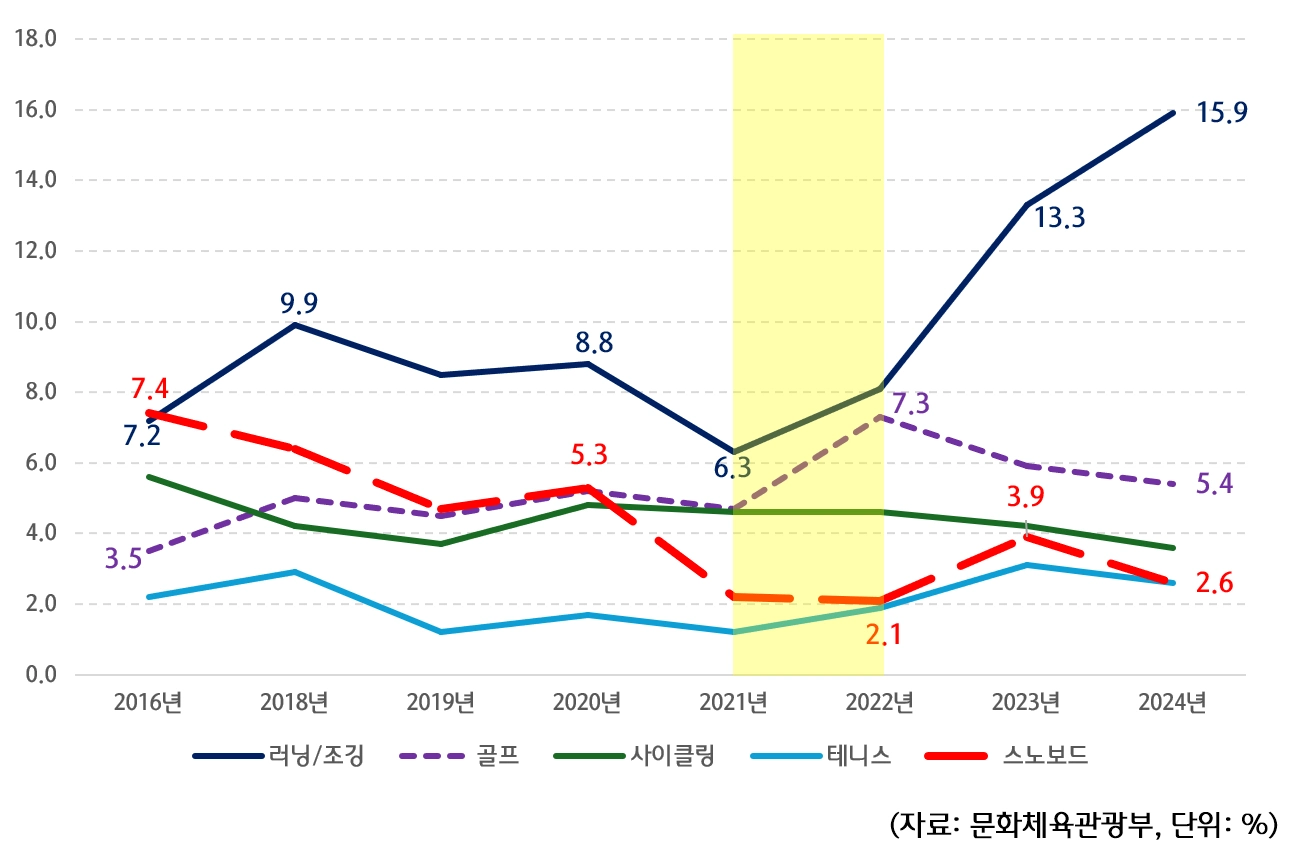
[Leisure Activities Participated in at Least Once in the Past Year (People in Their 30s)]
The Collapse of Regional Economies Caused by a Domino Effect of Closures
The decline of the industry does not end with the closure of a single ski resort. As ski resorts in the metropolitan area and provinces, including Alps Resort, Yangji Pine, Star Hill, and Bears Town, have successively closed, the regional economic communities formed around them, such as rental shops, restaurants, and accommodations, are experiencing a chain collapse. About 30% of shops near ski resorts in the Pyeongchang area have closed in the last 3-4 years, and the slopes of closed ski resorts carved into mountains remain as barren hills where trees cannot grow, generating massive social costs in terms of forest destruction and environmental restoration.
Desperate Efforts for Survival: Unconventional Season Passes and Snow Theme Parks
The beleaguered industry is not sitting idle, either. Yongpyong, High1, Welli Hilli, and Oak Valley launched the 'X4+ Integrated Season Pass,' allowing access to all four ski resorts with a single season pass, which received a great response. They also introduced mobile quick passes and time-based lift tickets to increase convenience for Millennials and Gen Z. Furthermore, they are creating snow theme parks like 'Snowy Land,' centered around sledding and photo zones, and are aiming for a boom in foreign tourists by providing halal food and prayer rooms to attract visitors from Southeast Asia and the Middle East, where it does not snow.
The Ultimate Solution: Japan's Niseko Model and 'Four-Season Wellness Complex Resorts'
However, experts unanimously agree that for ultimate survival, the concept of a ski resort as a 'seasonal business' must be completely abandoned. Japan underwent harsh restructuring, with the number of ski resorts plummeting from 698 in 1999 to 417 in 2024, but Hokkaido's Niseko region spectacularly revived through 'four-season tourism,' connecting the region's unique 'powder snow' with foreign capital and combining it with outdoor infrastructure like summer rafting and camping.
In Korea as well, amid high probabilities that the industry will be compressed and reorganized into 5 to 7 locations mainly in the alpine regions of Gangwon Province (Mona Yongpyong, High1, Phoenix, etc.), transitioning into four-season resorts is the only breakthrough. Mona Yongpyong appears to be making such attempts recently; it installed a skywalk and a 7.4km cable car, the longest in the country, on Mt. Balwang at 1,458m above sea level, attracting wellness tourists using its cool climate (24.6℃) even in midsummer as a weapon. Furthermore, it established a food corporation, 'Yongpyong Valley,' and successfully diversified into a well-being private brand (PB) food business, including makgeolli, hydrangea tea, and Gipumeun Kimchi, utilizing natural bedrock water from Mt. Balwang. In addition, it is maximizing profits by developing a 1.4 trillion won high-end luxury condo, 'Rusongchae,' by 2030, and building a global golf chain network by acquiring Japan's Aino CC and Shimabara CC.
The Korean ski industry must now part ways with the outdated parcel-out model that relies solely on winter. Spring will return to the frozen industry only when it stakes its life on lowering barriers to entry for beginners and youth by linking with school physical education, attracting the MICE industry to survive amidst the climate crisis, and building a four-season wellness infrastructure.
Company financial data, investment reports, and startup analysis — all in one place
Explore PitchdeckCurated news, every week — straight to your inbox
Every Friday · Unsubscribe anytime