Nowon-gu Average 640 Million Won, 2,108 Transactions.
Yongsan-gu Average 2.42 Billion Won, 200 Transactions.
Although both are in Seoul, the price is four times higher, while the transaction volume is one-tenth. A comprehensive analysis of 19,615 actual transactions from the first quarter of 2026 by the Ministry of Land, Infrastructure and Transport reveals that Seoul is divided into three markets, and the 'average of 1.09 billion won' becomes a number that exists nowhere.
We used data to pinpoint where the mass market in the 600 million to 1.1 billion won range, which accounted for 65% of Q1 transactions, is located; why the ultra-high-priced market of 2 billion won or more, making up a mere 6.4% of the total, moves independently; and what the 3,407 transactions in four cities in Gyeonggi-do, where Seoul's demand has flowed out to, signify.
The 600 Million Won Range Real Demand Market Maxing Out Loan Limits
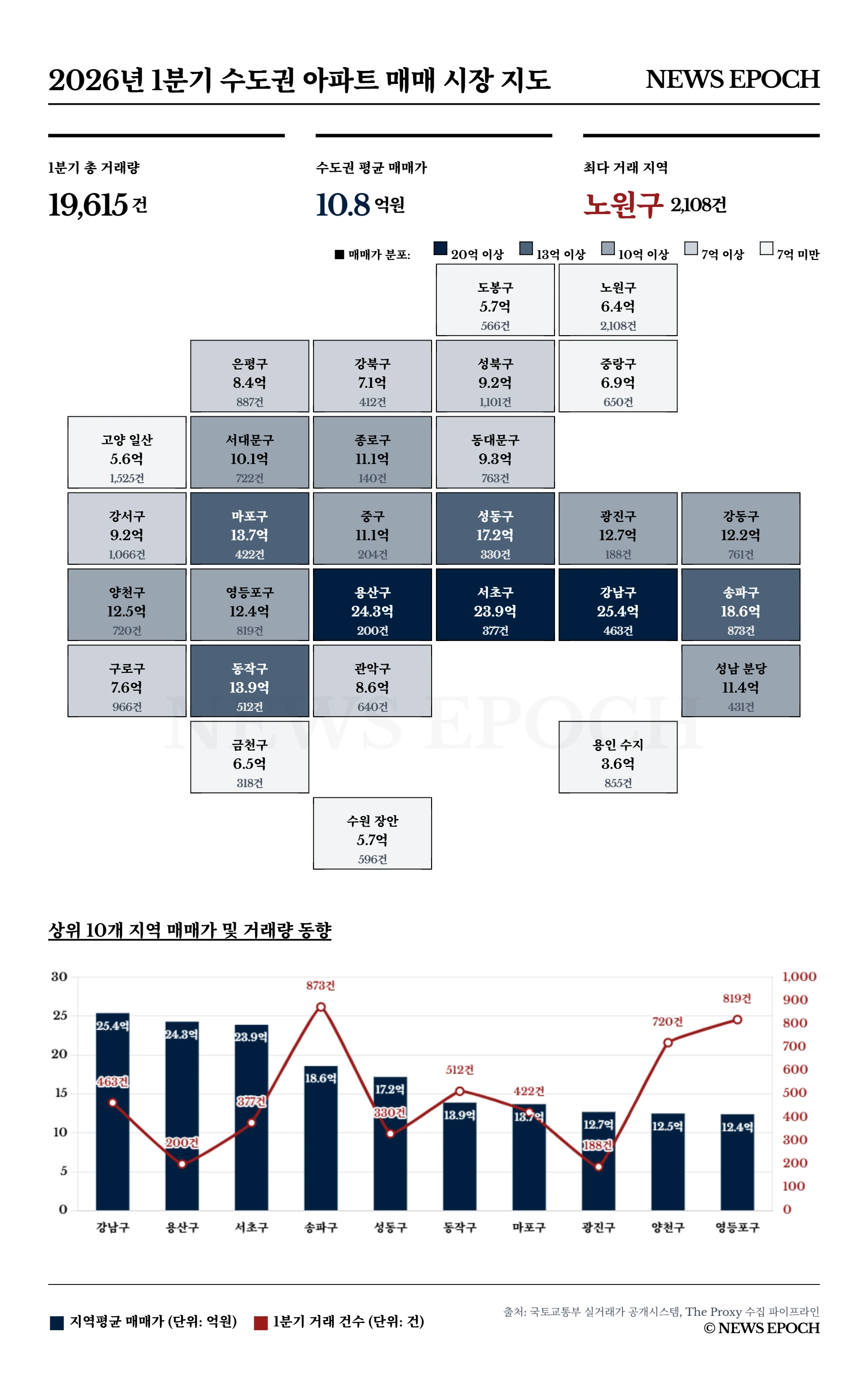
The area that led the actual transaction market in the first quarter of this year was not Gangnam, but regions in the 600 million won range accessible within mortgage loan limits. Nowon-gu, with an average sales price of 640 million won, recorded 2,108 transactions in the first quarter alone, taking an overwhelming first place in Seoul.
Demand also headed outside of Seoul. The transaction volume in Ilsandong-gu, Goyang-si, Gyeonggi-do, which has an average price of 560 million won, was 1,525, easily surpassing Seongbuk-gu (1,101 transactions), the second highest in Seoul. The total first-quarter transaction volume of four cities in Gyeonggi-do, including Ilsandong-gu in Goyang and Suji-gu in Yongin, amounted to 3,407, reaching 3.3 times the total transaction volume of Seoul's top three districts (Gangnam, Seocho, and Yongsan), showing how heated the real demand in the outskirts was.
15.6 Billion Won Transacted Without a Loan, A League of Their Own
On the other hand, the total first-quarter transaction volume of Gangnam, Seocho, and Yongsan, the so-called 'Gangnam 3-gu', stopped at 1,040 transactions, failing to reach even half of Nowon-gu's single transaction volume. This is because high prices create high barriers to entry, and they are heavily affected by loan regulations.
However, the situation is completely different for the true ultra-high-priced market. For a buyer purchasing a 15.65 billion won unit at Nine One Hannam, which jumped by 1.61 billion won in just 70 days, the base interest rate or loan-to-value (LTV) regulations are no constraint at all. There are no buyers who finance 15.65 billion won through a mortgage, making this a transaction with a completely different economic context from the Seoul average price of 1.09 billion won.
Three Markets Obscured by the '1.09 Billion Won Average'
An analysis of the 19,615 actual transaction data points from the Ministry of Land, Infrastructure and Transport shows that the Seoul apartment market is divided into three markets that cannot be explained by an average.
Top-tier market (Top 6.4%): Gangnam, Seocho, and Yongsan, with an average sales price of 2 billion won or more. Total 1,040 transactions.
Mid-tier market (Middle 28.5%): 8 districts including Songpa, Seongdong, and Mapo in the 1.2 billion to 1.9 billion won range. Total 4,625 transactions.
Mass market (Bottom 65.0%): 14 districts including Nowon at 1.1 billion won or below. Total 10,543 transactions.
Two-thirds (65%) of all apartment transactions occur in the mass market of 1.1 billion won or below. However, the news focuses on the top-tier market, and government policies use the Seoul average of 1.09 billion won—near the mid-tier market—as their standard.
2,108 transactions seeking the 600 million won range to fit loan limits, and 1 transaction paying 15.65 billion won without a loan, coexist in the same Seoul. Under the same interest rates and the same regulations, Seoul is already divided into three markets operating on different logics.
This article was written by News Epoch, which secured and analyzed 19,615 apartment actual transaction data points from the Ministry of Land, Infrastructure and Transport using The Proxy collection pipeline.
Transaction volume is reported data based on the contract date, and due to delays in actual transaction reporting (contract date + 30 days), the March figures may slightly increase later.
The four cities in Gyeonggi-do are Ilsandong-gu in Goyang-si, Suji-gu in Yongin-si, Jangan-gu in Suwon-si, and Bundang-gu in Seongnam-si. Data baseline: Collected on April 2, 2026.
Company financial data, investment reports, and startup analysis — all in one place
Explore PitchdeckCurated news, every week — straight to your inbox
Every Friday · Unsubscribe anytime