A 38-Month Cross-Analysis of the Bank of Korea's Base Rate × Mortgage Rates × Apartment Transaction Volume
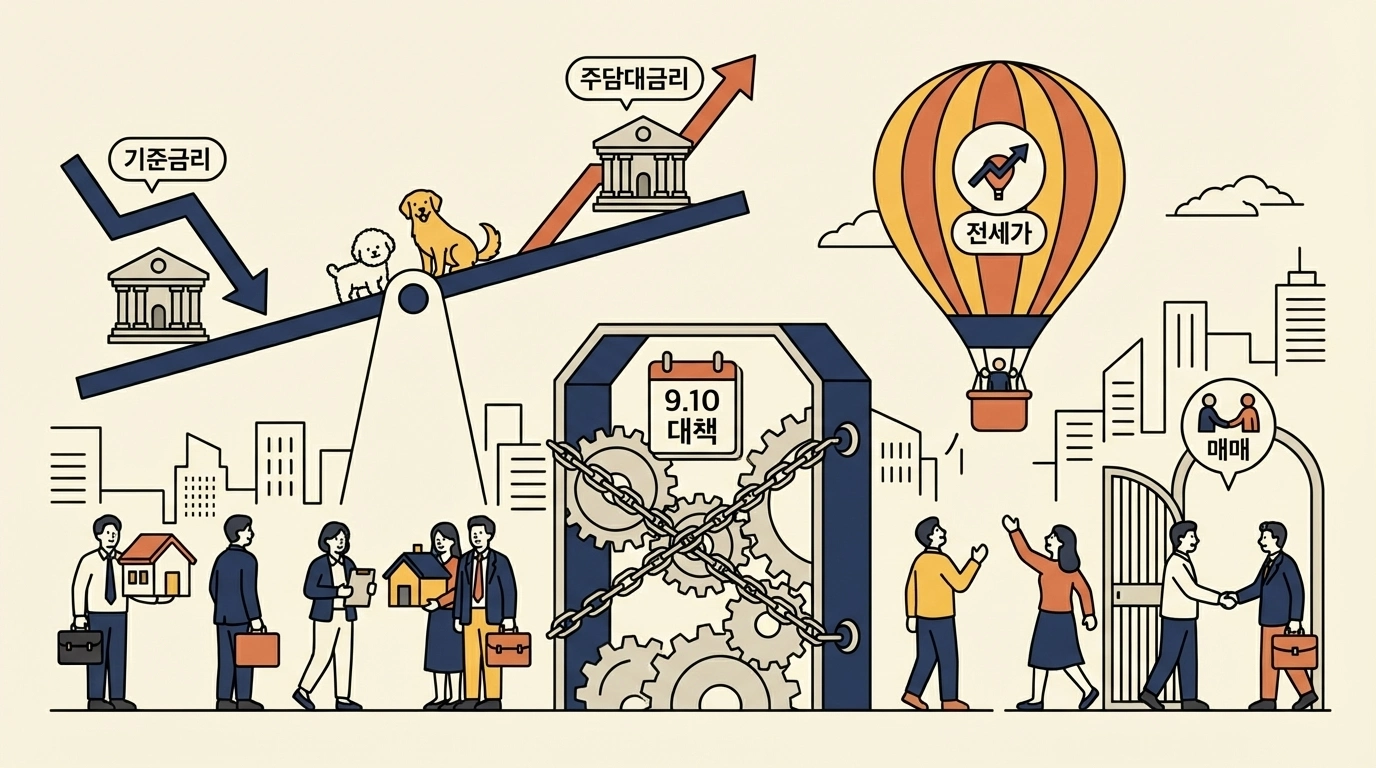
While the Bank of Korea lowered the base rate by 1%p, the mortgage rates charged by banks to homebuyers rose by 0.79%p. In July 2024, when the base rate and mortgage rate were equal at 3.50%, apartment transactions hit a three-year high of 11,530. Eighteen months later, in January 2026, the base rate had been lowered to 2.50%, but the mortgage rate stood at 4.29%. A gap of 1.79%p. In a structure where lower policy rates do not lead to lower loan interest, the transaction volume paradoxically remains 3.2 times higher than in early 2023.
We traced the cause of this paradox by cross-analyzing 38 months of ECOS interest rate data and actual transaction data.
Spread from 0%p to 1.79%p
Over the past 38 months, the gap between the base rate and the mortgage rate shifted three times: 0%p in July 2024, 0.24%p in September 2024, and 1.79%p in January 2026.
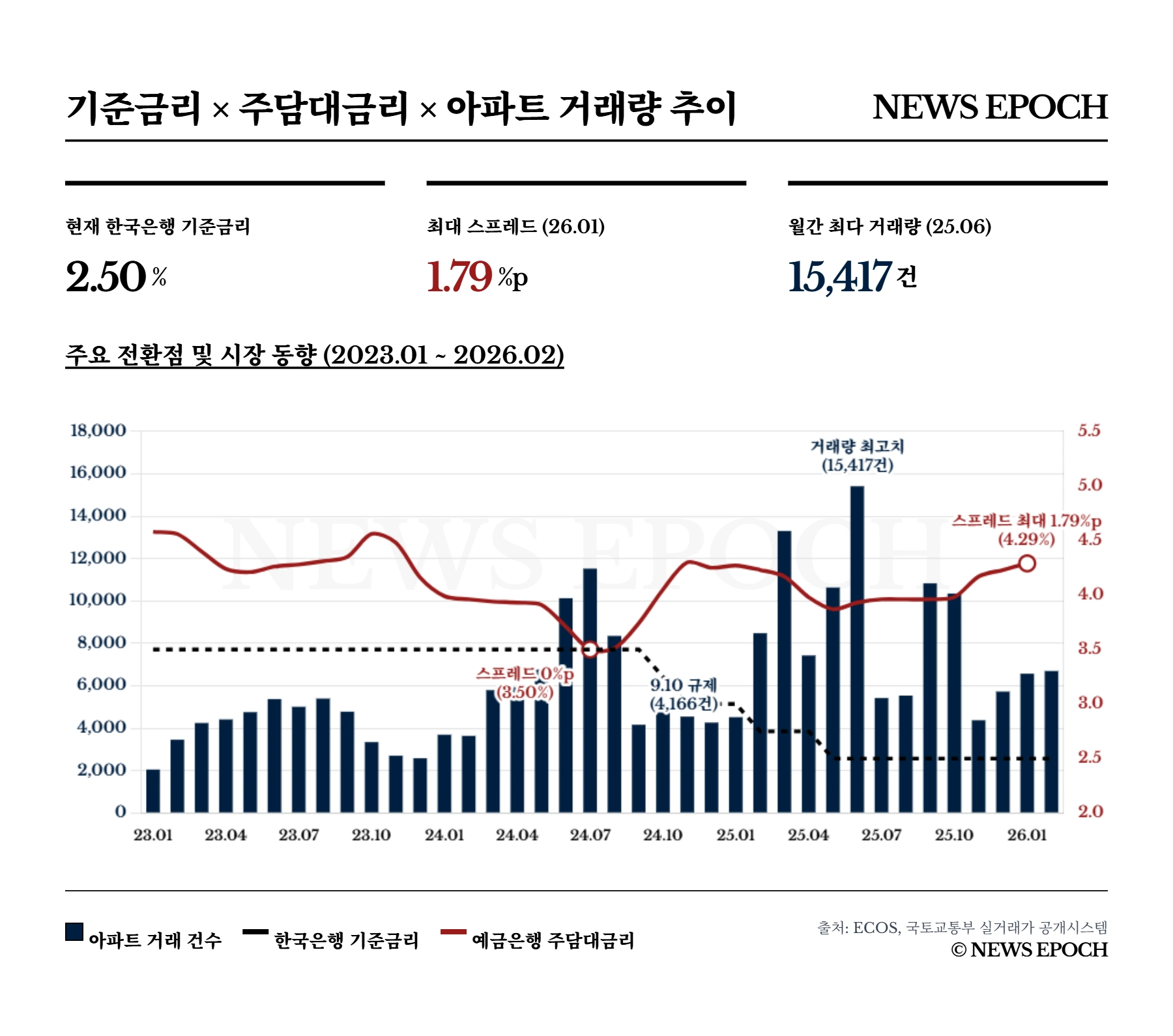
In the first half of 2024, while the base rate was fixed at 3.50%, the mortgage rate steadily declined, falling to 3.50% by July. A spread of 0%p. This meant banks were charging only as much as the base rate. Transaction volumes surged during this period, reaching 10,136 in June and 11,530 in July.
In September 2024, the trend shifted as the government implemented lending restrictions (the so-called September 10 measures) to manage household debt. The mortgage rate jumped to 3.74%, and transactions plummeted to 4,166, a 50% drop compared to the previous month. In October of the same year, the Bank of Korea cut the base rate to 3.25%, but the mortgage rate actually rose to 4.05%. Although mortgage rates are linked to market rates like COFIX rather than the base rate, the standard perceived by individuals is the Bank of Korea's announcement. A structure emerged where even if the base rate is lowered, actual lending rates do not follow suit because bank add-on rates rise.
Thereafter, the base rate was cut four consecutive times: 3.25% (Oct 2024) → 3.0% (Nov 2024) → 2.75% (Feb 2025) → 2.50% (May 2025). A total of 1%p. However, during the same period, the mortgage rate fluctuated from 4.05% → 4.30% → 4.23% → 3.87%, before climbing to 4.29% by January 2026. The spread widened from 0%p in July 2024 to 1.79%p in January 2026, marking the largest gap in the 38-month period.
The September 10 Measures, The Moment All 25 Districts of Seoul Halted at Once
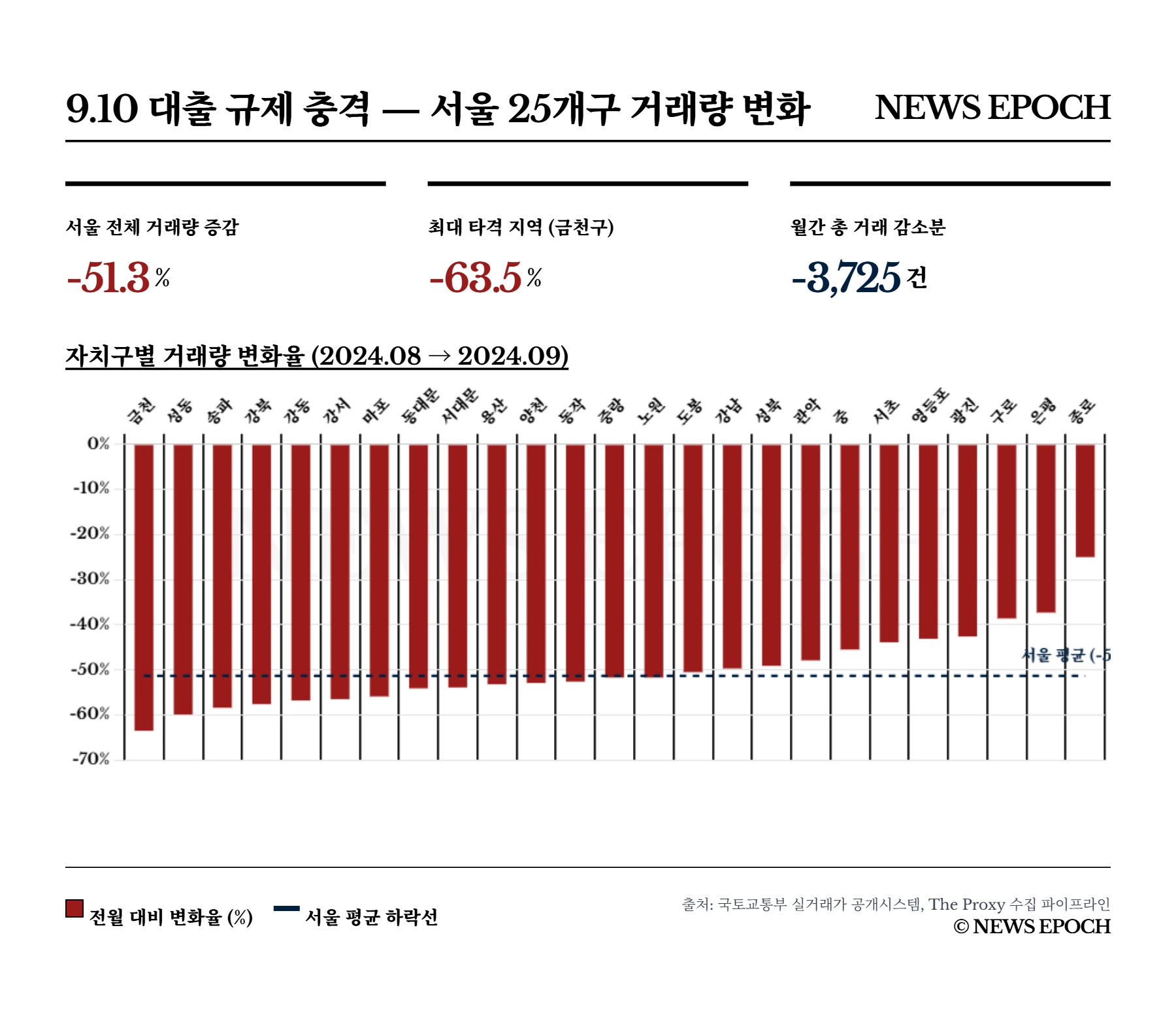
The shock of the lending restrictions in September 2024 spanned all of Seoul. August to September is traditionally a season of declining transactions, but the decline rate in the same period of the previous year (2023) was 12.1%. The 51.3% drop in 2024 was a shock amounting to 4.2 times the typical seasonality. All 25 districts experienced a decrease, with the magnitude of the drop ranging from -25.0% (Jongno-gu) to -63.5% (Geumcheon-gu).
The areas hit hardest were mid-to-low-priced regions. Geumcheon-gu (-63.5%), Seongdong-gu (-59.9%), Songpa-gu (-58.4%), and Gangbuk-gu (-57.6%) formed the upper tier of the impact. In contrast, Jongno-gu (-25.0%), Eunpyeong-gu (-37.3%), and Guro-gu (-38.6%) were relatively buffered. The direct hit from the regulations was most pronounced in the end-user segments with high reliance on loans.
Gangnam-gu (-49.7%) and Seocho-gu (-43.9%) also saw declines but remained in the middle tier. High-priced areas have a relatively higher proportion of loan-free transactions, making them less directly affected by the regulations.
Why Transactions Aren't Shrinking Even When Rates Rise
By the textbook, transactions should decrease when interest rates rise. Yet, at a mortgage rate of 4.29% in January 2026, the transaction volume was 6,573, which is 3.2 times that of January 2023 (2,053 transactions) when the mortgage rate was 4.58%. More trading is happening at higher interest rates.
The Seoul Apartment Jeonse Price Index explains one pillar of this paradox. According to ECOS data, the Seoul Apartment Jeonse Price Index rose from 86.77 in January 2024 to 96.60 in February 2026, an 11.3% increase in two years. When Jeonse prices rise, the additional burden upon renewal grows, prompting a demand to switch to purchasing. This conversion demand is the force maintaining transaction volume despite high mortgage rates.
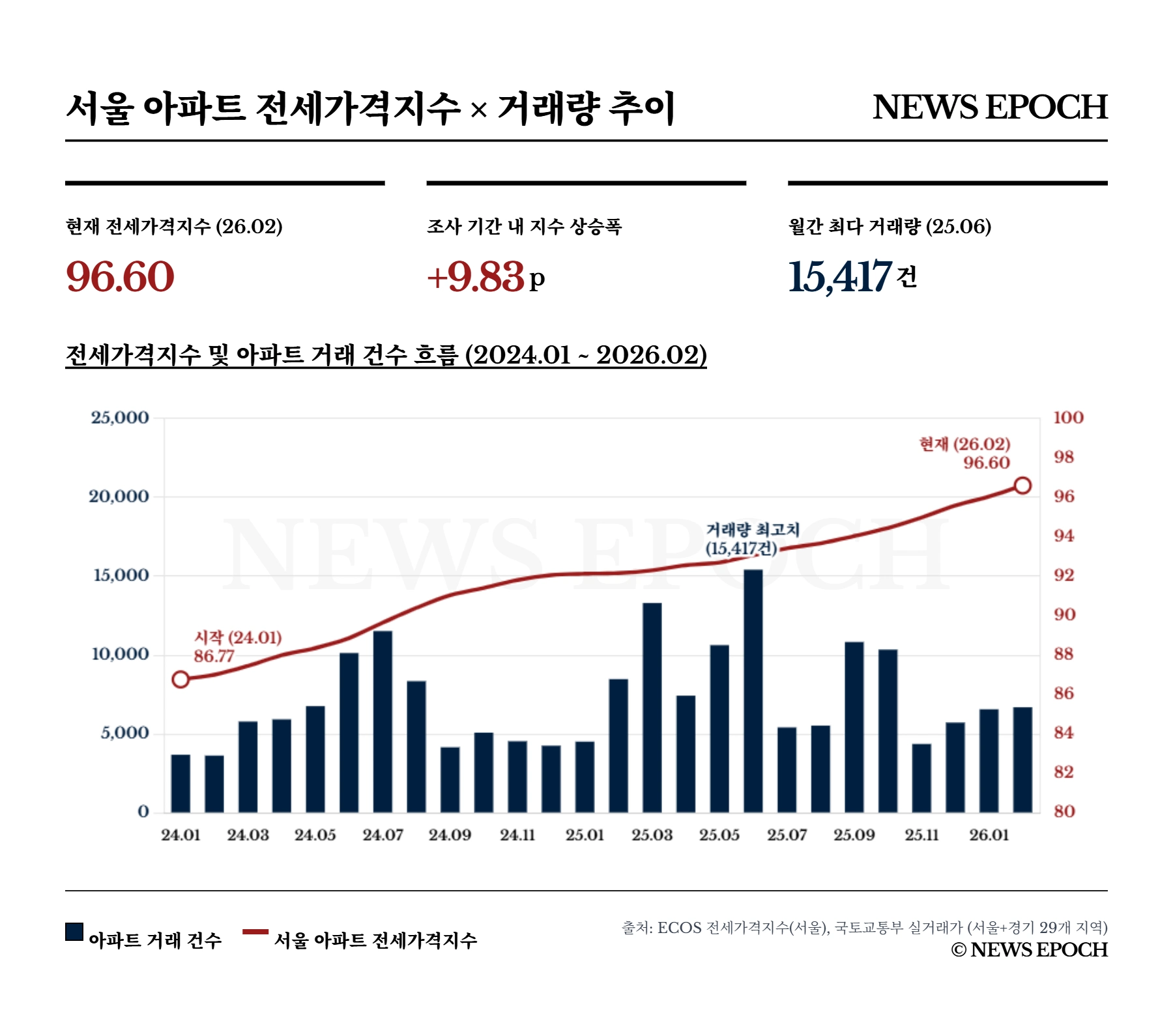
Indeed, the period of accelerated Jeonse price increases in 2025 overlaps with the surge in transaction volumes. In March 2025, the Jeonse index was 92.30 and transaction volume was 13,307. In June, the Jeonse index was 93.07 and transaction volume reached 15,417, the highest in the 38-month period. The pattern of the Jeonse index and transaction volume moving together is far clearer than the inverse relationship between interest rates and transaction volume.
Housing cost inflation points in the same direction. The housing, water, electricity, and fuel component of the Consumer Price Index rose by 3.5% from 113.84 in January 2024 to 117.83 in February 2026. In an environment where the cost of living spaces is rising across the board, the data reflects decisions to secure housing through purchases even if mortgage rates are high.
The Optical Illusion of Base Rate Cuts
While the Bank of Korea lowered the base rate by 1%p, the interest rates that homebuyers received from banks rose by 0.79%p. It is not that the base rate cut failed to act as a stimulus for the real estate market; rather, bank add-on rates and government lending restrictions are absorbing the effect of the cut in the middle. The 1.79%p spread demonstrates the magnitude of this absorption.
Nevertheless, transaction volumes remain at three times the level of early 2023. The pressure to switch to purchasing, created by the 11.3% rise in Jeonse prices over two years, surpasses the burden of interest rates. As long as mortgage rates do not follow suit even if the base rate is cut further, and as long as Jeonse prices continue to rise, the real estate market is highly likely to continue operating in a structure that responds to Jeonse prices rather than interest rates.
This article was written by News Epoch through the acquisition and cross-analysis of Bank of Korea (ECOS) macroeconomic data and Ministry of Land, Infrastructure and Transport actual apartment transaction price data via The Proxy data collection pipeline.
Base rates and mortgage rates are based on ECOS; transaction volumes are based on the Ministry of Land, Infrastructure and Transport's open system for actual transaction prices.
Mortgage rates are 'based on new loans' and differ from existing loan rates. Mortgage rates for February 2026 are not yet recorded in ECOS (confirmed up to January 2026).
Transaction volumes are based on 29 regions (25 districts in Seoul + 4 cities in Gyeonggi-do). Data standard: ECOS February 2026, actual transaction prices collected on April 2, 2026.
Company financial data, investment reports, and startup analysis — all in one place
Explore PitchdeckCurated news, every week — straight to your inbox
Every Friday · Unsubscribe anytime