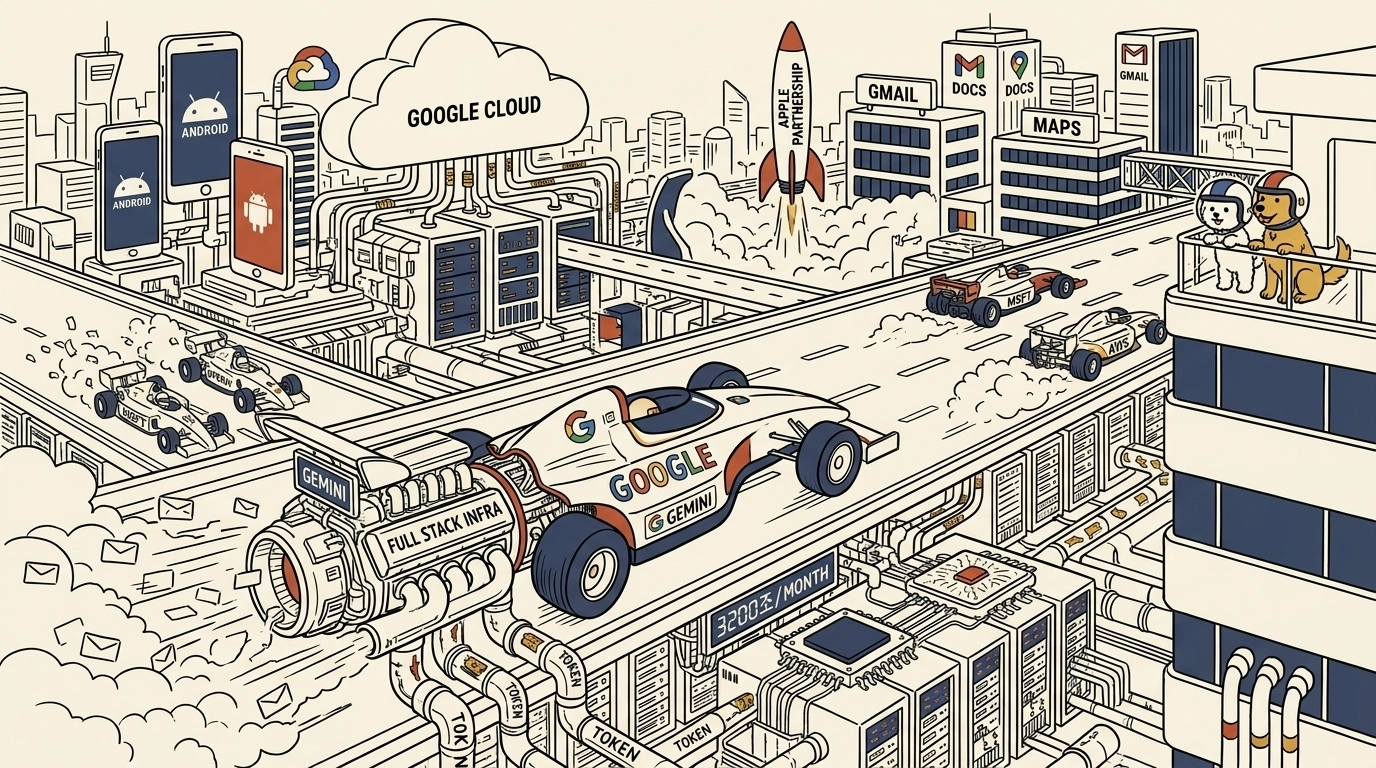
Just two years ago, Google seemed to be lagging behind in the AI race and in a state of crisis. This is because its early AI models were criticized for providing fatal and inaccurate answers, such as suggesting putting glue on pizza or eating rocks. Recently, however, a consensus has been forming in Silicon Valley that Google has not merely caught up with its competitors, but will ultimately be the final winner of the AI race.
This reversal in atmosphere is also clearly evident in Google's recent moves. According to major foreign media outlets such as The New York Times on the 20th, Google CEO Sundar Pichai announced at the recent Google annual developer conference that the company is processing 3.2 quadrillion artificial intelligence tokens every month. Repeatedly emphasizing this massive scale, he expressed his thoughts by saying that in the past, he could not have even imagined he would be speaking of numbers in such units.
Business Insider reported that CEO Pichai revealed five key figures at this event, showing off Google's overwhelming data processing capabilities. It is interpreted that Google, which previously seemed to be faltering compared to competitors in the artificial intelligence market, has begun to solidify its position in earnest based on massive capital expenditure and a data maximization strategy. Global information technology media outlets are also unanimously spotlighting Google's spectacular comeback. StartupHub evaluated that Google has perfectly leapt from a lagging position to the forefront. In addition, The Register analyzed that amidst the global artificial intelligence frenzy, Google is putting forward a strategy of investing massive capital to push its token processing volume to the extreme.
'Full Stack' Infrastructure and Overwhelming Cloud Growth
The core reason Google is poised to occupy the most advantageous high ground over the next 3 to 5 years is precisely because it is the only company to have completed a 'full stack' of the AI ecosystem. Unlike Microsoft, which relies on OpenAI's models, Google possesses its own leading large language model (LLM), Gemini, and has the unrivaled technological prowess of producing its own AI chips for over 10 years. This robust infrastructure is also being proven through performance, with Google Cloud's year-over-year growth rate sharply accelerating from 48% to 63%, significantly outpacing competitors Amazon Web Services (AWS) and Microsoft.
Deployment and User Accessibility Through a Robust In-House Ecosystem
Google's strongest moat is the Android operating system, which accounts for more than 75% of the world's smartphones, and hardware such as Pixel phones. Because Gemini is built into Android devices, it can go beyond the sandbox that third-party apps cannot access and deeply integrate with the user's data. Furthermore, through a partnership with Apple, Gemini is also slated to be installed as the underlying AI technology in the iPhone's Siri in the future, effectively planting Gemini in the vast majority of smartphones worldwide.
Beyond simply offering a standalone chatbot, Google has reinvented itself by seamlessly integrating AI into core services used daily by billions of people, such as Gmail, Google Maps, and Google Docs. In particular, Gemini provides exceptional convenience in the travel booking sector as the only chatbot natively linked with Google Flights and Google Hotels. As a result, Gemini's regular users have more than doubled in just one year to reach 900 million, an overwhelming figure that is on par with OpenAI's ChatGPT active users and amounts to approximately 30 times the web traffic of Anthropic's Claude.
Outstanding Performance and Unwavering Financial Stability
Unlike its early unstable appearance, the latest model, Gemini 3.0 Pro, is receiving high praise for its outstanding performance. Unlike other companies that focus merely on increasing the scale of their language models, Google is building models capable of understanding and acting in the physical world by combining visual, linguistic, and behavioral abilities. Even in actual development environments, Gemini has demonstrated an amazing ability to accurately identify and solve the root causes of complex UI problems or edge-case coding issues when ChatGPT or Claude fail to properly grasp them.
Above all, Google possesses the massive financial power to back AI development, which incurs astronomical costs. While OpenAI runs a massive deficit of 15 million dollars a day to operate ChatGPT, Google is generating enormous cash through its solid advertising business. In fact, Google's recent quarterly advertising revenue recorded 77 billion dollars, a 16% increase, thanks to leveraging AI technology to more deeply analyze consumer interests. The fact that it can build infrastructure without massive cash depletion is its greatest strength in the long game.
Unlike Microsoft, which experienced failure with Windows Phone in the early smartphone era, Google has succeeded in swiftly integrating AI into its flagship product lineup. Gary Rivlin, a former New York Times reporter who has covered the AI race in the tech industry, summarizes the current situation as follows: "If I had to bet on the biggest winner in AI, I would choose Google. Are you looking for the Next Google? That is probably Google right now."
Company financial data, investment reports, and startup analysis — all in one place
Explore PitchdeckCurated news, every week — straight to your inbox
Every Friday · Unsubscribe anytime