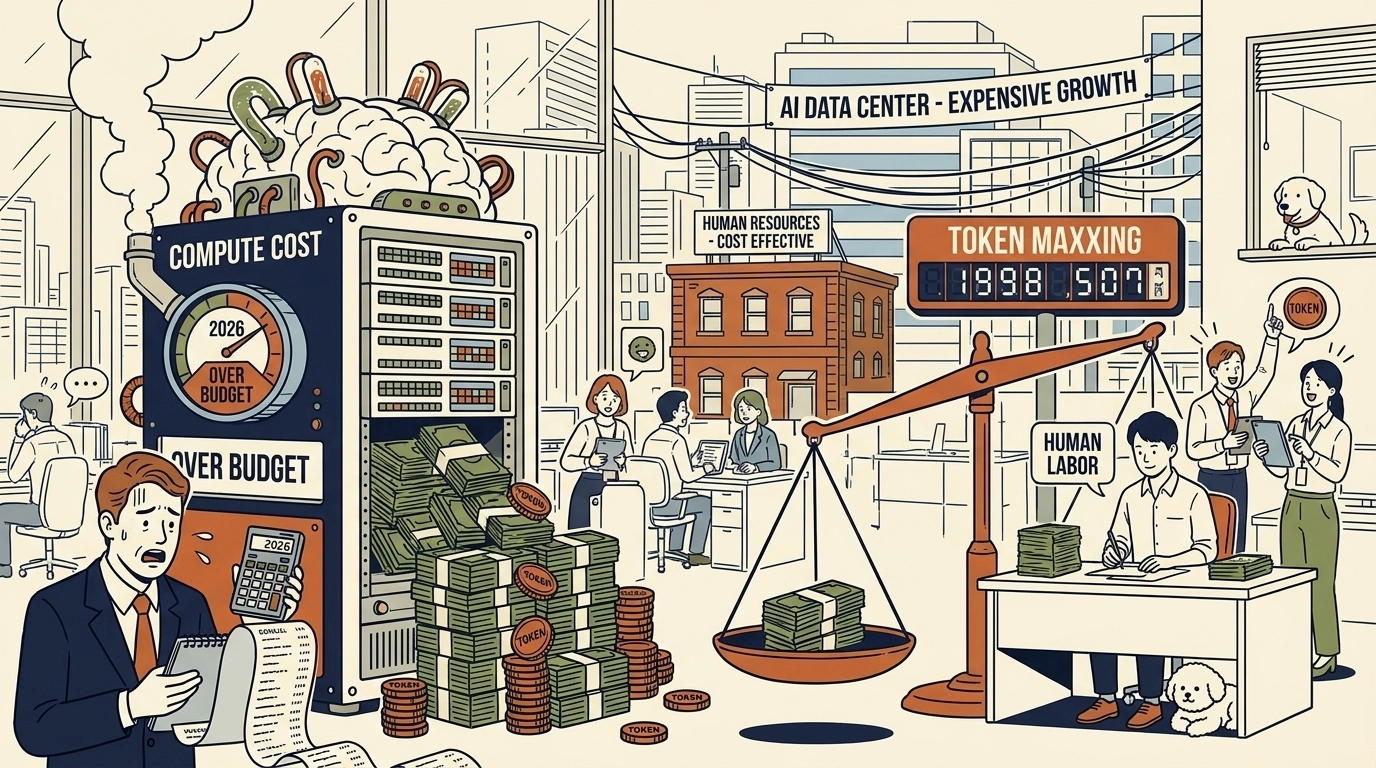
An unexpected paradox is unfolding at the forefront of the artificial intelligence (AI) revolution. While companies attempt to replace human workers with AI to reduce costs, in reality, phenomena where the cost of operating AI systems far exceeds labor costs are being reported everywhere.
"Computing Costs Are Higher Than Employee Salaries"
The most shocking confession came from none other than inside Nvidia, which is making massive profits by selling chips in the 'AI gold rush'. Bryan Catanzaro, Vice President of Applied Deep Learning at Nvidia, revealed in a recent media interview, "For our team, computing costs far exceed the labor costs of our employees." If even Nvidia, which can minimize costs by building its own AI infrastructure, is in this situation, the cost pressure felt by ordinary companies is bound to be much greater.
In fact, across various industrial fields, budget overruns caused by AI adoption are continuously occurring, threatening the financial soundness of companies. A prime example is Uber. Uber's Chief Technology Officer (CTO) Praveen Neppalli Naga actively promoted the use of code generation tools, entrusting 11% of the company's real-time code updates to AI agents. However, as a result, the AI budget planned for the entire year of 2026 was exhausted in just four months, leaving them facing a situation where they had to redo their budgeting from scratch.
Similar cost shocks are being reported in the startup industry as well. Amos Bar-Joseph, CEO of Swan AI, proudly revealed on LinkedIn that his team of just four people was billed a whopping $113,000 (about 150 million won) for their use of Anthropic AI over a single month. This amounts to $28,000 per employee per month, an astronomical sum that far exceeds the salary of an average developer.
This surge in costs is not just a problem of individual companies' spending habits, but is spreading into a structural issue across the entire industry. According to data from spend management company Tropic, AI software fees have steeply soared by 20% to 37% over the past year. Accordingly, it is pointed out that AI subscription models are increasingly hitting a so-called 'Pricing Wall' that companies cannot afford.
The 'Tokenmaxxing' Phenomenon: Cost Expenditure Becoming a Flex
Behind this surge in costs lies not only structural problems but also changes in developers' behavioral patterns. It has even led to the emergence of the neologism 'Tokenmaxxing'. Nvidia CEO Jensen Huang tied engineers' productivity to token usage, saying it would be very concerning if an engineer earning a $500,000 salary did not use $250,000 worth of tokens annually. Stimulated by this, some engineers began to consider token usage as a means of showing off to prove their productivity. As a result, Meta employees consumed a staggering 60 trillion Claude tokens over 30 days, and one engineer in Stockholm revealed that he was spending more money on token costs than his own annual salary.
Why Humans Are Cheaper Than AI: The Gap Between Illusion and Reality
Tech companies have been carrying out massive layoffs in the name of cost efficiency. In 2026 alone, more than 92,000 tech workers lost their jobs at nearly 100 companies. According to Morgan Stanley, Big Tech companies poured about $740 billion into AI-related spending this year alone.
However, a 2024 MIT research study shows that this 'AI replacement' is still premature. The researchers concluded that AI automation is economically viable for only about 23% of total jobs, and for the remaining 77% of tasks, it is still much more cost-effective to retain human workers. This is because even with AI adoption, continuous human supervision is required to correct hallucinations or system errors, and additional implementation and hardware maintenance costs are incurred. In some quarters, there are even pointed jokes that instead of bearing the expensive costs of burning tokens, companies are rehiring junior developers to perform basic coding tasks.
Currently, instead of using cutting-edge large language models that incur enormous costs, some developers and companies are attempting to overcome budget constraints by utilizing local models or open-source models like Gemma4 to handle repetitive tasks.
Professor Keith Lee of the Swiss AI Lab diagnoses the current situation as a "short-term mismatch." He points out that there is a disconnect between the economics on paper and the actual behavior of companies. He emphasized, "As the cost of running AI models drops and infrastructure improves, the economics will change," adding that true cost efficiency will only be achieved when AI becomes not just cheaper, but predictable on a large scale. Ultimately, rather than recklessly consuming massive amounts of tokens simply to reduce labor costs, companies are now at a turning point where they must objectively evaluate true return on investment and operational efficiency.
Company financial data, investment reports, and startup analysis — all in one place
Explore PitchdeckCurated news, every week — straight to your inbox
Every Friday · Unsubscribe anytime