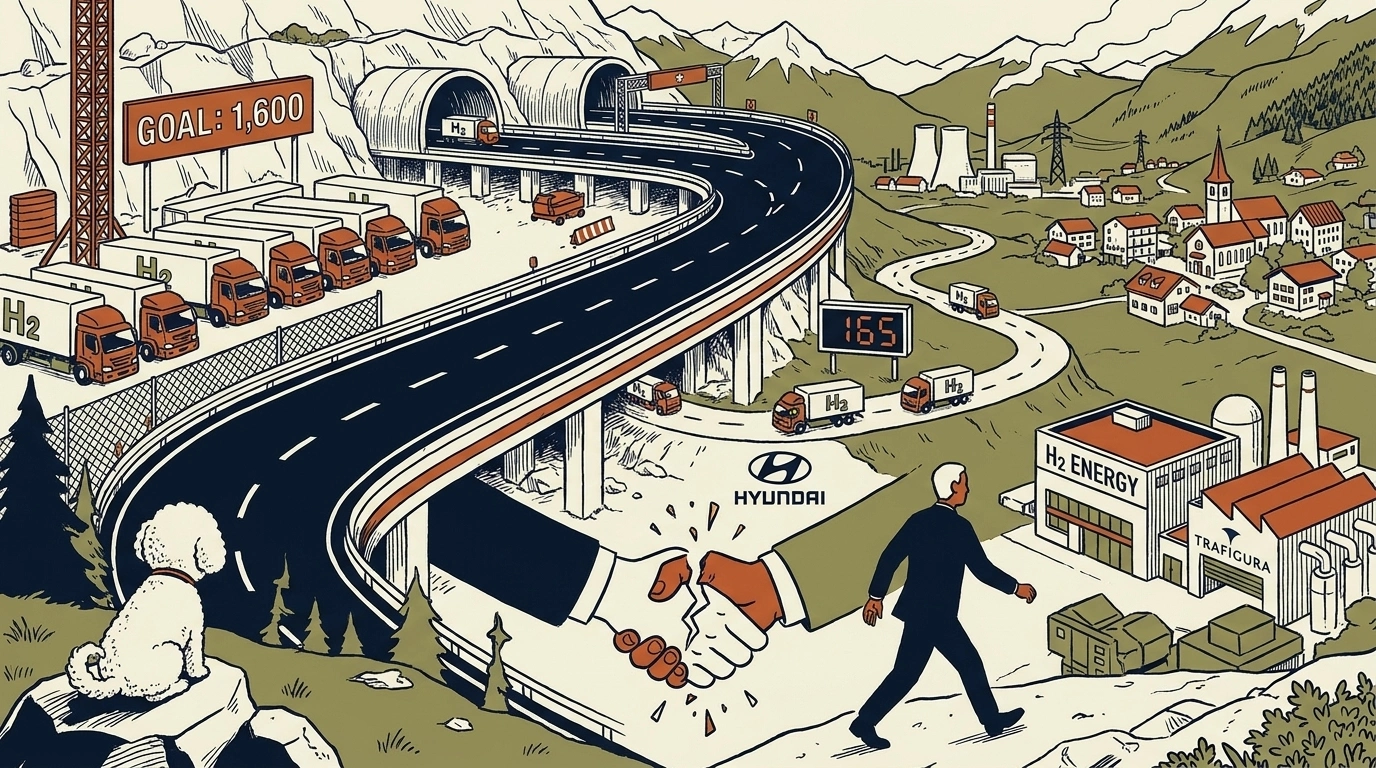
Established in June 2019 at Hagenholzstrasse 60 in Zurich, Hyundai Hydrogen Mobility AG became a wholly-owned subsidiary of Hyundai Motor as of May 2025. The co-investor, Switzerland's H2 Energy, has withdrawn, and the initial goal of 'supplying 1,600 units to Switzerland between 2019 and 2025' stood at just 165 units as of February 2026. This is the 7-year trajectory recorded jointly by the Swiss Federal Commercial Registry (Zefix) and Hyundai Motor's official announcements.
Hagenholzstrasse 60, Zurich — A JV with a Capital of 10 Million Swiss Francs
The registration information of Hyundai Hydrogen Mobility AG (hereinafter HHM) is fixed in the Swiss Federal Commercial Registry Zefix under the UID CHE-221.948.489. The date of establishment is June 20, 2019, and the capital is 10 million Swiss Francs (CHF 10,000,000). The share structure consists of 10 million registered shares with a par value of 1 Swiss Franc each.
The business purpose stated in the registry is "domestic and international sales, leasing, and maintenance of hydrogen-fueled trucks and hydrogen-fueled buses with a gross weight exceeding 5 tons, along with related advertising and maintenance activities." The location is Hagenholzstrasse 60, Canton of Zurich, which is the result of a relocation from its initial establishment location in Opfikon in 2019.
The ownership structure at the time of establishment was a joint investment by Hyundai Motor Company (South Korea) and H2 Energy AG (Switzerland). H2 Energy is a Swiss hydrogen refueling station network operator, and after announcing a strategic partnership with Hyundai Motor at the IAA Commercial Vehicles exhibition in Hannover in September 2018, it established the joint venture the following year.
"1,600 Units" — The Actual Number in February 2026
When announcing the JV agreement in April 2019, Hyundai Motor declared, "We will supply 1,600 XCIENT Fuel Cell heavy-duty trucks to Switzerland from 2019 to 2025." The initial deployment began in Switzerland in October 2020.
The latest tally officially announced by Hyundai Motor on February 5, 2026, differs from this goal. A total of 165 units are currently in operation across 5 European countries (Switzerland, Germany, France, the Netherlands, and Austria), with a cumulative mileage of 20 million km. The cumulative mileage of 20 million km was achieved in January 2026, and the announcement was made through official channels the following month. According to foreign media estimates, the CO₂ reduction effect is estimated at approximately 13,000 tons.
Compared to the original goal of 1,600 units, the 165 units currently operating across 5 European countries are at about one-tenth of that level. Hyundai Motor did not separately mention the '1,600 units' goal in its February 2026 announcement, and this figure does not appear in subsequent official materials either.
Date | Event | Figure |
|---|---|---|
2018.09 | Announcement of strategic partnership between Hyundai Motor and H2 Energy (IAA) | — |
2019.04 | JV Agreement: Goal to supply 1,600 units to Switzerland from 2019 to 2025 | 1,600 units |
2019.06 | Establishment of HHM AG (Zurich) | Capital CHF 10M |
2020.10 | Initial deployment of 7 units in Switzerland | 7 units |
2022.04 | Establishment of HHM Germany GmbH (Munich) | — |
2022.10 | Commotion over reports of 'withdrawal from Switzerland' | — |
2023.10 | H2 Energy Europe AG majority stake acquired by Trafigura | — |
2024.06 | Surpassed 10 million km cumulative mileage in Switzerland | 10 million km |
2025.05 | HHM AG transitioned to a wholly-owned subsidiary of Hyundai Motor | 100% stake |
2026.02 | Hyundai Motor official: 165 units across 5 European countries, cumulative 20 million km | 165 units |
The Void Left by H2 Energy
The decisive catalyst for the dissolution of the JV structure was the departure of co-investor H2 Energy. In October 2023, global commodity trader Trafigura acquired a majority stake in H2 Energy Europe AG. Through this stake acquisition, H2 Energy shifted its business focus from hydrogen mobility (truck operations) to hydrogen production and trading, and its group structure was also dualized into H2 Energy Holding AG (technology and small-scale business) and H2 Energy Europe AG (controlled by Trafigura, 1GW green hydrogen project in Esbjerg, Denmark, etc.).
Hyundai Motor's Q1 2025 consolidated audit report specified in its English version that it already held a 75% stake in HHM. In May of that year, H2 Energy's remaining stake was transferred to Hyundai Motor, making HHM AG a wholly-owned subsidiary of Hyundai Motor. The transaction amount and individual contract terms of this equity deal were not disclosed.
Separately from HHM, Hyundai Motor Group established 'HHM Germany GmbH' in Munich, Germany, in April 2022, incorporating it as a wholly-owned subsidiary of HHM AG. It is an organization dedicated exclusively to expanding hydrogen truck infrastructure, independent of the German commercial vehicle corporation. The same registry in Zurich also lists a company with a similar name, HD Hyundai Electric Switzerland AG (UID CHE-442.532.635, established 2017-12-01, capital CHF 100,000), but this entity is a separate business intended for holding power equipment and IP.
From Switzerland's LSVA to Germany's Maut — The Shift in the Incentive Landscape
The economic rationale for the JV choosing Switzerland in 2019 was the 'LSVA exemption'. Zero-emission vehicles, such as hydrogen and electric ones, are exempt from the LSVA (Leistungsabhängige Schwerverkehrsabgabe), which the Swiss Confederation has imposed on freight vehicles with a gross weight exceeding 3.5 tons since 2001 (taxation is calculated based on a maximum of 40 tons). Starting in January 2025, the LSVA rate increased by about 5%, levying 0.96 Swiss Francs per km based on a 40-ton Euro VI truck. The exemption structure itself remains valid as of 2026, and the exemption principle was maintained in the 'LSVA III' (digital transformation) implemented in January 2026.
However, after 7 years, the core incentive for hydrogen truck economics has shifted toward Germany. The German federal government extended the Maut (highway toll) exemption for zero-emission trucks, originally scheduled to end in late 2025, until June 30, 2031. Without a separate decision, zero-emission trucks would have had to bear tolls starting in 2026, but this extension maintained the full exemption. Germany is the largest freight transport market in Europe, and as the scale of operation grows, the economic difference based on tax exemption expands.
Hylane (a subsidiary of GP Joule), known as HHM's largest rental customer, announced a contract to introduce an additional 32 XCIENT units in December 2023, but since 2025, it has been transitioning its portfolio to a multi-brand configuration including Iveco, MAN, and Mercedes.
Beyond Trucks — The Shift in the Group's Hydrogen Strategy Center of Gravity
While the momentum of HHM's standalone business failed to add any separate milestones following the February 5, 2026 announcement, Hyundai Motor Group's hydrogen strategy expanded into other regions and different vehicle models. It participated for the first time in the H2&FC EXPO 2026 held at Tokyo Big Sight on March 17, unveiling the HTWO brand in Japan, and on April 27 (announced on the 28th), it signed a business agreement with Dowon Transportation, Samhwan Transportation, Sewoon Industry, and Hyundai Motor Securities to supply 400 hydrogen electric buses within 5 years and 10 hydrogen refueling stations in Seoul and Incheon by 2029.
In Hyundai Motor's Q1 consolidated earnings announced on April 23, sales reached a record high for a first quarter at 45.94 trillion won, but operating profit was limited to 2.51 trillion won due to the impact of US tariffs, a 30.8% decrease year-on-year. On May 7, it unveiled the 2027 XCIENT hydrogen truck dedicated to the North American market (dual 90kW fuel cells, approx. 725 km per charge, North American cumulative 63 units and approx. 1.6 million km). On May 10-11, it decided to launch the GW-class Saemangeum Hydrogen City project in earnest with Korea South-East Power, and the group formalized a three-pillar strategy of 'Hydrogen, Robotics, and AI' by bundling the 9 trillion won Saemangeum project and the 930 billion won Ulsan PEM water electrolysis plant (to be completed in 2027).
At the World Hydrogen Summit 2026 held in Rotterdam from May 19 to 21, the group also unveiled the new NEXO and exhibited power generation and industrial fuel cells, advocating itself as a 'hydrogen ecosystem partner'. However, even at this event, the European truck fleet figure was not updated from 165 units.
While HHM has stagnated at 165 units in Europe, the center of gravity for the group's hydrogen business is expanding from trucks to cities and infrastructure, and from Europe to South Korea and North America.
Hyundai Hydrogen Mobility AG is the entity that placed the world's first mass-produced hydrogen fuel cell heavy-duty trucks on European roads. At the same time, this corporation has recorded between the Zefix registry and official announcements the actual speed at which the hydrogen commercialization experiment is progressing amidst goals and performance, joint and standalone structures, and Swiss and German tax exemptions. After its transition to a wholly-owned subsidiary in 2025, HHM's next 7 years will no longer be read alongside a joint venture partner.
This article was written by News Epoch through a cross-analysis of the Swiss Federal Commercial Registry Zefix, Hyundai Motor's 2025 and 2026 consolidated earnings, and official announcements on the group's hydrogen business from February to May 2026. Zefix reference date: April 14, 2026.
Company financial data, investment reports, and startup analysis — all in one place
Explore PitchdeckCurated news, every week — straight to your inbox
Every Friday · Unsubscribe anytime