![[Data Pick] Chanel Surpasses Nike for First Reversal in Domestic Sales... Starkly Contrasting 'Premiumization' and 'Logistics' Strategies](https://d1gl51xbrxoj65.cloudfront.net/uploads/2026/06/26/1782447068579-hgl6v.webp)
While the global luxury market maintains overall growth, differentiated patterns have recently emerged by country and region. In South Korea, in particular, the high-end luxury market is showing a distinct growth trend in terms of sales. Amid this trend of consumption polarization, recently, Chanel Korea has surpassed the sales of representative sports brand Nike Korea for the first time, drawing the industry's attention.
A Divergent 5-Year Trend... Chanel's Soaring Success and Nike's Decline
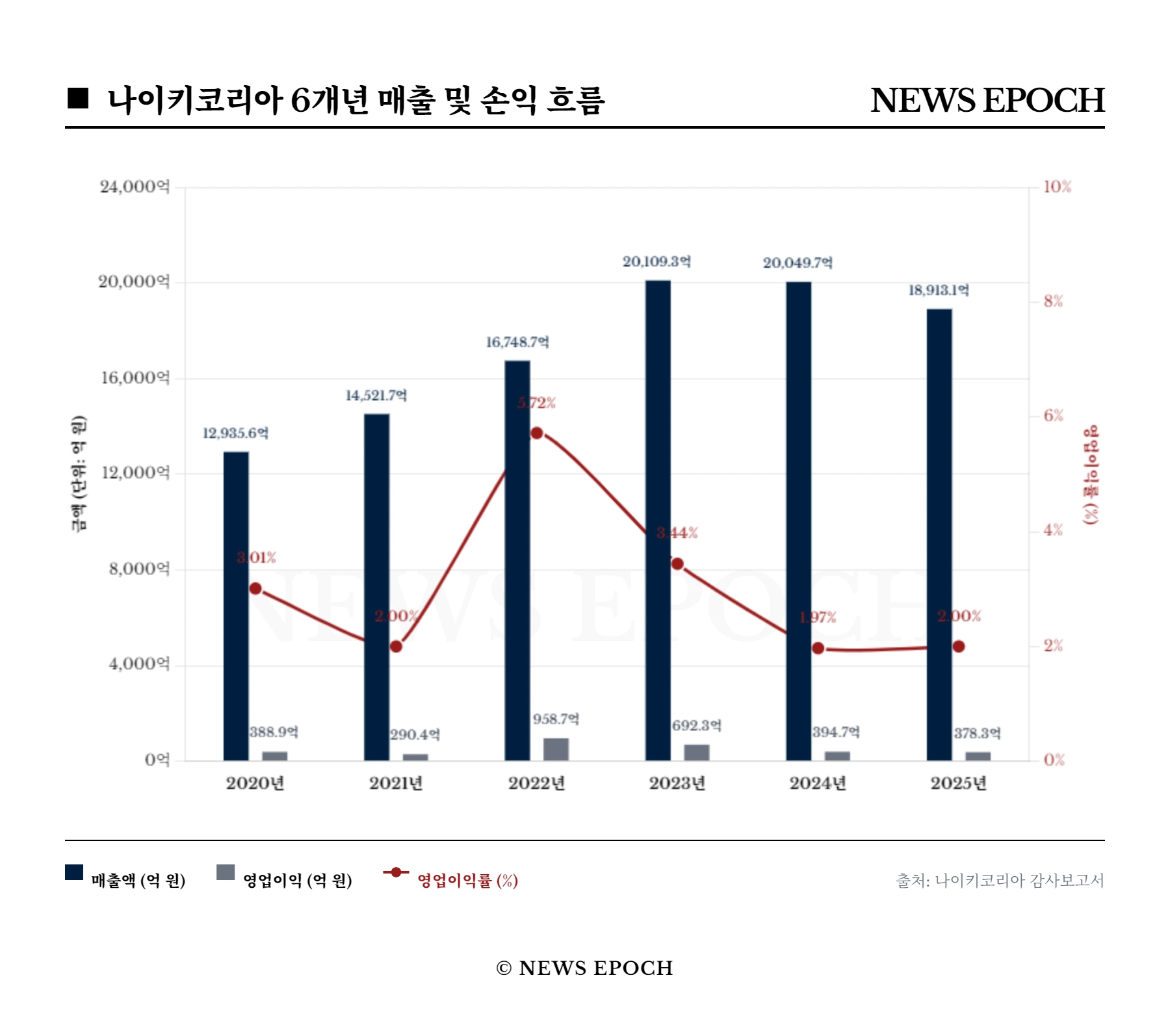
Looking at the sales and profit and loss trends of the two companies over the past five years, it is clear that the trajectories of the two brands are distinctly different. Nike Korea's sales, which were about 1.4522 trillion won in 2021, grew steadily to peak at 2.0109 trillion won in 2023, but then declined for two consecutive years, experiencing negative growth to 1.8913 trillion won in 2025. Operating profit also recorded a high of about 95.9 billion won in 2022 and then gradually declined, remaining at about 37.8 billion won in 2025.
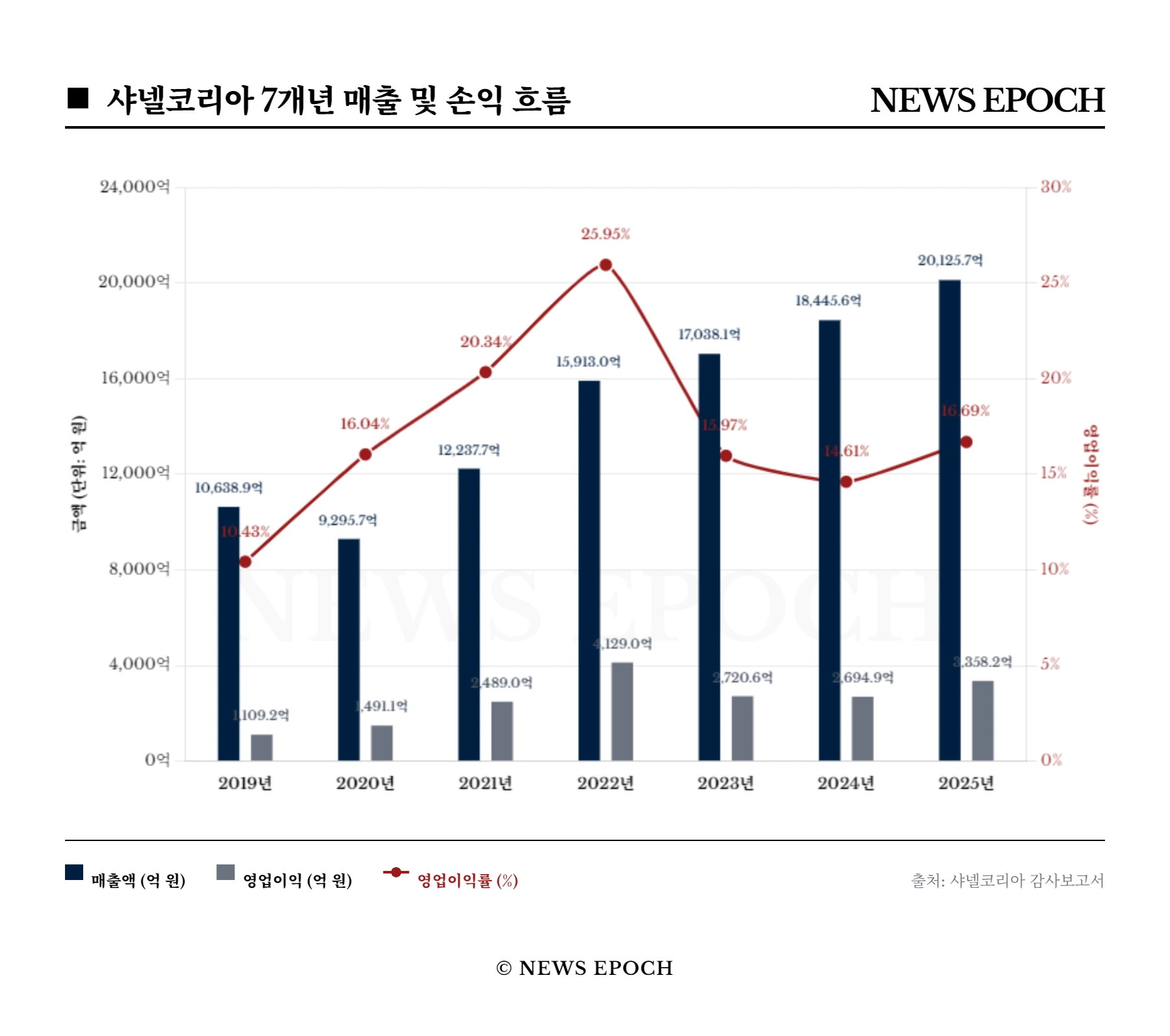
On the other hand, Chanel Korea drew a steep upward curve. Sales, which were 1.2238 trillion won in 2021, increased explosively every year, recording 2.0126 trillion won in 2025 and overtaking Nike. Operating profit also maintained a solid growth trend, recording about 335.8 billion won in 2025, proving its firm profitability.
A 10-Fold Difference in Operating Profit Margin, the Key is 'Cost of Sales Ratio'
Comparing the operating profit margins of the two companies based on their 2025 performances, Nike Korea is about 1.66% and Chanel Korea is about 16.68%, with Chanel appearing more than 10 times higher. This dramatic difference in profitability stems from the 'cost of sales ratio'. Out of Nike Korea's 1.8913 trillion won in sales, the cost accounts for 1.5306 trillion won, reaching a cost of sales ratio of 80.92%. Conversely, out of Chanel Korea's 2.0126 trillion won in sales, the cost is around the 1.0495 trillion won level, maintaining a relatively low cost of sales ratio of 52.14%.
Differences in Dividend Policy and the Nature of Cost Execution
The method of fund management after profit generation is also contrasting. Chanel Korea paid a total of 195 billion won in dividends in 2025 alone, including 130 billion won in year-end dividends and 65 billion won in interim dividends. This amounts to approximately 76.1% of its net income (256.1 billion won), which was remitted to its UK controlling company (Chanel Limited). In contrast, Nike Korea has not paid any dividends despite its unappropriated retained earnings accumulating to 335.1 billion won over the past few years.
Strategic differences between the two companies are also evident in marketing and cost execution. Chanel Korea is investing massive costs in brand communication and customer experience management (such as department store boutique care) by spending about 57.7 billion won on advertising and 113.2 billion won on sales promotion out of its selling and administrative expenses in 2025. On the other hand, Nike Korea spends heavily on maintaining its logistics system and managing its distribution network rather than the proportion of advertising expenses within its SG&A. Expenditures for large-scale logistics processing account for a large portion, including 18.7 billion won in transportation costs, 32.8 billion won in warehouse operating costs, and 23.8 billion won in commission fees.
'Logistics Infrastructure' vs. 'Premium Space', Conflicting Asset Investment Structures
This cost structure continues into their asset investment methods, clearly showing the characteristics of the two brands. Due to the nature of a sports brand that must quickly distribute large quantities of products nationwide, Nike Korea is carrying out large-scale direct investments in 'logistics infrastructure'. It recently signed a contract worth a total of 75.9 billion won for logistics automation facility investment and is executing the budget, causing its machinery assets, which were at the level of 5.2 billion won (in 2023), to surge to 31.5 billion won in 2025. The amount tied up in construction-in-progress assets that are not yet completed also reaches 53.1 billion won.
In contrast, Chanel Korea has completely zero facility investments in items such as large machinery. Instead, most of its tangible assets consist of land (83.1 billion won) and leasehold improvements (34.2 billion won), which signify boutique store interiors. Asset investments are concentrated on securing and maintaining the enlargement and premiumization of department store luxury halls and top-tier boutique spaces, rather than on logistics efficiency.
Differences in Inventory Risk Control Methods and Future Outlook
The strategies of the two companies are also sharply divided in inventory asset management. Nike Korea, where trends change quickly and new seasonal products pour out, centers on 'product turnover rate' and has a very large inventory size. As of 2025, Nike's inventory assets are 377.0 billion won, accounting for 40% of the company's total assets (941.2 billion won). Since out-of-trend inventory loses value, Nike accumulates an allowance for inventory valuation loss of 20 billion to 30 billion won every year to mark down its inventory value.
On the other hand, Chanel Korea strictly controls supply based on 'scarcity', rather than piling up inventory in large quantities. Its inventory assets as of 2025 are 278.5 billion won, maintaining a much smaller total amount of inventory despite having a larger sales volume than Nike. Because its selling price compared to cost is so high, it hardly recognizes valuation losses on inventory each year and manages its inventory relatively very stably.
In the retail industry, as the polarization between luxury and mass consumer goods becomes clearer, it is believed that this sales reversal phenomenon will continue for the time being. In particular, with the high-end consumption of the demographic with purchasing power being supported by the aftermath of the boom in domestic semiconductor companies and rising stock prices, the solid dominance of the luxury market is expected to continue.
Company financial data, investment reports, and startup analysis — all in one place
Explore PitchdeckCurated news, every week — straight to your inbox
Every Friday · Unsubscribe anytime