![[Data Pick] Endemic boom over for imported premium liquor market... Slowing performance amid tax risks and intensifying B2B promotion competition](https://d1gl51xbrxoj65.cloudfront.net/uploads/2026/07/02/1782956297326-3hw24.webp)
It has been shown that the growth of the domestic whiskey and premium liquor market, which enjoyed unprecedented prosperity riding on the home-drinking culture and highball trend during the COVID-19 period, has clearly turned into a slowdown. According to the audit reports of the recent fiscal year for major foreign liquor importers operating in South Korea, despite differences in the settlement timing of each company, the external size of the majority of companies shrank or their operating profits dropped significantly. Furthermore, the risk of massive tax collection following investigations by the Korea Customs Service, combined with the transaction structure with their global headquarters and the intensifying promotional competition targeting distribution channels to defend sales, are adding to the financial burden of these Korean subsidiaries.
Entering a market cooling period... Apparent sales stagnation and decline
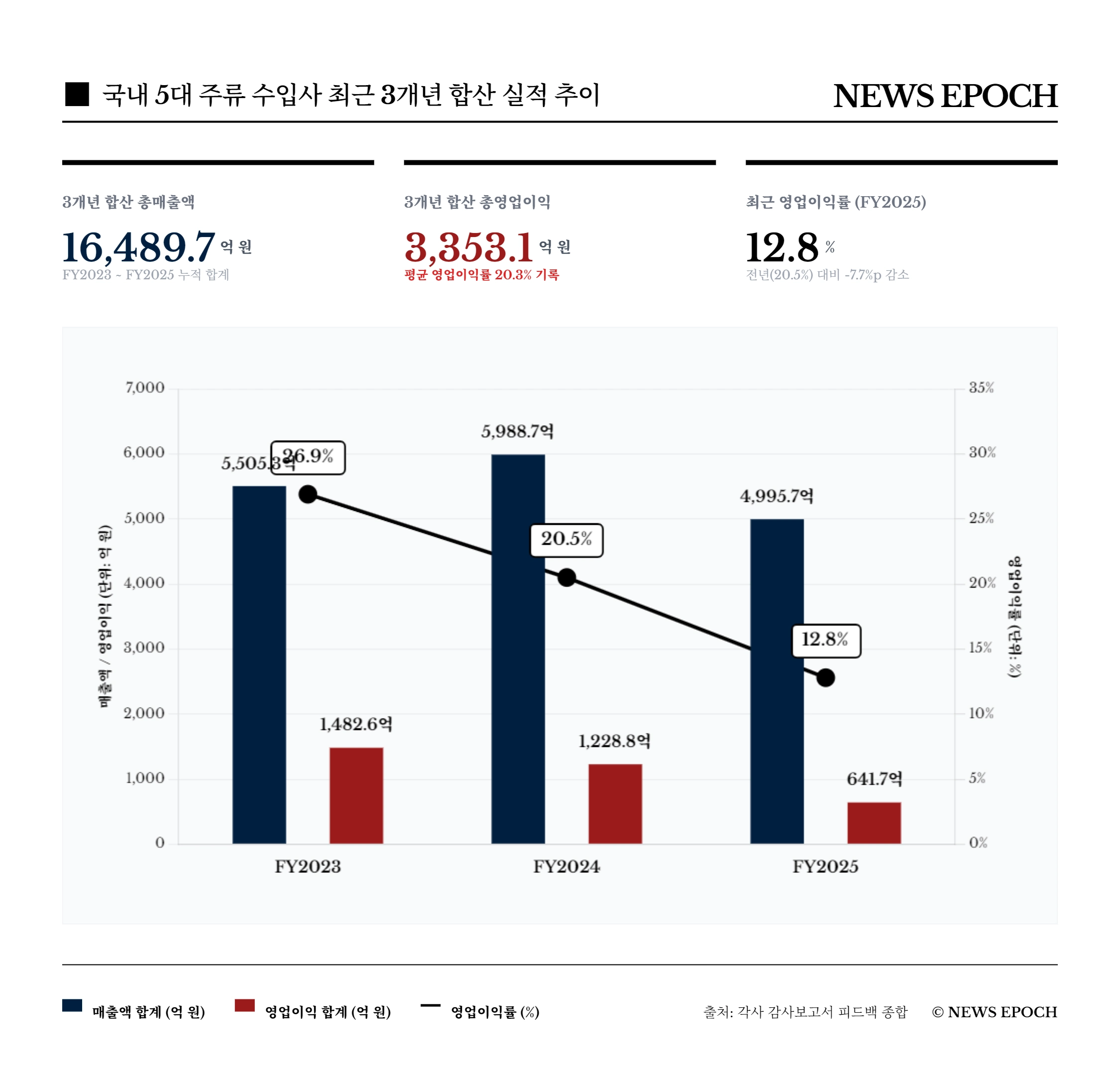
Signs of slowing growth across the imported liquor industry are directly confirmed in the sales status on their financial statements. Pernod Ricard Korea Co., Ltd. (June settlement), which possesses a popular premium lineup, saw its sales for the 34th term (July 2024 - June 2025) plummet by 31.1% to 120.7 billion won compared to the previous year (175.2 billion won). Beam Suntory Korea LLC (December settlement), which led the highball trend, also recorded sales of only 78.2 billion won in 2025, shrinking by 22.7% compared to the previous year (101.2 billion won), showing a broken growth trend.
The industry's No. 1 in sales, Diageo Korea Co., Ltd. (June settlement), recorded sales of 160.6 billion won in its 3rd term, defending its external size with only a slight decrease of 1.2% compared to the previous year (162.5 billion won), but its profit scale declined. William Grant & Sons Korea Co., Ltd. (December settlement), which focuses on single malt whiskey, also recorded sales of 96.1 billion won in 2025, a 5.3% decrease from the previous year (101.5 billion won). In the case of Brown-Forman Korea Co., Ltd. (April settlement), its 27th term sales were 44.0 billion won, decreasing by 24.9% compared to the previous year (58.6 billion won), indicating that it could not avoid the impact of the market slump.
Polarization of profitability and realization of tens of billions of won in customs risks
Amid the market contraction, the profitability structures of individual companies showed distinct polarization. The company that proved to have the most solid fundamentals was William Grant & Sons Korea. Despite the sales decrease, this company recorded an operating profit of 33.71 billion won in 2025, demonstrating profitability with an operating profit margin to sales reaching 35.1%. On the other hand, Pernod Ricard Korea's operating profit plummeted by 71.6% from 53.09 billion won to 15.09 billion won, and Beam Suntory Korea's operating profit also plunged by 75.5% to only 2.23 billion won due to the burden of fixed costs, among others.
A point to note is the risk of 'transfer pricing and customs duty collection', which is a common vulnerability for foreign liquor companies. Following the results of the Busan Customs' customs investigation, Diageo Korea suddenly reflected 23.0 billion won as 'additional payment of customs duties, etc.' in non-operating expenses. Due to this, its pre-tax profit turned into a deficit, recording a net loss of 11.17 billion won, shifting to a deficit.
In the case of Brown-Forman Korea as well, the company recorded an operating loss (-1.41 billion won) and a net loss (-2.54 billion won) in the previous year (26th term) while heavily reflecting 27.9 billion won in expected tax assessments due to a customs investigation as provisions. However, in the 27th term, as this one-off tax effect disappeared, it succeeded in turning to a surplus with an operating profit of 3.76 billion won and a net profit of 2.91 billion won.
Aspects of major liquor portfolio diversification by each company
These five companies have constructed their portfolios by rolling out different flagship product lines for each detailed segment of the domestic liquor market.
Diageo Korea: The 'Johnnie Walker' series, the world's No. 1 Scotch whiskey, drives its core sales. In addition to this, it supplies the single malt whiskeys 'Singleton' and 'Talisker', the premium tequila brand 'Don Julio', and the global dark beer brand 'Guinness' to South Korea.
Pernod Ricard Korea: It possesses the leading brands of blended Scotch whiskey that have shown strength in the domestic karaoke and entertainment markets. 'Ballantine's', 'Royal Salute', and 'Chivas Regal' form a triangular formation, and the vodka brand 'Absolut' and the premium champagne 'Perrier-Jouët' are its major portfolios.
William Grant & Sons Korea: It occupies an unrivaled position in the single malt whiskey market. The world-renowned single malt brand 'Glenfiddich' and 'Balvenie(The Balvenie)', which caused a shortage phenomenon in South Korea, account for most of its sales, and it is focusing on a portfolio with a strong enthusiast base, such as the craft gin brand 'Hendrick's Gin'.
Beam Suntory Korea: It possesses the core brands that established the 'Highball' culture in South Korea. 'Suntory Kakubin', which is most widely used as a highball base, and 'Jim Beam', the epitome of American bourbon whiskey, are its mainstays. In addition, it distributes the premium bourbon 'Maker's Mark' and Japanese premium single malt lineups such as Yamazaki and Hakushu.
Brown-Forman Korea: It unfolds its market centered around 'Jack Daniel's', the symbol of Tennessee whiskey. In addition to the basic product 'Jack Daniel's Black', the trend-setting 'Jack Daniel's Apple (including Honey)' series has established itself as a core revenue source centered on the younger generation, and it also holds the premium bourbon 'Woodford Reserve'.
Global headquarters-centered financial structure... Even paying out dividends amid deficits
Due to the structural characteristic where a foreign holding company or global headquarters holds a 100% stake, the headquarters' trend of withdrawing funds tended to continue regardless of the fluctuations in the profit and loss of the Korean subsidiaries. In the case of Diageo Korea, despite recording a net loss, it remitted the 13.8 billion won in dividends confirmed in the previous year to its headquarters as they were.
Pernod Ricard Korea also maintains a contract structure that pays billions of won in management advisory fees and service fees to its headquarters' group entities (such as Pernod Ricard Holding) every year. Beam Suntory Korea showed structural characteristics of being exposed to the global headquarters' pricing policies and exchange rate volatility, as its proportion of purchases from related parties like the Singapore Asian subsidiary (Beam Suntory Asia) is absolute, and its subscription details for financial products to hedge foreign exchange risks are insufficient.
Reducing consumer advertising and supporting wholesalers... 'B2B pushing' promotion intensifies
As consumers' voluntary demand decreased, importers entered into a promotional competition to preempt distribution networks. Their promotional methods diverge clearly according to the changes in B2C mass marketing costs and B2B distribution channel incentive accounts.
William Grant & Sons Korea, facing the recession, reduced its advertising and promotional expenses directed at the unspecified public by 35.1% from 20.5 billion won to 13.3 billion won, while increasing 'sales promotion expenses', which directly support distribution channels such as liquor wholesalers with incentives or retail fixtures, by 16.1% from 6.2 billion won to 7.2 billion won. Diageo Korea also maintained massive advertising expenses of 51.3 billion won while concurrently surging 'commission fees', which have the nature of distribution agency and volume-linked costs for expanding its control over store shelves, by 32.3% from 6.1 billion won to 8.1 billion won.
On the other hand, Pernod Ricard Korea tightened its belt by cutting advertising and promotional expenses by 18.9%, but it maintained the service fee item (2.17 billion won) linked to commercial district promotions and brand ambassador operations at the previous term's level, which is analyzed as focusing on defending core channels. Beam Suntory Korea, which kept its advertising and promotional expenses (32.3 billion won) and rent (1.03 billion won) at the previous year's level despite the sales decline, continued an infrastructure-centric promotional stance by loaning highball dispenser machines free of charge (acquisition of fixtures and equipment) to major commercial districts and operating hub pop-up stores. Brown-Forman Korea, which had limited financial capacity, appears to have employed a strategy of choice and concentration amid overall cost control by going all-in with its marketing resources on convenience store channels and specific product lines with clear market responses, such as 'Jack Daniel's Apple'.
Industry insiders believe that as the imported liquor market has passed its rapid growth phase and entered a stage of entrenchment, the survival of foreign liquor companies and the direction of market reorganization will be determined in the future by their ability to adjust import transfer prices with their headquarters, their control over distribution channels, and their fixed cost management capabilities.
Company financial data, investment reports, and startup analysis — all in one place
Explore PitchdeckCurated news, every week — straight to your inbox
Every Friday · Unsubscribe anytime