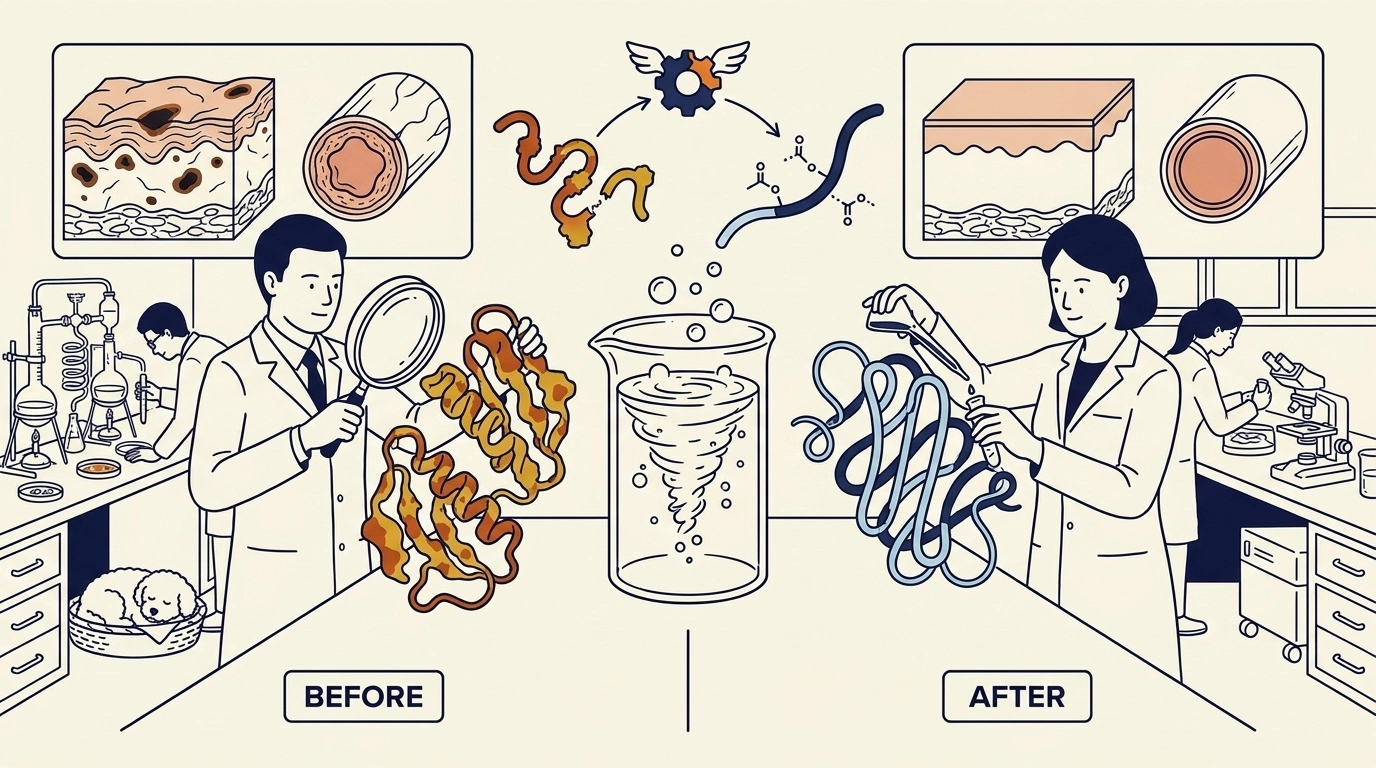
US researchers have developed an enzyme that removes chemical damage that accumulates on proteins as we age. When this enzyme was applied to the skin and artery tissues of a donor in their 70s, aging-related substances were reduced by more than half. Foreign media, including The New York Times and specialized publications issued by the American Chemical Society, also paid attention to the research results and future treatment possibilities.
However, it is not a study administered to humans or living animals. It is an early-stage study in which donated tissues were thinly sliced or only proteins were isolated, and the enzyme was directly applied in a laboratory. It does not mean that skin wrinkles or elasticity have improved or that aging has actually been reversed.
A joint research team from US biotech company Revel Pharmaceuticals, Calico Life Sciences, and the University of Colorado Anschutz Medical Campus published these research findings in the international journal 'Nature Communications' on July 14.
'Browning reaction' slowly progressing in the body
Our bodies contain proteins that are used for years to decades, such as collagen, elastin, and the lens proteins of the eye. Over time, substances derived from sugars or fats attach to these proteins.
A chemical reaction similar to the 'Maillard reaction', where sugar and protein react and turn brown when food is grilled or stir-fried, proceeds very slowly even at body temperature. The various substances produced in this process are called 'Advanced Glycation End-products', or AGE for short.
AGEs can alter the structure and function of proteins, stiffen tissues, or trigger inflammatory responses. They are also related to diabetic complications, vascular aging, kidney disease, and eye disease.
This study targeted one of the AGEs, 'Nε-carboxymethyl-lysine', or CML for short. CML attaches to the amino acid lysine, which makes up proteins, altering the protein's properties and stimulating a receptor called RAGE to trigger inflammation and oxidative stress signals.
Until now, research has mainly focused on inhibiting glycation reactions to prevent the formation of new CML. CML that is already attached to proteins and stabilized was considered virtually impossible to remove.
Selected from over 500 million enzyme variants
The researchers found a solution in microbial enzymes existing in nature. Noting that part of CML's structure is similar to the amino acid glycine, they investigated enzymes that break down glycine.
The research team compared the structures of about 44,800 enzymes stored in a protein structure database. In this process, they selected a bacterial enzyme as a candidate with an entrance wide enough to access the CML attached to the protein.
However, the initially found enzyme acted only weakly on CML. The researchers continuously mutated the enzyme gene to create over 500 million variants and repeated 'directed evolution', pitting them against each other, five times.
In the selection process, E. coli that cannot grow without lysine were used. It was designed so that only the E. coli with enzymes capable of reverting CML back to normal lysine would survive.
Through this process, the research team developed an enzyme that selectively acts on CML and named it 'CMLase'. Instead of breaking down the protein itself, CMLase oxidized the CML attached to the protein to restore the original lysine.
Some foreign media introduced CMLase as an 'AI-designed age-reversing enzyme'. While it is true that AlphaFold structure data and computation-based screening were utilized in the research, the final enzyme was developed through large-scale structure searches and directed evolution using over 500 million variants.
Over 55% reduction in CML in 74-year-old skin
The researchers first artificially induced CML damage in albumin, casein, hemoglobin, and collagen, and then treated them with CMLase. Depending on the type of protein, CML decreased by 52 to 97%.
Next, they used actual tissues from elderly donors. In the lens protein of a 64-year-old donor, CML was reduced by 45 to 78%, depending on the test method.
In the abdominal aortic tissue of a 75-year-old donor, the CML staining intensity decreased by more than 70%. In the abdominal skin of a 74-year-old donor, CML staining in the epidermis and dermis was reduced by more than 55%.
The CML staining intensity of the 74-year-old skin treated with CMLase became lower than that of untreated 31-year-old skin. This is the basis for foreign media reports that "returned 70s skin to a 30s level."
However, this does not mean the skin itself returned to a 30s state. It only means that a single chemical marker called CML was detected in the 74-year-old skin tissue at a lower level than in the 31-year-old skin. Whether wrinkles, elasticity, cellular function, or gene expression became younger was not confirmed.
The New York Times: "Could we turn back the body's clock?"
When the paper was published, foreign specialized science and longevity media covered the research first.
On July 14, US life sciences publication 'The Scientist' likened CMLase to a 'lawnmower enzyme' that selectively picks out and removes unwanted weeds. This meant it selectively stripped away protein damage that had long been thought impossible to remove.
Professor James Galligan of the University of Arizona, who was not involved in the study, told The Scientist, "It is bold in itself to challenge a problem that has long been considered irreversible." He further added significance to the fact that they developed an enzyme capable of selectively removing only CML, based on the measurement criteria used by the research team.
On the same day, longevity industry publication 'Longevity.Technology' introduced the research results under the headline, 'Irreversible no longer means forever.'
The publication drew a line, stating that this experiment did not prove age reversal and the researchers did not claim so. However, it evaluated the fact that at least one of the molecular damages long thought to be permanent could be repaired with an enzyme as a 'conceptual shift'.
Longevity research publication 'Lifespan' also detailed on July 17 the process by which the research team explored protein structures and evolved the enzyme. In particular, it cited as a major achievement the fact that CMLase worked on naturally aged lens, skin, and arterial tissues.
On the other hand, it pointed out that the effect was only confirmed in thinly sliced tissues, and it had not been verified whether the function of the treated tissues actually improved or whether the bacteria-derived enzyme would trigger an immune response in the human body.
'Chemical & Engineering News (C&EN)', published by the American Chemical Society, offered a more cautious assessment on July 21.
C&EN highly praised that CMLase degraded CML even in the complex aortic tissue of a 75-year-old donor. At the same time, it reported that because the current enzyme activity is still low, Revel is trying to further increase its efficacy before testing it on animal models for diabetic retinopathy.
Science news outlet 'Phys.org' on July 22 ran the headline, 'Enzyme erases up to 70% of stubborn traces of aging in human tissues'. While introducing the results of the skin, artery, and lens experiments, it made clear that it is not yet an anti-aging treatment ready for human use.
The research became widely known to general readers when The New York Times reported on it on July 24 under the headline, 'Could This New Enzyme Turn Back the Body's Clock?'
AGE researcher John Baynes, a former professor at the University of South Carolina, explained to The New York Times that AGEs accumulate on tissue proteins "like rust." He noted that past drug development aimed at preventing AGE formation had not yielded significant results, and highly commended the fact that the new enzyme worked on proteins isolated from actual tissues.
Stanford University Professor Michael Jewett, who was not involved in the study, also evaluated it as a proof-of-concept study that expanded the possibilities of new longevity treatments, although it is not yet a clinical solution. In particular, he attributed significance to the research method of creating an enzyme with functions not found in nature.
Following The New York Times report, the research spread to a general readership as Swedish, German, and Spanish-language media translated or adapted the content. In this process, headlines such as 'Enzyme that returned 70s skin to 30s', 'Enzyme that erased up to 70% of aging traces', and 'Enzyme that reversed cellular aging' emerged.
However, 'cellular age reversal' differs from the actual research results. What the research team confirmed was mainly a reduction in CML accumulated on old proteins and extracellular tissues. It is not a study that made the age of the cells themselves or their genetic state younger.
Tissue from a single donor... Unknown if it will be effective in humans
This study is significant in that it overturned the existing perception that CML is irreversible damage. This is because it proposed an approach that directly repairs damage already accumulated over decades, rather than inhibiting new damage from forming.
However, there are many aspects to verify before evaluating it as a treatment.
The lens used tissue from a 64-year-old donor, the skin from a 74-year-old donor, and the aorta from a 75-year-old donor. The 'four observation areas' of skin and arteries presented in the paper were also not tissues from four donors, but pieces divided from the same donor's tissue.
The experiment used isolated proteins or very thinly sliced tissues. It has not been confirmed whether CMLase can penetrate deep into dense tissues when administered to the skin, blood vessels, kidneys, and eyes of living humans.
They also did not investigate whether blood vessels became softer, skin elasticity improved, or inflammatory responses decreased after CML was reduced. A reduction in chemical damage is a separate issue from the recovery of tissue function.
The fact that CMLase was created from a bacterial enzyme is also a challenge. The human immune system may recognize it as a foreign protein, so immune responses and safety following repeated administration must be verified.
CML is just one of numerous AGEs. CMLase does not act on glucosepane, a representative glycated substance that cross-links collagen and makes tissues stiff. Removing just CML does not solve the complex aging phenomenon of the human body.
Revel Pharmaceuticals, which led this research, has applied for patents related to CMLase. The corresponding author, Aaron Cravens, is the co-founder and CEO of the company. Part of the research funding was provided through the US National Institute on Aging's small business research support program.
To connect the research results to treatment possibilities, other research teams must replicate them, and tissue penetration, safety, immune response, and actual disease improvement effects in living animals must be sequentially confirmed.
CMLase is not yet an enzyme that turns back human time. However, it is worth watching follow-up research in that it demonstrated the possibility of stripping away the 'rust' of aging proteins, which was thought difficult to remove once formed, in actual tissue donated by the elderly.
Company financial data, investment reports, and startup analysis — all in one place
Explore PitchdeckCurated news, every week — straight to your inbox
Every Friday · Unsubscribe anytime