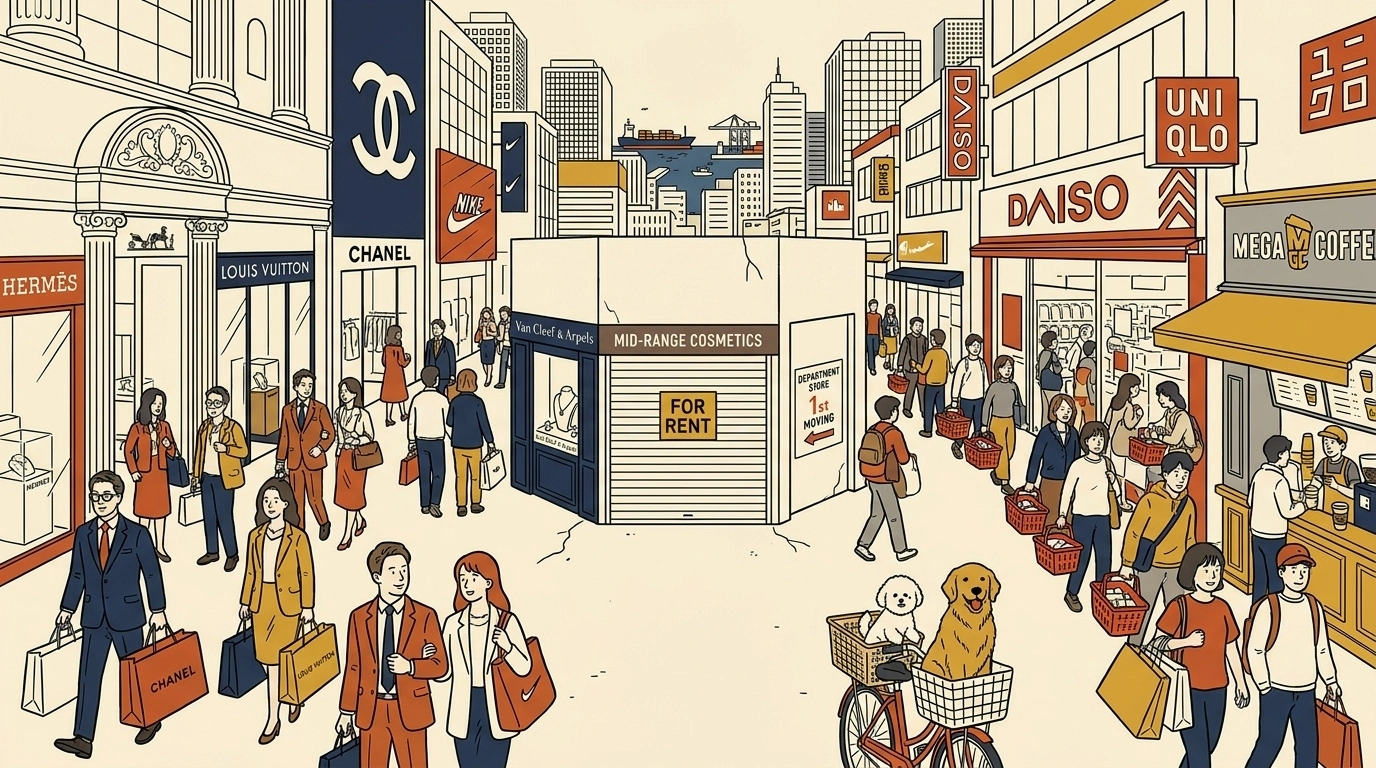
Luxury and Cost-Effective Products Grow Side by Side... Imported Cosmetics on the First Floor of Department Stores Shrink
The income and asset gap in Korean society is showing up as a distinct pattern in the consumer market as well. While highly recognized expensive luxury goods and consumer goods and services with clear price competitiveness are growing simultaneously, the middle ground, where the reason for charging a higher price is unclear, is losing its place.
A symbolic scene showing this trend is the reversal of sales between Chanel and Nike. Based on the recently disclosed annual performance, the 2025 sales of Chanel Korea reached 2.0126 trillion won, surpassing the 1.8913 trillion won of Nike Korea. The operating profit was 335.8 billion won for Chanel Korea and 37.8 billion won for Nike Korea, a gap of about 8.9 times.
However, the accounting periods of the two companies are different. Chanel Korea's results are from January to December 2025, while Nike Korea's are from June 2024 to May 2025. The global sales of Nike headquarters for the 2025 fiscal year also decreased by 10% compared to the previous year. Therefore, rather than proving the polarization of consumption in Korea with this reversal alone, it is appropriate to view it as a symbolic case showing the phenomenon of more money flowing into top-tier luxury brands than mass-market global sports brands.
The combined sales of the Korean subsidiaries of Hermès, Louis Vuitton, and Chanel, collectively referred to as 'Er-Lu-Cha' in Korea, also reached approximately 4.99 trillion won in 2025, effectively amounting to 5 trillion won.
However, the three companies have not grown every year without exception. Louis Vuitton Korea saw a decrease in sales and operating profit in 2023, but rebounded after 2024. Hermes Korea's sales increased by 16.7% in 2025, surpassing 1 trillion won for the first time. Although there have been fluctuations among individual brands, the combined market size of the top three luxury companies is growing over the long term.
Daiso, Uniqlo, and Mega Coffee Also See Double-Digit Growth
On the other side, brands promoting reasonable prices are growing rapidly.
The 2025 sales of Asung Daiso reached 4.5363 trillion won, a 14.3% increase compared to the previous year. Operating profit also rose by 19.2% to 442.4 billion won. Starting from household goods, Daiso is expanding its product range into cosmetics, fashion, and health functional foods, broadening the scope of ultra-low-cost consumption.
The 2025 fiscal year sales of FRL Korea, which operates Uniqlo, increased by 27.5% to 1.3524 trillion won. Operating profit surged by 81.6% to 270.4 billion won. FRL Korea's fiscal year ends on August 31 every year. Its sales have seen double-digit growth for three consecutive years, from 921.9 billion won in the 2023 fiscal year to 1.0602 trillion won in the 2024 fiscal year, and 1.3524 trillion won in the 2025 fiscal year.
MGC Global, which operates Mega MGC Coffee, also recorded 646.9 billion won in sales in 2025. MGC Global changed its name to the current one from the former NHOUSE in December 2025. Sales increased by 30.4% from the previous year, and operating profit rose by 3.5% to about 111.4 billion won.
Although the operating profit growth rate was lower compared to the sales growth rate, the outward growth trend continued. However, the operating profit margin dropped from 21.7% in 2024 to 17.2% in 2025, suggesting a need to also look into changes in profitability resulting from store expansion and top-line growth.
The important point is that it is difficult to completely separate luxury consumers and cost-effectiveness consumers into different groups. The same consumer can be price-conscious about household goods, clothing, and coffee purchased repeatedly on a daily basis, while spending large amounts of money on bags, watches, and perfumes that show their taste and identity.
Imported Cosmetics Being Pushed Out of the First Floor of Department Stores
In this process, the hierarchy of space in department stores is also changing. In the past, the first floor of a department store was a symbolic space guarded by imported cosmetics brands. Recently, however, there has been an increasing number of cases where some cosmetics stores are moving to other floors, with luxury jewelry and fashion brands filling their places.
At the Lotte Department Store main branch, some beauty brands that were on the first floor moved to the first basement floor. High-end jewelry and watch brands such as Van Cleef & Arpels, Graff, and Omega took their places. Lotte Department Store reorganized the beauty hall on the first basement floor to the largest scale in the department store industry.
Galleria Department Store Apgujeong Luxury Hall West also moved the beauty section from the first floor to the second floor and arranged high-end brands such as Hermès, Chaumet, and Bottega Veneta. Rather than getting rid of cosmetics, the priority of the space they occupy within the department store has changed.
Brand withdrawals are also appearing. Lab Series, a men's cosmetics brand affiliated with Estée Lauder, ended its operations at the Galleria Gwanggyo Branch in April 2026. The remaining store at the Lotte Department Store main branch is also scheduled to withdraw in August, meaning that if it closes as planned, it will effectively withdraw completely from domestic department stores.
However, this should not be expanded to mean a wholesale withdrawal of all imported cosmetics. Some brands are only organizing provincial branches or stores with low profitability, and brands like Clinique and Kiehl's strongly lean towards lowering their dependence on department stores and diversifying their sales channels to Olive Young, Coupang, and Kurly. There are companies and brands among imported cosmetics companies that are seeing sales increases.
The quality improvement and price competitiveness of indie K-beauty brands are also among the factors putting pressure on traditional imported cosmetics. But it is difficult to conclude that this is the direct cause of individual brand withdrawals. This is because the spatial reorganization of department stores, sluggish duty-free shops, expanded online purchases, global restructuring of headquarters, and changes in domestic distribution contracts act in a complex manner.
Why Did the French Pharmacy Brand La Rosée Go to the Department Store?
While the position of some traditional imported cosmetics brands in department stores is narrowing, there are French brands like La Rosée that are rapidly increasing their stores. Rather than a simple exception going against the trend of the imported cosmetics market, this is closer to a case of changing the brand trust formation method that worked in France to fit the Korean distribution structure.
The entire French cosmetics market is not centered around pharmacies. Hypermarkets, specialty perfume stores, department stores, and online are also major sales channels. However, in the field of dermocosmetics and functional skincare, pharmacies and parapharmacies play an important role in building trust in the safety and expertise of products.
La Rosée is a brand founded in 2015 by two pharmacists who studied pharmacy in Lyon, France. The starting point was identifying consumer demand for cosmetics that consider both ingredients and environmental issues while working at a pharmacy. The brand targeted the market between dermocosmetics and general cosmetics, putting forward naturally derived ingredients and eco-friendly packaging.
In Korea, pharmacies are not a core distribution network for discovering and experiencing cosmetics. Accordingly, La Rosée can be seen as having adopted a strategy of securing the functions of trust and consultation performed by French pharmacies through department store counters in Korea.
La Rosée officially entered Korea in June 2023 and began opening regular department store shops in earnest starting in February 2025. According to the store-by-store opening schedule disclosed by the brand, it opened 25 stores in 2025 and continued to open more in 2026, expanding its domestic distribution network to about 40 locations as of the end of July.
The prices of major products in Korea are mostly in the 30,000 to 50,000 won range. This is lower than traditional imported premium cosmetics but higher than domestic indie brands sold mainly through Olive Young. The place where La Rosée has stepped in is the very middle price range pointed out as shrinking in this article.
Yet, it was able to quickly increase the number of stores because it has a relatively clear story that can explain the price, such as pharmacist founders, French pharmacy distribution, and naturally derived ingredients. Rather than the middle price range itself disappearing, it is more accurate to view that the 'vague premium', which fails to explain the reason why consumers should pay an additional price, is weakening.
Shinsegae International, From a Fashion Company to 'Two Pillars of Fashion and Beauty'
Shinsegae International is one of the companies that best shows the changes in the domestic imported beauty market. While imported fashion and its own clothing brands were central in the past, it is recently reorganizing fashion and beauty into its two main pillars by securing niche perfumes, premium cosmetics, and K-beauty brands together.
The company entered the cosmetics business in earnest by acquiring VIDIVICI in 2012. In 2018, it took over the cosmetics business assets operated by Shinsegae and launched its own brand, YUNJAC. Afterwards, it added imported perfume brands such as Memo, Ex Nihilo, and D.S. & Durga.
In 2020, it acquired a 100% stake in the Swiss luxury skincare brand Swiss Perfection. Swiss Perfection is not just a brand imported and distributed in Korea, but an overseas brand directly owned by Shinsegae International. In 2021, it launched its own luxury cosmetics brand, Poiret.
In 2023, it introduced Laura Mercier and Dolce & Gabbana Beauty, and in 2024, it added Loewe Perfumes. In the same year, it acquired a 100% stake in color cosmetics brand Amuse for 71.3 billion won, strengthening its hold on K-beauty and the young consumer market.
Bath & Body Works opened its first store at the Gangnam branch in May 2024 after Shinsegae Department Store secured the domestic distribution rights. Afterwards, Shinsegae International took over the domestic business rights and related assets from Shinsegae Department Store in January 2025. The brand's entry into Korea was in 2024, and the point it was incorporated into Shinsegae International's portfolio was in 2025. In 2025, it also newly introduced Maison Francis Kurkdjian.
The core is niche perfumes. Based on the 2025 year-end business report, Diptyque operated a total of 46 distribution networks, including 35 department stores, 9 duty-free shops, and 2 other locations. Santa Maria Novella had 35 locations, including 28 department stores and 5 duty-free shops. Byredo had 14 locations, Memo had 7, and Loewe Perfumes had 11.
It is more difficult to directly compare the functions and prices of perfumes than basic cosmetics, and the scent itself is a product that expresses an individual's taste and identity. It also strongly has the nature of a 'small luxury' where consumers pay a high price for psychological satisfaction. This is the background behind why niche perfumes are showing relative strength while some imported basic cosmetics are under pressure from highly price-competitive K-beauty.
However, this does not mean all brands have grown smoothly. Byredo's domestic distribution network plummeted from 30 locations in 2023 to 13 in 2024, and then recorded 14 in 2025. This is due to the impact of the termination of the 10-year distribution contract with Shinsegae International as Puig, the Spanish beauty company and parent company of Byredo, directly entered Korea. Since then, Shinsegae International has been continuing sales in Shinsegae-related distribution networks such as Shinsegae Department Store and duty-free shops.
This shows the structural limitations of the imported brand business. Even if a brand is successfully grown, the rights of the domestic business operator can be reduced if the overseas headquarters directly enters the market or changes distributors. This is why Shinsegae International is not relying solely on imported perfumes, but also strengthening its own and acquired brands together, such as YUNJAC, Poiret, Swiss Perfection, and Amuse.
These changes are also revealed in the financial numbers. The sales of the cosmetics division increased from 379.7 billion won in 2023 to 414.9 billion won in 2024, and 455.2 billion won in 2025. Its share of total fashion and cosmetics sales also rose from 35.1% to 38.6% and 41.0% during the same period.
Company Also Acknowledges "Boldness on Luxury Goods, Cost-Effectiveness on Necessities"
In its 2025 business report, Shinsegae International diagnosed the domestic consumer market as follows.
"As the consumption pattern of boldly spending on consumer goods with high psychological satisfaction, like luxury goods, and strictly weighing cost-effectiveness for daily necessities has become generalized, the demand for luxury and premium products and products with excellent cost-effectiveness has increased."
The phenomena of Chanel and Daiso simultaneously recording their highest sales ever, high-priced jewelry taking the place of some cosmetics stores moved from the first floor of department stores, and Shinsegae International expanding the proportion of its niche perfume and cosmetics portfolio are compressed within this sentence.
It is highly likely that what will disappear from the market in the future is not all mid-priced products. Products where the reason consumers have to pay more is unclear, and products that demand a premium solely on the fact that they are department store tenants or overseas brands, may be pressured first.
Conversely, brands that have powerful symbolism like top-tier brands, clear pricing and functionality like Daiso and Uniqlo, or specific backgrounds and tastes like La Rosée and niche perfumes, have a high probability of surviving.
The reorganization of the Korean consumer market is not merely a process of being divided into luxury goods and low-priced goods. Consumers now ask for the reason why it is expensive when buying a more expensive product, and demand quality beyond the price when buying a cheap product. The 'vague premium', which cannot answer both of those questions, is the first to be put to the test.
Company financial data, investment reports, and startup analysis — all in one place
Explore PitchdeckCurated news, every week — straight to your inbox
Every Friday · Unsubscribe anytime