Chemist Focuses on "Adhesion Technology," Doctor on "Retention Time"… Diverging Hair Loss Solutions
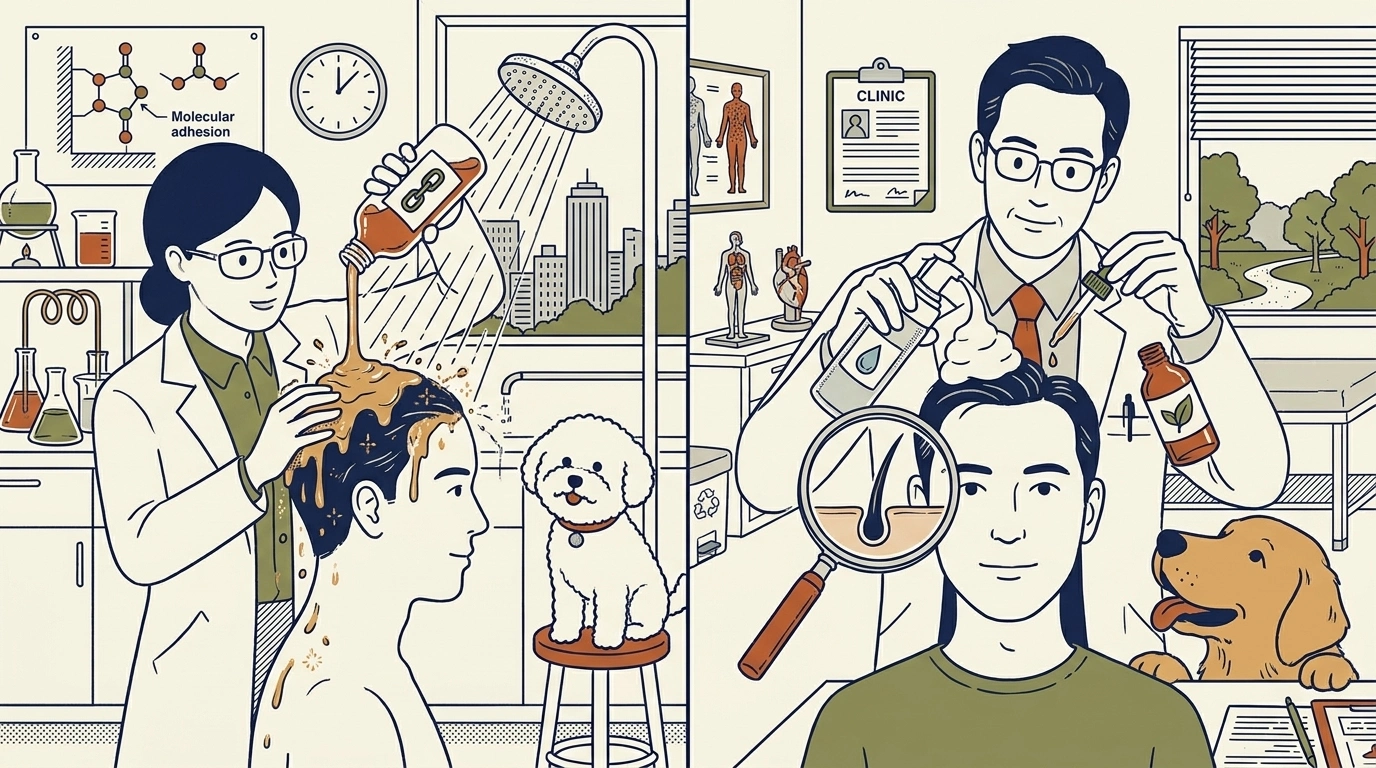
Looking at the same hair loss market, a chemist and a doctor have come up with completely opposite solutions.
On June 8, Polyphenol Factory, a KAIST faculty startup, unveiled the "Gravity PDRN Hair Recovery Shampoo." The core technology lies in leaving water-soluble PDRN on the scalp and hair.
About a month later, on July 14, Constant, the operator of the hair loss care brand Refilled, announced that it would stop selling its existing hair loss shampoos. Yang Mi-kyung, head of the research institute and a graduate of Seoul National University College of Medicine, stated that shampoo is merely a product for washing away impurities, and there is a limit to how well it can deliver hair loss care ingredients to the hair follicles.
While Gravity argued that "shampoos can also leave ingredients behind," Refilled countered by asserting that "the roles of washing products and leave-on products must be separated."
The Chemist Who Did Not Give Up on Shampoo
Lee Hae-shin, an endowed chair professor at KAIST's Department of Chemistry who developed Gravity, is a researcher in the field of adhesive chemistry. In 2007, he published a study applying the adhesion principles of mussels and geckos in the international journal 《Nature》.
Adhesion technology was also applied to this PDRN shampoo. According to the company, when PDRN obtained from marine microalgae is combined with polyphenols, they clump together in water to form a "coacervate." The explanation is that this increases the likelihood of the PDRN complex remaining on the surface of the scalp and hair even after the shampoo is rinsed off.
The product contains 100,000 ppm of a "PDRN complex ingredient" rather than pure PDRN. The actual amount of PDRN included in the complex ingredient cannot be confirmed through publicly available data.
Polyphenol Factory announced that in a human application test conducted by an external testing agency, the number of hairs lost during shampooing decreased by 73.66% after two weeks of use. It also stated that hair root volume, scalp soothing, and hair shine improved after a single use.
However, the figure of 73.66% cannot be interpreted as meaning "hair loss has improved by that much" or "new hair has grown." What was measured was the number of hairs that fell out during shampooing. Based solely on the launch materials and media reports, it is difficult to confirm detailed test designs, such as the establishment of a control group and whether randomization was applied.
There is also previous research on Gravity's adhesion technology. Professor Lee Hae-shin's research team developed a technology that attaches tannic acid to the hair and slowly releases salicylic acid, niacinamide, and dexpanthenol, publishing it in the international journal 《Advanced Materials Interfaces》 last year.
The research team reported that after observing 12 people using the shampoo for 7 days, the number of hairs lost during shampooing decreased by an average of 56.2%. However, it was a small-scale, short-term study comparing before and after use without a control group. There is also the difference that the tested product applied tannic acid and existing ingredients, not the currently released PDRN shampoo. The research was supported by Polyphenol Factory.
This study could serve as a counterargument to the claim that all shampoo ingredients are washed away. However, it is still limited as evidence to show that the PDRN shampoo inhibits the progression of hair loss over the long term.
The Doctor Who Stripped 'Efficacy' from Shampoo
Refilled chose a different path. It delegates only the cleansing function to shampoos, and aims to deliver hair loss care ingredients through leave-on products like tonics, ampoules, and serums.
Jeong Geun-sik, CEO of Constant, said at a press conference in July, "The fact that the category of hair loss shampoo is familiar to consumers is a separate issue from its actual effectiveness." Head of the research institute Yang Mi-kyung stated that the core of hair loss care lies in delivering active ingredients at a sufficient concentration to hair follicle cells for a long period of time.
Refilled replaced its existing shampoo with a "Scalp Reset Cleanser." The method is to remove sebum and impurities from the scalp with the cleanser and then apply a tonic, ampoule, or serum.
The company argues that while a certain amount of time is required for hair loss care ingredients to be absorbed, leaving a shampoo containing surfactants on the scalp for a long time can be burdensome. In its August launch materials, it presented 5 to 7 minutes as the time needed for absorption, and under 3 minutes as the time a shampoo can be left on the scalp.
However, this time standard is an explanation provided by Refilled so far. No independent clinical evidence has been disclosed that can be commonly applied to all ingredients and all shampoos.
The core ingredient promoted by Refilled is cADPR (cyclic ADP-ribose). In a study published in the international journal 《Applied Sciences》 last January, human hair follicle dermal papilla cells treated with cADPR showed an approximately 2.3-fold increase in β-catenin transcriptional activity related to hair growth. The expression of TGF-β2, associated with hair follicle regression, decreased to about 0.3 times the level.
However, this study is not a clinical trial using the finished product on a human scalp. It is an in vitro study treating cultured hair follicle cells with cADPR. The paper also stated that further research is needed to confirm the physiological significance and causal relationship. Two out of the three authors of the paper are affiliated with Constant.
Regarding the newly released Scalp Reset Cleanser, Refilled announced that scalp impurities decreased by 93.59% and sebum cleansing and control effects improved by 85% after a single use. However, this is also an indicator related to scalp cleansing. It is not the result of measuring hair growth or the effect of inhibiting the progression of hair loss.
Shampoo Is Not a Cure... But That Doesn't Mean There Is Absolutely No Evidence
The current enforcement regulations of the Cosmetics Act define hair loss-related functional cosmetics as "cosmetics that help alleviate symptoms of hair loss." Their legal status is different from medications that prevent or treat hair loss and make new hair grow.
In this regard, Refilled is correct in saying that "shampoo is not a hair loss treatment." The Ministry of Food and Drug Safety has also advised that no shampoo has been approved as a hair loss treatment, and functional cosmetics can only be advertised within the scope of helping to alleviate hair loss symptoms.
However, it is also difficult to conclude that all hair loss shampoos lack scientific evidence.
In a randomized, double-blind, placebo-controlled study published in 2022, the test group using a shampoo containing 0.2% salicylic acid, 0.2% panthenol, and 0.1% niacinamide for 24 weeks showed a 17.76% higher result in the indicator of increased hair count at the crown than the placebo group. A total of 42 people completed the trial.
Shampoo cannot be viewed as a treatment based solely on a single small-scale study. However, the claim that a shampoo formulation cannot have any effect whatsoever is also an overly broad interpretation. Results can vary depending on the ingredients, formulation, duration of use, and test methods.
It is also difficult to determine exactly which ingredient serves as the legal functional basis for Gravity's PDRN shampoo based solely on the publicly available ingredient list.
The Ministry of Food and Drug Safety interprets that, in principle, to claim to be a functional cosmetic alleviating hair loss symptoms, one must undergo a product-by-product review and submit human application test data conducted with the content of the ingredient exhibiting efficacy. Simply containing ingredients like dexpanthenol or biotin does not allow one to conclude that these ingredients are the basis for the product's functional review. Conversely, it is also currently difficult to find public data confirming that PDRN is the core ingredient for the review.
A Question More Important Than 'Shampoo or Serum'
Gravity attempts to compensate for the weakness of wash-off shampoos with adhesion technology. Refilled has opted for a method of separating cleansing and the delivery of active ingredients, using a tonic, ampoule, and serum after a cleanser.
The chemist presented a way to hold on to the ingredients so they don't wash away, while the doctor believes that to leave active ingredients for a long time, one should use products that are not washed off in the first place. It is still difficult to conclude which side is right.
The PDRN product data released by Gravity comes from the company's short-term human application test. Refilled's cADPR research is still at the cell experiment stage. The key metric measured by Gravity is the number of hairs lost during shampooing, and the metric for Refilled's new cleanser is the cleansing of scalp impurities and sebum. Neither side has released large-scale independent clinical trials demonstrating how hair density changed over the long term or whether the progression of hair loss was inhibited.
Ultimately, what will determine consumer choice is not just the names KAIST and Seoul National University. In addition to the feeling of use, price, and actual perceived changes, it matters how substantial the clinical data they provide is.
Gravity, which chose a "shampoo that leaves behind even when rinsed," and Refilled, which put forward "scalp care applied after washing." It remains to be seen how these two brands, starting from completely opposite directions, will be evaluated by consumers in the hair loss market going forward.
Company financial data, investment reports, and startup analysis — all in one place
Explore PitchdeckCurated news, every week — straight to your inbox
Every Friday · Unsubscribe anytime